Get Full Government Meeting Transcripts, Videos, & Alerts Forever!
Get email alerts on the Street Design topic
No spam. Unsubscribe anytime.
SFMTA board approves Oak Street quick‑build separated bikeway and safety upgrades; removes limited parking
Summary
After extensive public comment and technical review, the SFMTA board approved the Oak Street QuickBuild project to install a separated eastbound bikeway, pedestrian safety islands and daylighting islands. The board also amended one parking loading-hour item, changing the proposed all‑time yellow loading zone to 9 a.m.‑6 p.m.
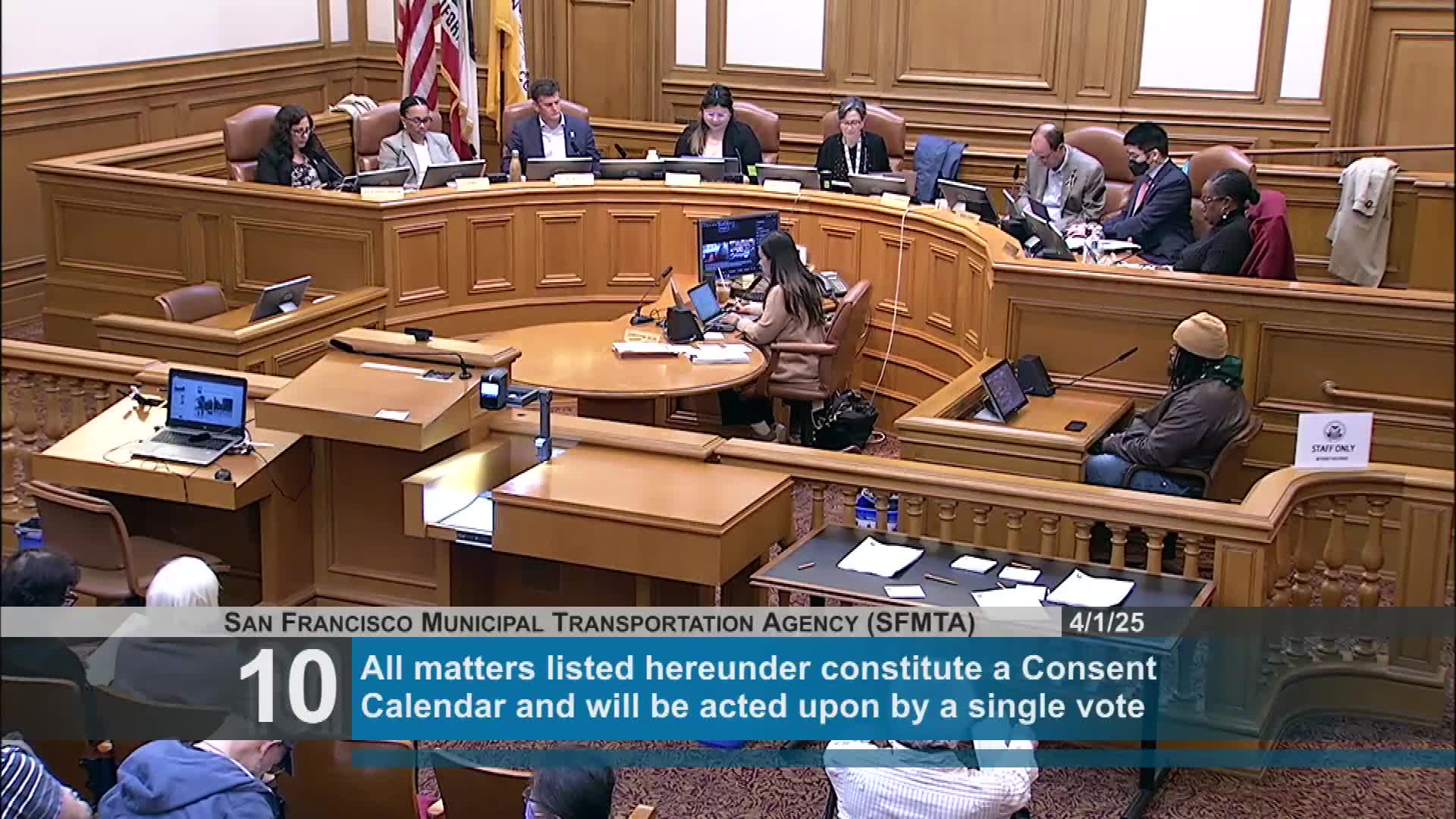
The San Francisco Municipal Transportation Agency board voted unanimously April 1 to approve the Oak Street quick-build project, a redesign of Oak Street between Stanyan and Baker that will add an eastbound Class 4 separated bikeway, pedestrian safety measures, daylighting at key intersections and short protected connections to the Panhandle path.
Mark Drager, the SFMTA project manager for Oak Street, told the board the corridor is on the city's High Injury Network and has seen a rise in collisions while Fell Street — a parallel, opposite-direction protected lane implemented in 2020 — showed a 38% reduction in collisions and a 50% reduction in pedestrian-involved collisions over the same period. The Oak proposal would convert one of four travel lanes on much of the corridor into a bikeway separated from traffic by floating parking and concrete islands at key intersections. Drager told the board SFMTA modeling indicates vehicle throughput would be similar to today while vulnerable users would see safety gains.
Supervisor Bilal Mahmoud, representing the council district covering the Panhandle and surrounding neighborhoods, spoke in favor of the project and said his office had heard broad neighborhood support after months of outreach. "This project represents an opportunity to connect two sides of our city and improve traffic safety," Mahmoud said at the meeting.
Project opponents raised concerns about parking removal, congestion and enforcement for cyclists on nearby park paths. Vanessa Kerr, a Panhandle resident who testified at the hearing, told the board: "None — and I do mean none — of the cyclists stop at the red lights" and asked for better enforcement and signage to calm speeds. Project staff said outreach included three phases across a year and that SFMTA, Recreation and Parks and Public Works coordinated on design and timing; the project would be implemented in two phases tied to a planned repaving of Oak Street in 2026 so that final concrete islands and permanent work would be installed with the Public Works paving contract. The quick‑build elements would be installed in 2025 and the more permanent concrete work would follow the repaving.
The board approved a staff amendment adjusting a proposed yellow‑loading zone (agenda Item G) on the north side of Oak east of Clayton from an all‑time loading restriction to 9 a.m.–6 p.m. (the amendment was moved by Director Chen and seconded by Director Hemminger). After the amendment and the project's final vote the board recorded a unanimous roll-call approving the project and its related traffic and parking changes. SFMTA staff told the board the project would remove 18 parking spaces on the Ashbury–Masonic block, five on Baker Street and 26 spaces associated with required daylighting islands, while preserving about 94% of the project-area parking supply overall.
The board's approval followed extensive public comment: parents, school groups (including prepared remarks from Urban School students), neighborhood associations, bicycle-advocacy groups and local merchants either supported or opposed the project, and multiple speakers urged mitigation for parking loss and additional safety features. Project managers said they will monitor the corridor after implementation and consider additional measures if compliance or speed issues persist.
Actions recorded: the board passed the Oak Street QuickBuild project and approved a time-limited revision to a loading zone. The full project schedule anticipates immediate quick‑build elements in 2025 and permanent island work timed with a 2026 repaving contract.