Get Full Government Meeting Transcripts, Videos, & Alerts Forever!
Get email alerts on the Criminal Justice topic
No spam. Unsubscribe anytime.
Dane County racial-disparities subcommittee lays out data priorities as vendor contract advances
Summary
The Dane County Community Justice Council Racial Disparities Subcommittee heard a strategic-planning update, learned a vendor selection is pending for a countywide plan, and discussed focusing initial analysis on arrest, bail and diversion disparities; two national technical-assistance awards were also announced.
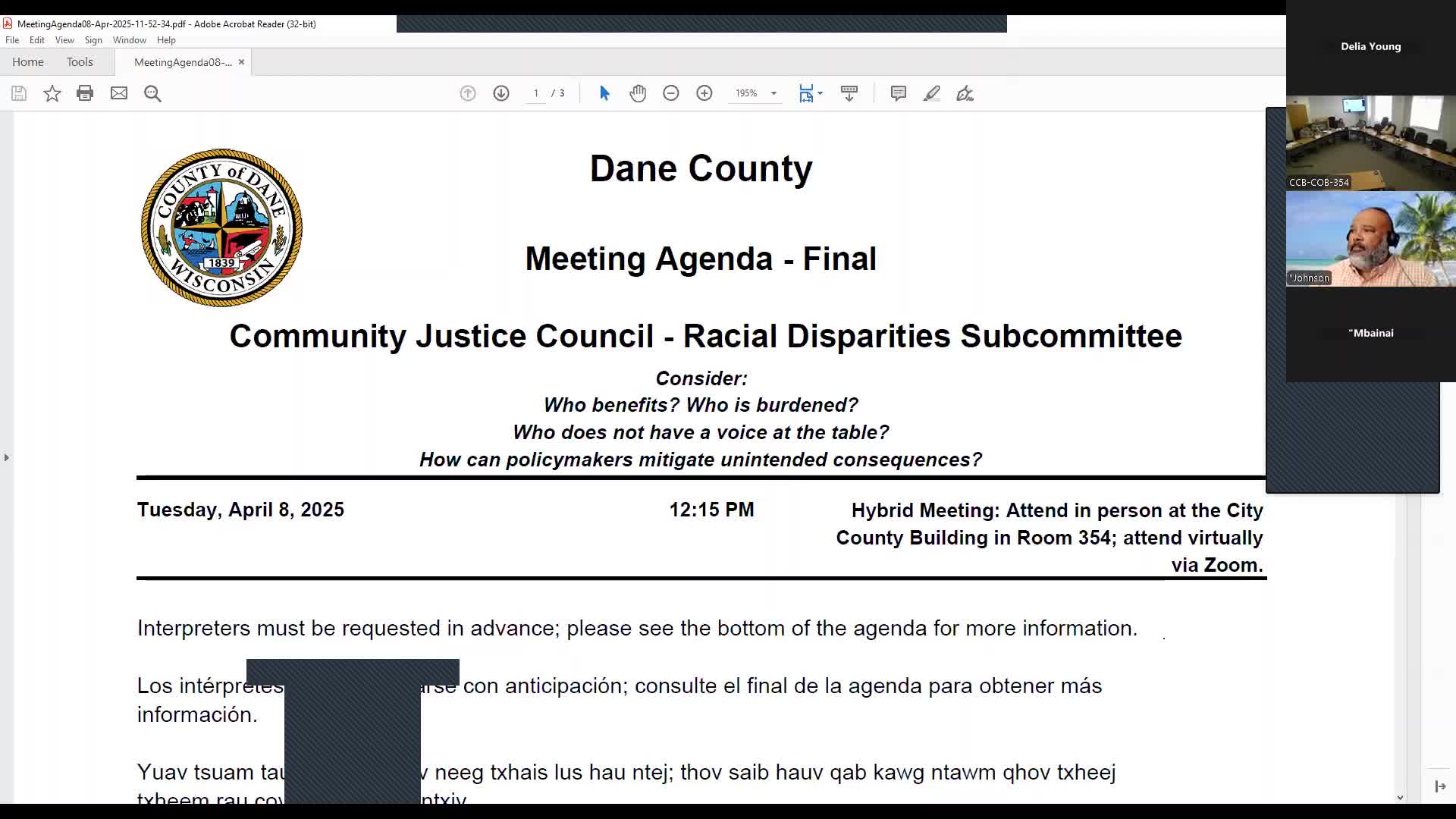
The Dane County Community Justice Council Racial Disparities Subcommittee on an April meeting received an update that the county has selected the Justice Management Institute as the planned vendor to develop a strategic plan, and members discussed focusing early data work on disparities in arrests, bail and diversion offers.
Jaya, the community court coordinator in the Office of Justice Reform, reintroduced herself to the subcommittee and described her background in social work, child welfare and housing services. "I'm introducing or reintroducing myself as the community court coordinator and the newest addition to the Office of Justice Reform," she said.
Helene Bergman, director of the Office of Justice Reform, outlined the strategic-plan process the county is launching and put the subcommittee's work in historical context. Bergman noted Dane County has been part of a decade-long MacArthur Foundation effort to lower jail populations and address racial equity, and that the national initiative is concluding this year. She said the county released an RFP in January, selected the Justice Management Institute (JMI) by unanimous evaluator decision, and expected contracting to be routed within days. Bergman said the JMI kickoff with the CJC executive committee was scheduled for April 24 and the county aims to complete the strategic plan by September.
Colleen, an Office of Justice Reform staff member, announced two national technical-assistance awards the county won. The county received a Sequential Intercept Model (SIM) training award—technical assistance tied to the MacArthur initiative—slated to bring two national facilitators to Dane County for a limited, invite-only event in early summer. The county also won a 16-month Housing Solutions and Center for Justice Innovation technical award to develop housing frameworks for vulnerable residents; Colleen said the first six months will focus on learning and local priority-setting and the final 10 months on framework development and policy recommendations.
Discussion among subcommittee members focused on which specific disparities the subcommittee should ask the vendor and county analysts to measure. Members suggested starting with quantitative indicators the county can measure and then layering qualitative information. Possible metrics raised included disparities in arrest rates, differences in bail amounts or whether bail is set, and differences in whether diversion options are offered. One member said the subcommittee should "identify if there is a disparity" first and then determine where in the system the disparity begins—at initial contact with law enforcement, at arraignment or later in case processing—because any early disparity can magnify downstream.
Members also discussed including victim input and other qualitative context alongside quantitative measures. Tamaraene Cornelius, identified in the meeting as the CJC research analyst, and staff said they would craft a brief survey and data parameters to bring back to the subcommittee before forwarding priorities to the vendor. Bergman and other staff emphasized the need to keep initial analytic scope focused so the vendor can incorporate subcommittee priorities into the countywide strategic plan.
At the start of the meeting the subcommittee agreed to table consideration of the meeting minutes until the next meeting on June 10 because of technical difficulties uploading documents. The meeting concluded after a motion to adjourn was moved and seconded.
The subcommittee scheduled its next meeting for June 10 and staff said they will return with a draft survey and the specific data pulls needed to measure the disparities discussed.