Get Full Government Meeting Transcripts, Videos, & Alerts Forever!
Get email alerts on the Greenwood Preservation topic
No spam. Unsubscribe anytime.
Beyond Apology Commission adopts bylaws; Deep Greenwood Foundation seeks descendant certification and preservation steps ahead of June 1 events
Summary
On April 17 the Beyond Apology Commission voted to adopt bylaws and heard public comments from the Deep Greenwood Foundation about certifying descendants of the 1921 Tulsa Race Massacre, preserving historic Greenwood buildings and documenting trees with National Geographic.
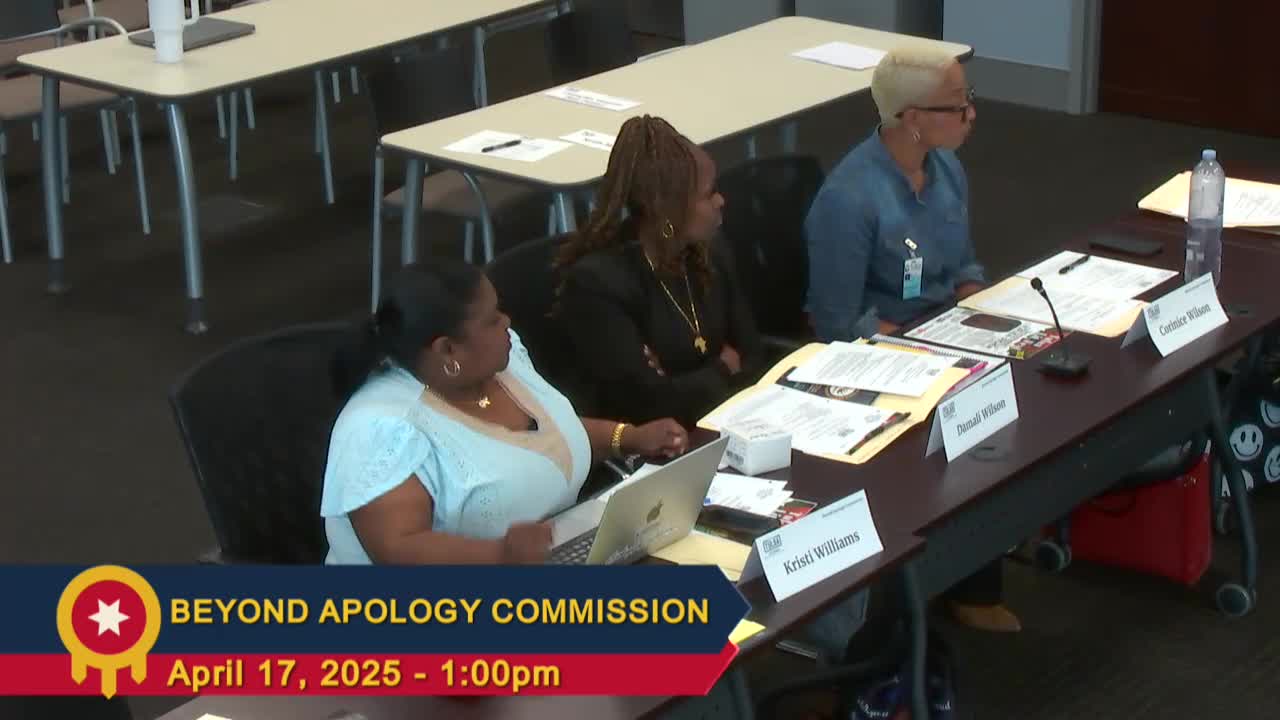
The Beyond Apology Commission voted to adopt its bylaws and heard multiple public comments about preserving Greenwood history and certifying descendants of the 1921 Tulsa Race Massacre at its April 17 meeting in Tulsa.
The commission moved to approve previously circulated bylaws after members said the document could be amended later to align with the mayor’s forthcoming announcement. A motion to adopt the bylaws was made, seconded and carried by voice vote. Earlier in the meeting the commission also approved the March 21 meeting minutes by voice vote.
Public comment and preservation proposals
Representatives of the Deep Greenwood Foundation described their work to identify and certify descendants and to preserve buildings tied to Greenwood’s history. Janetta Smith Williams, who identified herself as a descendant, said the foundation’s primary focus is certification of direct descendants and preservation of four Greenwood buildings tied to the 1921 events, and announced a descendants’ family reunion scheduled for June 1 from 3 p.m. to 6:30 p.m. in front of the Mabel B. Little House at 121 North Greenwood.
The group said it has identified more than 280 descendants and is using a certification model similar to those used for Holocaust survivors and other recognized survivor groups. Janetta Smith Williams said the Deep Greenwood Foundation is coordinating with the Greenwood Cultural Center and with Oklahoma legislators to put a certification process into place and that private donors currently support the group while it applies for grants.
Restitution and preservation ideas
Foundation representatives discussed ideas for directing local resources toward repairs and operations at Greenwood properties, including redirecting tax revenues that currently flow to a stadium tax trust to help the Greenwood Chamber address building repairs and maintenance. They cited specific needs such as installing a sprinkler system at Vernon to enable new uses like a daycare and noted that some buildings are not held in community ownership.
Speakers also raised concern about the removal of historic trees and headstones. One commissioner described an ongoing National Geographic project to document “witness trees” that have historic significance; the group discussed cataloging trees and seeking municipal protections or permit requirements to prevent further loss. An arboreal expert’s response included an explanation of how trees “seal” wounds rather than heal and why older trees require careful preservation.
Coordination among groups
Speakers repeatedly urged coordination among organizations working on Tulsa’s race-massacre legacy, saying that Justice for Greenwood, Beyond Apology and the Deep Greenwood Foundation each have roles and that unified efforts will be more effective. The Deep Greenwood Foundation said it will share a restitution plan with commission members and that it has legal partners and genealogists assisting with documentation and certification.
Ending
Commissioners agreed to hold final committee and annual planning until after the mayor’s June 1 announcement to ensure alignment with the city’s commemoration schedule. The meeting adjourned by voice vote at the end of the session.