Get Full Government Meeting Transcripts, Videos, & Alerts Forever!
Get email alerts on the Housing And Land Use topic
No spam. Unsubscribe anytime.
City attorney outlines proposal to require business licensing for group homes, with potential revocation for state license violations
Summary
City Attorney Kelly Concrete presented draft amendments to require group homes to register for a city business license, supply state licensing information and allow the city to revoke its business license if state regulations protecting residents' health and safety are violated; council asked staff to return with refined language.
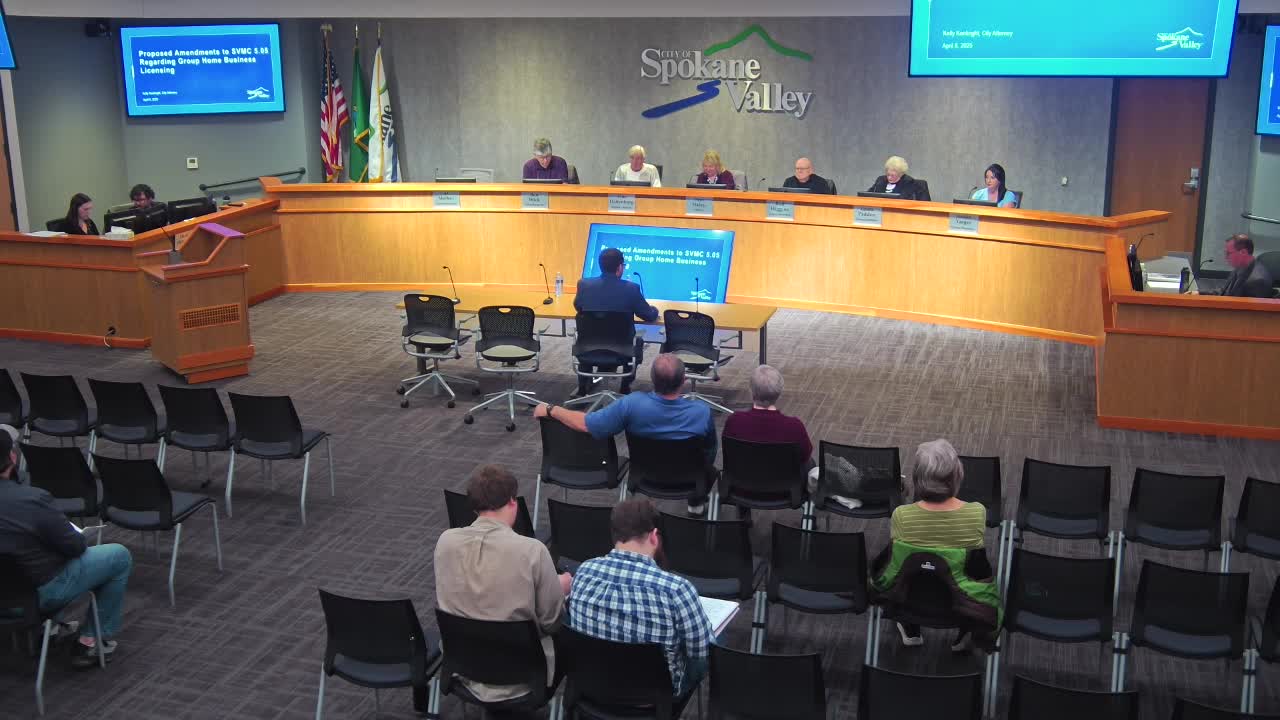
City Attorney Kelly Concrete presented proposed amendments to Spokane Valley’s business‑licensing code on April 8 that would require group homes to obtain a city business license, provide copies of any state licenses they hold, and allow the city to revoke the city‑issued business license if agencies determine the home has violated Washington law or rules designed to protect residents.
Concrete told council Washington and federal law constrain local regulation of where group homes may locate and how they determine occupancy; many licensing, occupancy and safety standards are set by state agencies such as the Department of Social and Health Services and implementing Washington Administrative Code provisions. The proposed city approach focuses on business licensing and coordination with state regulators rather than new local zoning limits. Under the draft, a group home registration would require submission of active state licenses for the facility type and identification of the applicable RCW and WAC provisions the operator must follow.
The proposed language would also give the city authority to revoke a group home’s city business license if a state agency finds violations of laws or regulations intended to protect the health, safety or welfare of residents. City staff said the tool is intended to improve coordination and provide a local enforcement lever for cases where operators are noncompliant. Staff clarified they are not seeking to conduct routine state licensing inspections at each house; rather the intent is to use business licensing as an additional regulatory and investigatory tool when complaints arise and to coordinate with the appropriate state agencies that hold primary licensing authority.
Council members raised questions about enforcement capacity, overlap with state regulators (for example, DSHS residential care services), and how chronic nuisance complaints or repeated law‑enforcement calls might factor into license revocation. Staff agreed to review related definitions in the city code (for example the local definition of "family" and any occupancy limits that may apply) and to clarify how chronic nuisance findings could relate to revocation. Council asked staff to return with revised draft language.
Public comment included requests that group homes have sprinkler systems and other safety measures; staff noted that many structural and licensing standards are set and inspected at the state level. Council provided consensus to return with updated draft amendments for formal consideration.