Get Full Government Meeting Transcripts, Videos, & Alerts Forever!
Get email alerts on the Public Works And Transportation topic
No spam. Unsubscribe anytime.
Council directs fee changes, hires and project staff for engineering and facilities work; Pines grade separation to add temporary positions
Summary
Council gave consensus to update right‑of‑way permit fees and create 1 permanent right‑of‑way inspector FTE; it also approved adding two temporary project positions paid from the Pines Road grade‑separation project (a senior engineer and an engineering technician) and agreed to reclassify a vacant facilities inspector to a facilities manager.
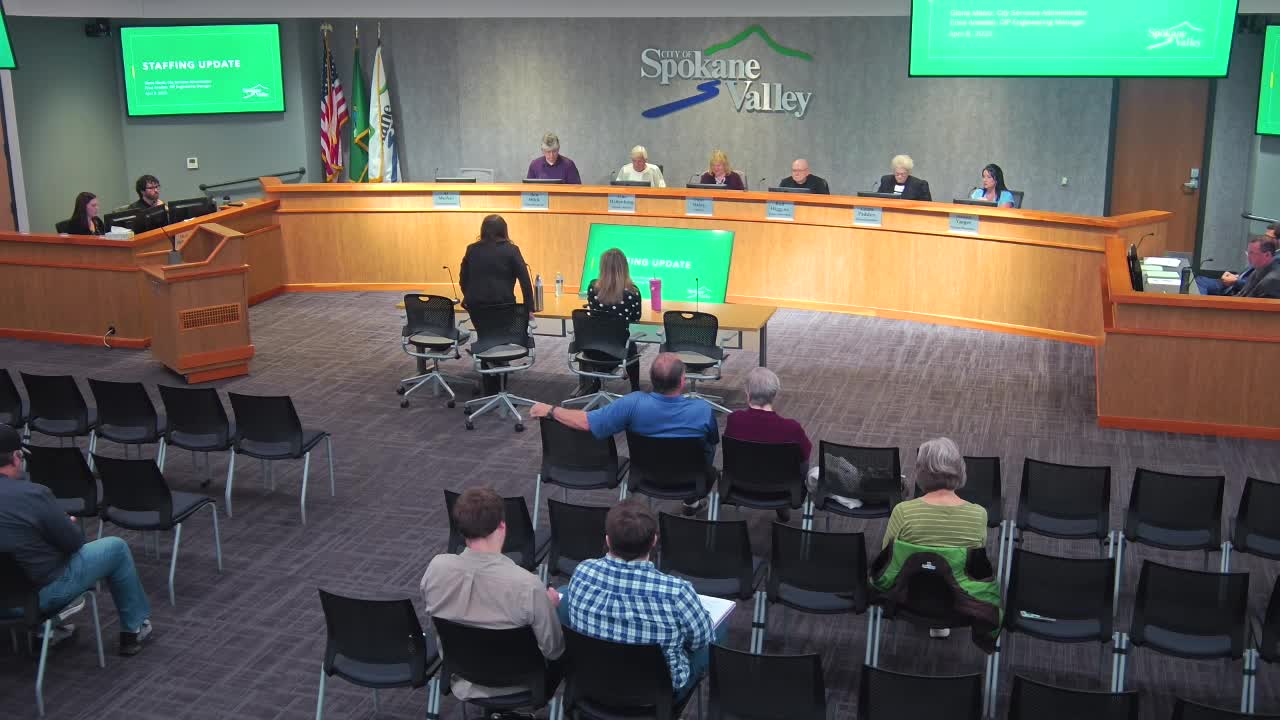
Spokane Valley city staff briefed council on a suite of staffing and fee changes on April 8 and received council direction to proceed with several measures to address inspection capacity, large capital projects and new grant obligations.
City Services Administrator Gloria Manns and Engineering Manager Erica Amston (transcribed as "Bridal Anston/Erica Amston") said the city's right‑of‑way inspection program has been stretched by a record permitting workload in 2023–24. A single right‑of‑way inspector handled roughly 1,000 permits in 2024, staff said, and the city used consultants and overtime to meet demand. Manns recommended hiring an additional permanent right‑of‑way inspector FTE and updating right‑of‑way permit fees in the master fee schedule to recover much of the new position's cost. Staff estimated increased revenue of approximately $187,000 based on 2024 permit volumes; the inspector salary range was described as $136,000–$160,000 total cost. Staff said if fees are updated as proposed, the new inspector would not increase the general fund burden.
Council voiced support and gave consensus to update the right‑of‑way permit fees, revise the master fee schedule language to clarify penalties for unpermitted work (100% penalty in addition to the permit fee), and to create one permanent right‑of‑way inspector FTE.
Amston presented the Pines Road grade‑separation project (the city's largest capital project, budgeted at about $48 million, with $43.0 million from grants) and described the scale of construction management, testing, documentation and federal compliance the roadway contract will require. Staff said WSDOT cannot provide construction management for this project and that the city must hire external construction management (HDR selected as consultant) and add two temporary city positions: a senior engineer and an engineering technician 2 for the roughly 30‑month duration of construction and closeout. Staff estimated the city's construction management cost (city effort plus consultant) at just under $4.2 million (about 8.7% of project cost) and said project funds can cover the two positions for the estimated 30‑month period. Council provided consensus to create the two positions funded by the project budget and to re‑evaluate staffing at project closeout.
Finally, Manns noted success in winning clean‑building grants that expand facilities work; staff recommended converting a current vacant facilities inspector position (grade 14) to a facilities manager classification (same grade, no net FTE increase) to attract candidates with the expertise needed to manage grant implementation and building compliance. Council gave consensus to reclassify the vacant facilities inspector to a facilities manager position.
Staff said they will return with formal ordinance or personnel actions (as required) and will evaluate the temporary Pines positions at project closeout to determine ongoing need.