Get Full Government Meeting Transcripts, Videos, & Alerts Forever!
Get email alerts on the Domestic Violence Services topic
No spam. Unsubscribe anytime.
Family Safety Center details polyvictimization, services and funding risks; new facility planned for October 2025
Summary
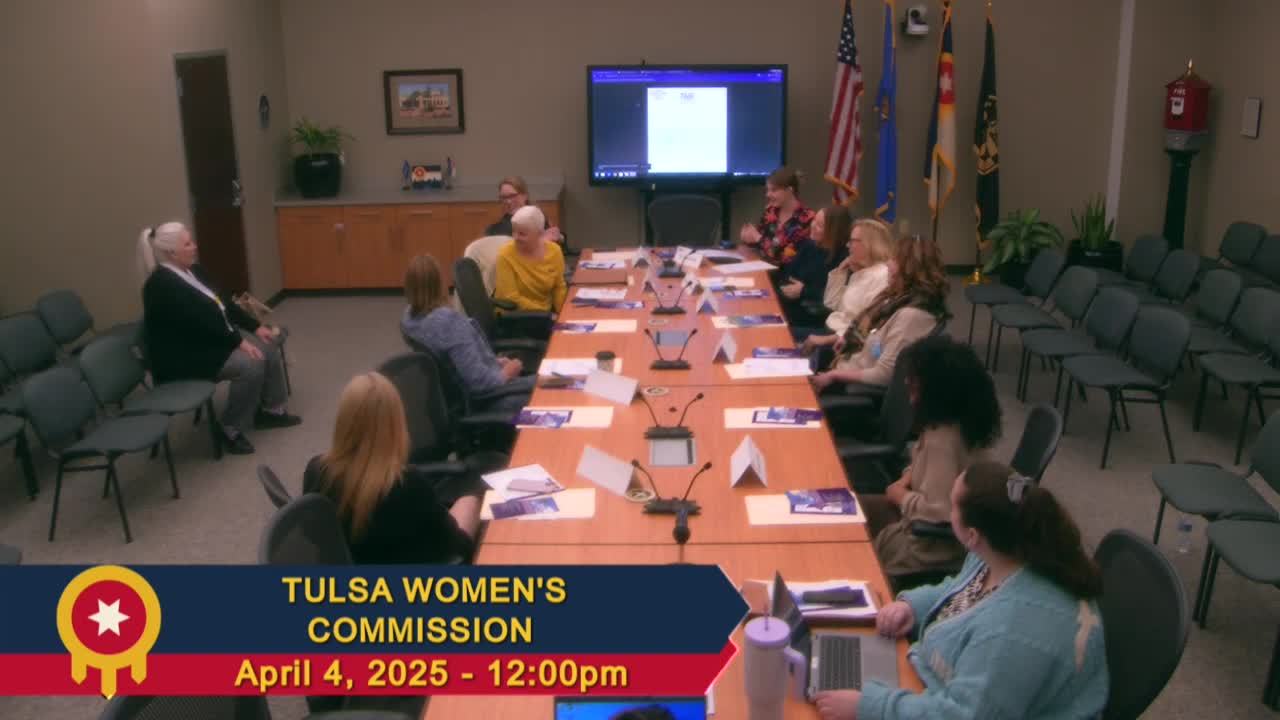
Suzanne Stewart, chief executive officer of the Family Safety Center, told the Tulsa Women’s Commission that polyvictimization — layered lifetime victimization — drives high levels of trauma and demand for services and that federal grant uncertainty threatens operations as the center prepares to open a 65,000-square-foot facility in October 2025.
Suzanne Stewart, chief executive officer of the Family Safety Center, told the Tulsa Women’s Commission on April that polyvictimization — layered, lifetime experiences of different kinds of victimization — amplifies the health and safety harms she encounters in Tulsa County and drives demand for the center’s services.
The Family Safety Center serves people who have experienced intimate partner violence, sexual assault, stalking and related trauma. Stewart said the center provides emergency-protective-order assistance, danger assessments, safety planning, on-site forensic nurses who document injuries and evidence, and legal help through partner legal services. She said the Tulsa Police Department refers cases to the center and that advocates contact people in many cases.
Stewart said the center’s data and national studies show high rates of trauma and related symptoms among clients, including suicidal ideation and self-harm. She described “polyvictimization” as layered experiences — for example, child abuse, physical assault and homelessness stacked across a lifetime — and said the center used a Department of Justice–sponsored assessment developed with university partners to screen roughly 3,000 clients from 2019 through 2023.
Why it matters: Stewart said survivors who seek services are far less likely to become homicide victims than people who never sought help, citing the state domestic-violence fatality review board’s findings. She also warned that funding uncertainty at the federal level threatens the center’s ability to continue offering high-demand services as it moves into a larger site.
Stewart said roughly 65 percent of clients seek assistance with emergency protective orders; advocates help prepare the affidavit and petition that a judge typically reads and acts on quickly, she said. She described law-enforcement referral as a statutory obligation but did not cite a specific statute.
Funding and capacity: Stewart told commissioners the Family Safety Center’s operating budget is about $1.4 million (she described the figure as “about 1.4”), largely supported by federal grants administered through the Department of Justice and related programs. She said the center does not pay rent for its current municipal court–adjacent space but that moving into a new building will add approximately $350,000 per year in utilities and maintenance expenses.
Stewart said the federal grant-review process — including pending Department of Justice awards and reviews of Office for Victims of Crime and Office on Violence Against Women funding — has delayed or reduced expected grant renewals and created uncertainty for partner agencies that provide on-site legal and mental-health services. She said some partner positions are grant-funded and vulnerable to cuts.
New facility and services: Stewart said the Family Safety Center will move into a new building at 2829 South Sheridan, scheduled to open in October 2025. She described the planned facility as about 65,000 square feet and said it would be larger than the center’s current space (which she described in the meeting as “15” without specifying units). Stewart said the new site will allow expansion of services and partners, including tribal victim services, tribal law enforcement, and federal partners such as the FBI and U.S. Attorney’s Office for tribal-related cases.
Access and client protections: Stewart said the center serves anyone regardless of immigration or documentation status and that the site is a private, protected space; she said law enforcement or other government actors cannot enter without a warrant or subpoena. She said the center has embedded Tulsa Police Department victim-witness advocates and detectives at its current location to help build trust and facilitate trauma-informed response.
Workforce and legal help: Stewart said partner legal organizations (named partners in her remarks included Legal Aid and other legal services partnered onsite) provide staff attorneys funded by grants, but those positions pay less than private-sector equivalents and are hard to fill. She asked the community and commission members for help identifying pro bono attorneys and other supports should grant funding change.
Evidence and data reporting: Stewart said Tulsa County recently had a 5.4 percent increase in reported incidents in a year and that Oklahoma has ranked near the top among states on multiple trauma and violence measures; at the meeting she said Oklahoma ranked second in a recent year. She also said increases in reported numbers partly reflect increased referrals and contacts with the Family Safety Center and Tulsa Police Department advocacy.
Questions and next steps: Commissioners and members asked about unreported cases (Stewart said those numbers are unknown) and whether reporting makes an abuser more or less dangerous (Stewart said reporting can sometimes make an abuser more empowered to continue, which is why safety planning is survivor-driven). She urged commissioners to raise awareness, help with community outreach, and identify attorneys and philanthropic support as the center prepares for the new building.
Ending: Stewart said people who seek the Family Safety Center’s services are rarely the victims in the state’s fatal domestic-violence cases (she cited a high percentage of homicide victims never having sought services). She asked the commission to help spread awareness and to assist with fundraising and pro bono legal support as federal grants are reviewed and the center prepares to open its new facility in October 2025.