Get Full Government Meeting Transcripts, Videos, & Alerts Forever!
Get email alerts on the Zota Objective Standards topic
No spam. Unsubscribe anytime.
Planning commission debates how to implement state’s objective‑standard mandate; commissioners raise public‑engagement concerns
Summary
Commissioners and staff discussed implementing recent state legislation that requires objective standards and ministerial review for development plans. The city’s law department and planning staff said the law pushes the city toward codified objective standards; commissioners pressed for a clearer, formalized avenue for public participation.
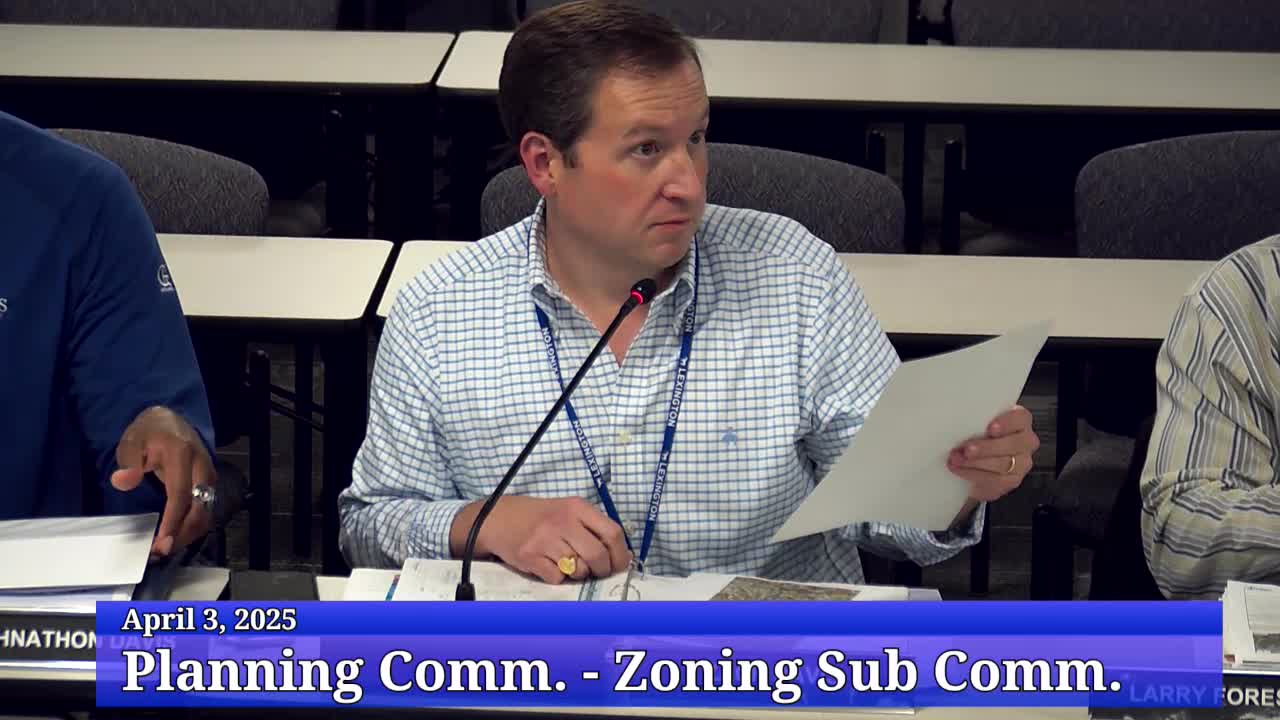
Planning staff and the city law department updated the Lexington‑Fayette Urban County Planning Commission on work to implement state legislation that requires objective development standards and ministerial application of development plans. The discussion centered on how to translate draft text changes into clear rules while preserving meaningful public input.
Planning staff explained the approach: to codify objective standards and to ensure any processes that allow applicants to seek relief (waivers/variances) are updated in tandem. "We are trying to do both of those things," a law department attorney told the commission, arguing that the statute combines two requirements: objective standards for development plans and ministerial application of those standards. The law representative said adopting objective standards codified in the ordinance would reduce subjective interpretation and streamline approvals.
Commissioners expressed support for clearer objective standards but repeatedly raised the question of how the public will be able to participate and offer input once development‑plan approvals become largely ministerial. One commissioner asked whether the draft process could offer a more defined avenue for public comment than an informal ‘‘call the office’’ approach. Planning staff said they intended to compile commissioners’ comments, evaluate feasibility, and return with a consolidated set of proposed changes; staff also noted that a downtown master plan effort will provide an opportunity to reengage universities and other stakeholders.
Staff emphasized timing constraints driven by the state law’s effective dates and the desire to avoid creating regulatory gaps. They warned that splitting the text amendment into multiple separate ordinances to allow more time for public engagement could leave parts of the new framework unadopted by the statutory deadline, and that could reduce the city’s ability to apply the updated standards consistently to incoming applications.
No formal vote was taken on the draft text amendments at this meeting; staff said they would circulate updated language and a matrix of revisions to commissioners and would return for further action at the next meeting. Commissioners were invited to submit proposed language or concepts to staff before the commission’s next scheduled review.
Why it matters: The state law discussed requires objective standards and ministerial application for development plans; implementing those rules will change how some development plans are reviewed in Lexington and may narrow staff and commission discretion. Commissioners and staff agreed the city must balance the statutory requirements with clear, documented public‑engagement mechanisms where feasible.
The law department and planning staff indicated they will continue to refine the draft language, coordinate necessary process changes (including waivers) and work with the commission to prepare a recommended ordinance package for council review. Staff asked commissioners to send any remaining comments promptly so staff could circulate a consolidated revision before the commission’s next meeting.