Get Full Government Meeting Transcripts, Videos, & Alerts Forever!
Get email alerts on the Hiring Veterans Preference topic
No spam. Unsubscribe anytime.
Milwaukee FPC amends hiring rule to add veterans preference points
Summary
The Fire and Police Commission voted April 3 to amend FPC rule 8, section 6(a) to add additional preference points for veterans, aligning the commission's rule with civil service practice; commissioners asked staff for follow-up data and a broader review of preference points.
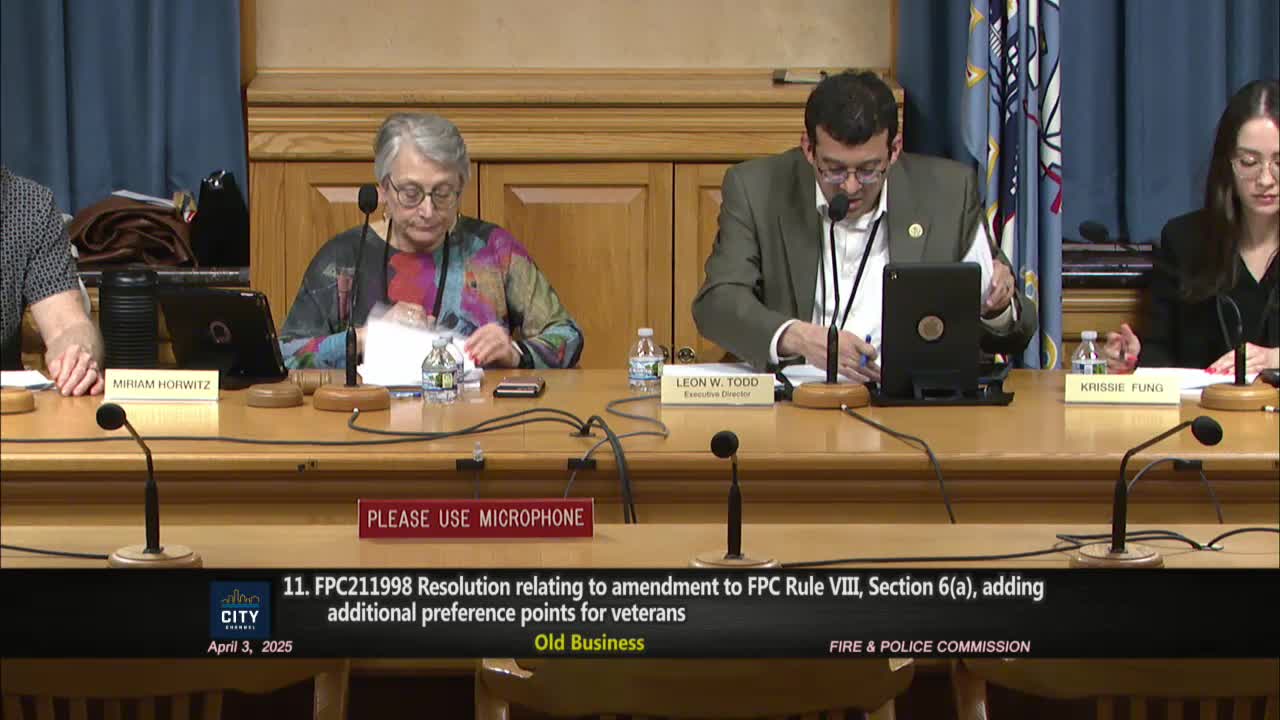
The Milwaukee Fire and Police Commission voted April 3 to amend FPC rule 8, section 6(a) to add additional preference points for veterans, a change the commission's chair said brings the board's rule closer to the civil service practice required under state law.
Commissioners discussed the mechanics and likely effects of the change before taking a roll-call vote. Commissioners Burgos, Evans, Fung, Ramey, Snyder, Spence, Ward Patterson and Chair Commissioner Horowitz voted aye; the motion carried.
Commissioners and staff said the amendment is intended to align the commission's rule with the preference awarded for veteran status under the civil service rules. Commissioners noted existing residency and education preference points — staff said education preference ranges between about 3 and 5 points depending on degree level — and discussed how adding veteran points could shift the rank order on eligible lists.
Director Leon Todd (FPC executive director) and other staff explained the administrative differences between the Civil Service Commission's “rule of 5” and the FPC practice, which effectively operates on a rank-order hiring approach: whereas the civil service process forwards a pool of top candidates to department hiring authorities, the FPC maintains eligible lists in rank order and hires from them in sequence. Commissioners were told that preference points change candidates' rank positions and thus could cause candidates to move ahead of others on eligible lists.
Commissioners asked staff to provide demographic and residency data tied to preference-point awards. Staff said such a report could be produced for future recruit classes and for the current eligible lists; in discussion members noted the police officer eligible list just considered in the meeting appeared to include about three or four people with veterans preference points out of roughly 60 candidates.
Several commissioners urged that the board return to committee to review all categories of preference points (residency, education, certifications and the newly adjusted veteran points) so the commission can assess whether other adjustments are warranted.
The commission adopted the amendment after a motion to approve and a second; the matter had been held at the March 20 meeting and was filed as FPC 211,998. No additional conditions or amendments were recorded during the April 3 vote.
The commission proceeded to the next agenda item after the vote; staff indicated they would follow up on the data requests and the commissioners' request to review other preference-point categories.