Get Full Government Meeting Transcripts, Videos, & Alerts Forever!
Get email alerts on the Municipal Finance topic
No spam. Unsubscribe anytime.
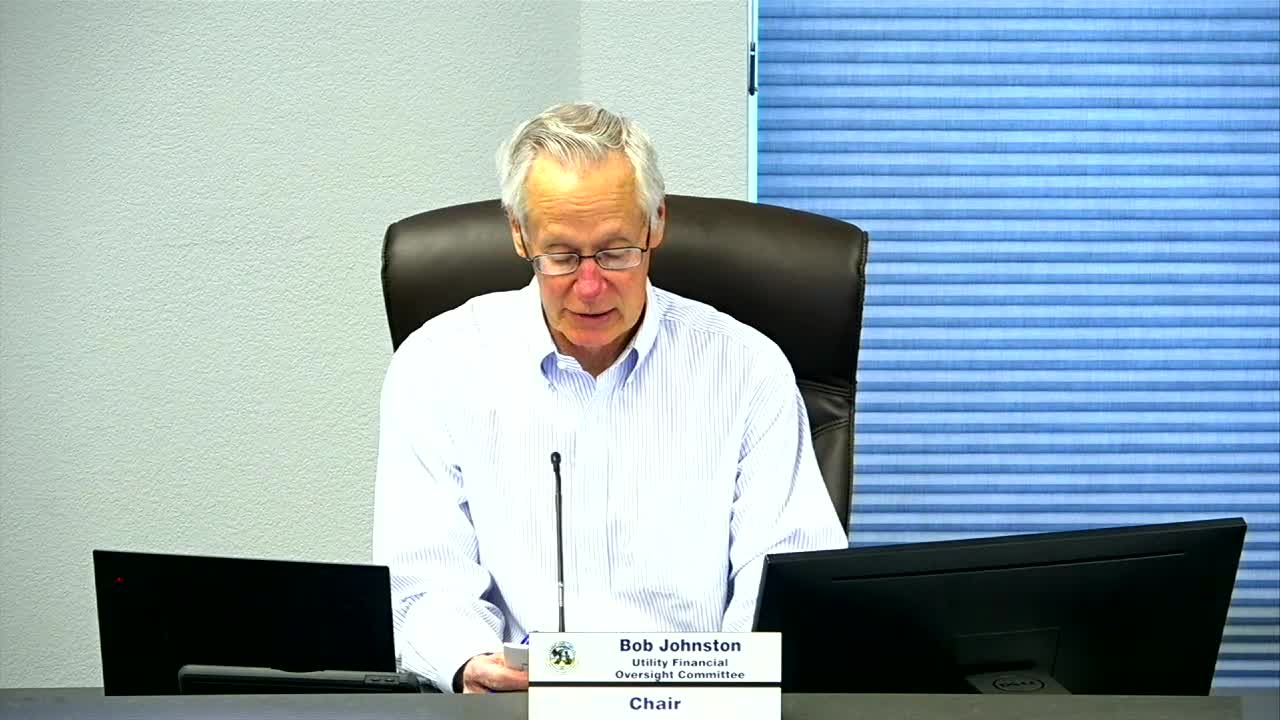
Carson City utility oversight committee recommends tentative FY26 water, wastewater and stormwater budgets to Board of Supervisors
Summary
The Utility Finance Oversight Committee on a voice vote acknowledged the tentative FY26 wastewater, water and stormwater budgets are in compliance with city financial policies and recommended the Board of Supervisors approve them.
The Utility Finance Oversight Committee on a voice vote on an item-by-item basis acknowledged the tentative fiscal year 2026 budgets for the wastewater, water and stormwater utility funds are in compliance with Carson City's adopted financial policies and recommended the Board of Supervisors approve the tentative budgets.
Jamie Stevenson, accounting manager for Carson City, presented the three enterprise fund budgets and said staff included “the utility rate increase of 2.5% for all revenue projections” based on the December 2024 West Urban CPI rate schedule that went into effect in July 2022. Stevenson told the committee that salaries and benefits increases and internal service charges are the primary upward pressures on expenditures and that a recent health-insurance renewal lowered the originally budgeted medical increase.
Stevenson described key figures and supplementals for the funds. For the wastewater fund she said salaries and benefits were initially expected to increase by $214,518 but, after the insurance adjustment, the net increase to salaries and benefits would be about $194,124; planned capital outlay for wastewater is $6,245,000, with the largest single project listed as a vehicle and warehouse building. For the water fund she said salaries and benefits would increase about $209,335 (adjusted to $188,845 with the insurance change) and planned capital outlay is $3,725,000, including continued work on the Quill treatment plant and waterline projects. For the stormwater fund she said salaries and benefits increase about $91,770 (adjusted to $87,863) and planned capital outlay is $1,550,000, with the Bowers Lane storm drain project listed as the largest planned expenditure.
Staff identified several supplemental requests that would be forwarded with the tentative budgets, including chemicals ($50,000), power ($250,000) and phone service ($14,000) for wastewater; meter replacements ($125,000), power ($43,000) and phone ($12,000) for the water fund; and no supplementals for stormwater. Stevenson and staff also described two personnel supplementals that span multiple funds: an additional 50% of an operational-technology systems administrator position and 15% of a compliance officer position. Those additions would raise salaries and benefits by about $88,595 and, if approved, would require two vehicles that add roughly $41,250 to capital costs. Stevenson said that if the positions and vehicles were added, staff would reduce the infrastructure capital account by about $100,000 to maintain the city’s financial policy targets.
Committee members asked about vacancy rates, meter failures and indexing. Stevenson said vacancy for the utility group is roughly 5% (two vacancies in a 40-person group) and that the city is seeing about 300 meter failures a year on its older radio-read meters. Committee members confirmed the CPI adjustment is applied across user rates and that connection fees use the Engineering News-Record construction cost index.
Each fund motion was carried by voice vote; the minutes record only the committee’s voice approvals and do not list individual aye/no tallies. The committee moved to: acknowledge the tentative wastewater fund budget for FY26 is in compliance with adopted financial policies and to recommend the Board of Supervisors approve it; acknowledge the tentative water fund budget for FY26 is in compliance and to recommend approval; and acknowledge the tentative stormwater utility fund budget for FY26 is in compliance and to recommend approval. All three motions were approved by voice vote.
The committee’s recommendation forwards the tentative budgets to the Board of Supervisors for review and adoption as part of Carson City’s formal budget process. Staff cautioned that the tentative budgets could change between this recommendation and the final budget, depending on Board direction, final insurance and benefit rates and any approved supplementals.