Get Full Government Meeting Transcripts, Videos, & Alerts Forever!
Get email alerts on the On Site Sewage Code topic
No spam. Unsubscribe anytime.
Skagit County public health begins updating on-site sewage code to match new state rules
Summary
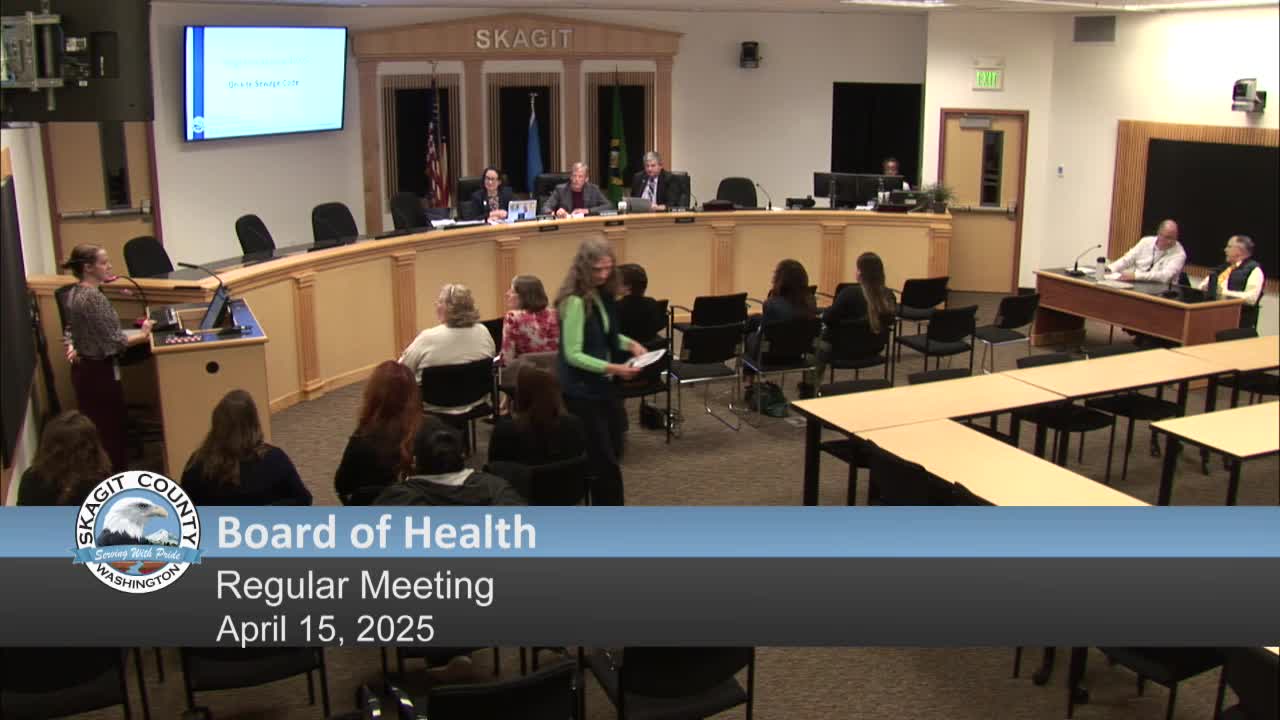
Skagit County Public Health staff told the Board of Health on April 15 that the county is drafting updates to its on-site sewage (septic) code to ensure local rules meet recently revised Washington state standards.
Skagit County Public Health staff told the Board of Health on April 15 that the county is drafting updates to its on-site sewage (septic) code to ensure local rules meet recently revised Washington state standards.
Charice Gaynor, an environmental health specialist with Skagit County Public Health, said the Washington Administrative Code revisions adopted by the Washington State Board of Health—many of which took effect April 1, 2025—require local health jurisdictions to bring their regulations into conformity. “All of our local regulations must be as stringent as the state code. We cannot be less stringent,” Gaynor said.
Gaynor told the board the department began drafting proposed revisions in June 2024, sought an initial review from the state Department of Health in September, ran a three-session technical advisory group with local designers, installers and inspectors in December 2024, and completed legal review this year. The county has held work sessions with the Board of Health in March and April 2025 and has another work session scheduled later in April. Staff plan to post a public meeting and public hearing in May or June, with possible adoption in June.
The proposed changes fall into five categories, Gaynor said: aligning permitting forms and timelines with the county’s Tyler Enterprise Permitting system; adopting current practice language (including use of Department of Health standards and guidance as the county’s design/operation standard); adding definitions and clarifications; establishing a few new requirements such as certification tiers and holding-tank permits; and adding detail such as timelines for submitting inspection and pumping reports.
Gaynor described several specifics discussed with local providers: a clearer definition of continuing education units (CEUs) and expectations for certification maintenance; a proposed two-tier certification so that more complex systems require a higher certification level; an operational permit requirement for holding tanks (a requirement under WAC that the county had not previously codified); and a clarification tied to a “high seasonal water table” assessment used when depth to groundwater is 18 inches or less.
One substantive change she highlighted was removal of the county’s previous waiver for property-transfer inspections on vacant structures. The WAC change requires property-transfer inspections within six months of sale, and Gaynor said the county must remove its prior vacant-structure waiver to be as stringent as state rules. She noted that the seller remains responsible for completing the property-transfer inspection; staff said they can consider waiving the inspection if a buyer submits plans or a permit for a new system before sale.
Commissioners asked questions about practical impacts. Commissioner Janicki thanked staff for detailed briefing materials and called the packet “really fabulous” for helping the board understand the technical issues. Commissioner Browning asked whether buyers who plan to replace existing systems could be spared duplicative costs; Gaynor replied that the requirement falls on the seller but staff can consider waivers when a buyer proposes a new system and submits a permit.
Gaynor said the next steps are to complete the remaining work-session review, incorporate board input, publish a final draft for public comment, and hold a public hearing. No formal changes were adopted at the April 15 meeting.
Ending: After the presentation the board moved on to other public-health agenda items, and staff reiterated that the code update remains in draft form pending additional board input and the formal public hearing process.