Get Full Government Meeting Transcripts, Videos, & Alerts Forever!
Get email alerts on the Utilities Water topic
No spam. Unsubscribe anytime.
Marion County reports rapid expansion of waterline program; in-house crew adds miles
Summary
Tony Cunningham, Marion County utilities director, told the commission on April 1 that the county had significantly accelerated its waterline-extension work and expects further expansion using a mix of ARPA funds, a share program and a new in-house construction crew.
Tony Cunningham, Marion County utilities director, told the commission on April 1 that the county had significantly accelerated its waterline-extension work and expects further expansion using a mix of ARPA funds, a share program and a new in-house construction crew.
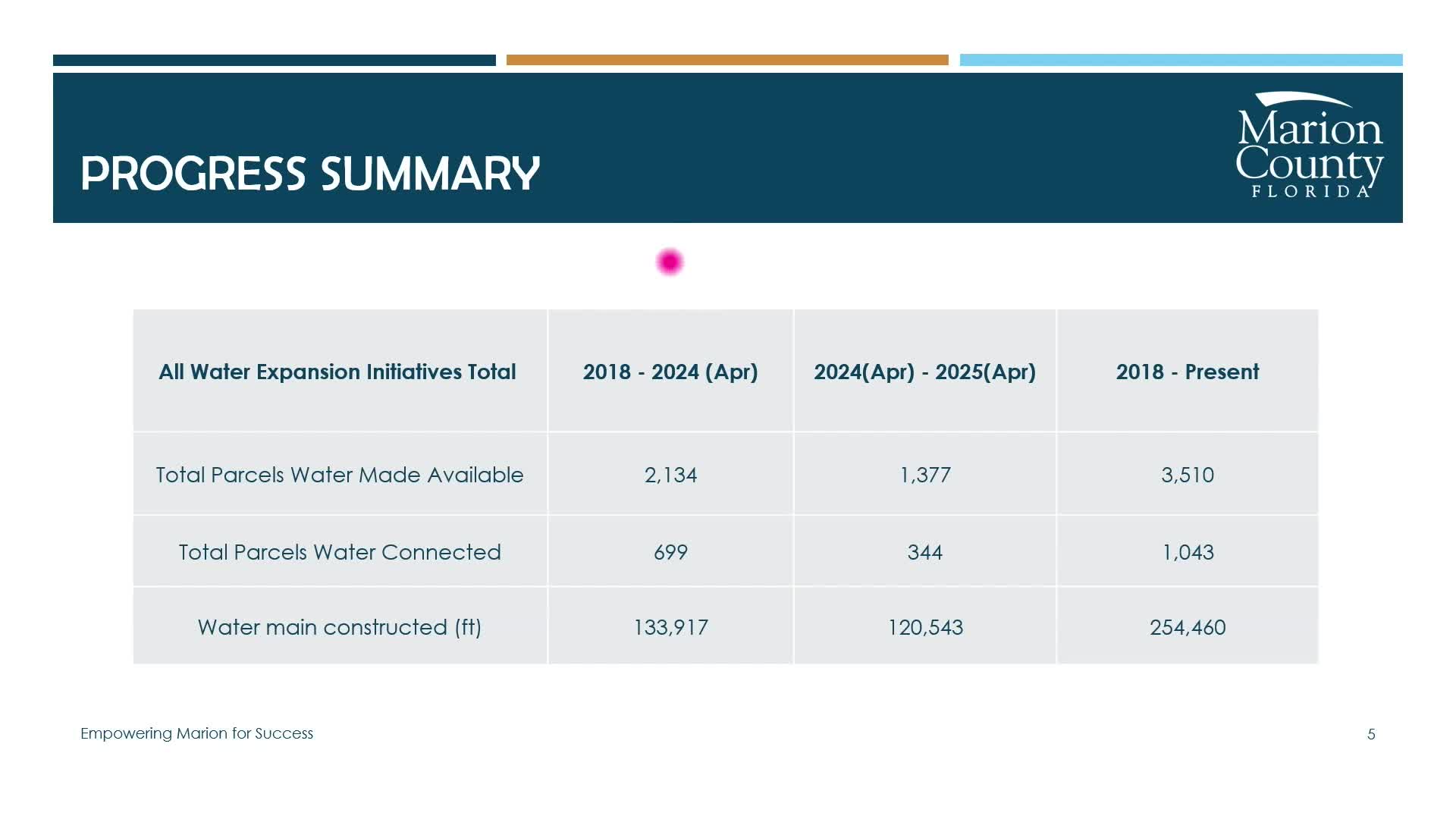
"So from beginning of the program up until last... we were able to make water available to about 2,100 lots. Of those lots, almost 700 of them have connected," Cunningham said, then added that in the last year the county made water available to roughly 1,300 parcels and 344 of those have connected. "The big takeaway is there is we've done almost as much work in the last year as we were able to do in the previous six years."
Cunningham said the program has made water available to about 3,500 parcels in total, with about 1,030 connections and roughly 48 miles of pipeline installed since the program began.
County staff highlighted multiple delivery streams: individually funded water-main extensions (paid by the owner/developer), a share program in which the utility funds a longer extension and recoups costs as customers connect, an in-house construction crew assembled to lower unit costs and speed construction, and ARPA-funded projects focused on Marion Oaks and Silver Springs Shores. Cunningham said the in-house crew has already installed about 3.5 miles of pipe this year and the county has plans that could cover 10 or more miles as the program continues.
On cost, Cunningham described typical per-connection or extension figures during a public exchange: "If I had to say average... extension cost is somewhere around $5,000 to $7,000," he said. County staff also referenced connector and capital charge estimates during the discussion: potable-water connection charges around $5,000, sewer taps about $12,500 and a capital charge roughly $1,600.
Cunningham listed public health, environmental protection, infrastructure resilience, fire protection and long-term cost-effectiveness as primary reasons to expand water service. He said looping lines improves water quality and emergency capacity, and emphasized that utility projects can lower individual long-term costs compared with private wells and septic systems.
Commissioners asked about the in-house crew's productivity and unit costs; staff said the crew can install several hundred feet per day in good conditions and that in-house unit prices are coming in substantially lower than outside contractors. Cunningham said more detailed unit-price data would be presented next year after additional metrics are compiled.
Ending: The county will continue waterline extension work across multiple funding streams and return with more detailed unit-price and budget data; staff said the combination of ARPA funds and in-house construction is driving the recent acceleration.