Get Full Government Meeting Transcripts, Videos, & Alerts Forever!
Get email alerts on the Police Budget topic
No spam. Unsubscribe anytime.
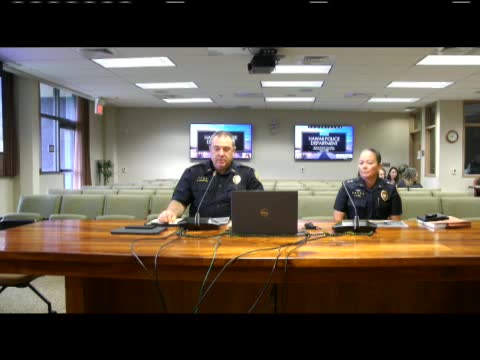
Hawaii County Police outline recruitment push, new customer-service texts and facilities priorities in 2025 budget review
Summary
Chief Ben Moskowitz told the County Council on May 1 that Hawaii Police Department priorities for FY26 include hiring a net 30 sworn officers, rolling out a new text-based case-status system, continued facility improvements and stepped up focus on drug trafficking enforcement.
Chief Ben Moskowitz, chief of police for Hawaii County, told the County Council at a May 1 special budget hearing that the Hawaii Police Department’s top priorities for fiscal year 2026 are increasing sworn staffing, expanding training, boosting grant funding and concentrating vice resources on drug-trafficking organizations. The department asked the council for budget adjustments to support those aims, plus facility upgrades and information-technology work.
The department seeks “to continue to conduct constant recruitment to get ourselves up to 470 sworn,” Chief Moskowitz said. He told the council HPD currently has 496 sworn positions authorized and about 57 vacancies; a recruit class of roughly 30 will begin in July. “We want to add a net of at least 30 officers” over the coming year, Moskowitz said, noting that recruit school, field training and attrition mean hiring must be sustained to make an on‑the‑street impact.
Moskowitz described several initiatives tied to the department’s FY25 accomplishments and FY26 objectives. He said HPD revamped its public website and launched a recruiting pipeline with University of Hawaii and Waiākea High School, filled new lieutenant-level posts for vice and Puna watch command, and created a grant coordinator position that helped increase federal and state grant funding. The department also plans more annual recall training for officers.
A notable technology project is the department’s planned automated customer-service system. Moskowitz said the new system will send text messages to 911 callers with a case reference number and basic status updates—when a unit is assigned, delayed or has arrived—and later provide a police-report number when a report is created. “It all kind of happens in the background alongside our CAD system,” he said, adding the contract is in place and a public rollout is expected in the next couple months.
Council members pressed the chiefs on staffing and program details. Councilmember Daniel Onishi asked whether community- and youth-oriented positions (for example, recreation or PAL-style posts) could be included or adapted as civilian roles to expand outreach without the higher cost of sworn officers. Moskowitz told Onishi and other councilmembers HPD will research existing class specifications and work with personnel to pursue recurring funding or position descriptions, and said the department would be happy to help identify position descriptions and recruitment paths.
Councilmember Tamara Villegas raised concerns about immigration enforcement incidents that involved federal agents operating in local facilities and asked the council and department to consider steps to protect minors; Chief Moskowitz deferred a policy response in the budget hearing but offered to discuss the issue with council members and the mayor’s office outside the forum.
Other questions covered training, equipment and overtime. Councilmember Greg Woods and others discussed the pilot testing of voice‑recognition/mobility dictation software for officers to reduce report-writing time; Moskowitz said the pilot worked but the full rollout requires significant licensing/outlay (an earlier supplemental request for software did not pass) and FBI/NIBRS compliance for secure handling of criminal-justice data. He estimated prior quotes for such systems at a few hundred thousand dollars and said the department continues to seek funding opportunities.
On facilities, Moskowitz told councilmembers the department is pursuing temporary leased storefront substations (as a short-term solution) while negotiating options for a permanent new station and supporting infrastructure in Puna and Ocean View. Moskowitz said adding officers for a rural substation is necessary before a physical station can be fully effective—“I have to get the positions to start the pipeline” of testing, backgrounds, recruit school and field training, he said.
Moskowitz and Assistant Chief Sherry Bird also outlined traffic‑safety, vice, and domain consolidation work. He said HPD will migrate departmental email and infrastructure to hawaiipolice.gov to reduce reliance on county infrastructure and free county IT capacity. The department will continue to target higher‑level drug distribution, and vice units have been reorganized to create island‑wide capacity.
Why it matters: Recruitment, training and IT modernization are among the largest line items for modern police operations, with a direct effect on response times, investigative capacity and public trust. Chief Moskowitz emphasized a multi‑year hiring pipeline—in part so recruits can complete training and field training—rather than one‑time hiring blasts.
What’s next: The department will start a July recruit academy class and expects the text‑notification customer‑service tool to begin providing status numbers and updates to 911 callers in the coming months. Councilmembers asked for follow‑up on software cost estimates, the pilot’s public timeline, and whether additional community‑oriented civilian positions could be budgeted or reclassified to expand youth programming and community policing.