Get Full Government Meeting Transcripts, Videos, & Alerts Forever!
Get email alerts on the Education Virtual Learning topic
No spam. Unsubscribe anytime.
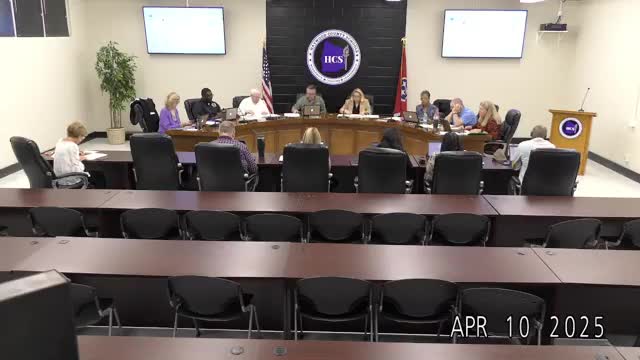
Haywood County Board votes to discontinue Haywood County Virtual Academy
Summary
The Haywood County Board of Education voted to discontinue the district's virtual academy, citing falling enrollment (28 K'8 students) and a budget shortfall after state TISA funding. The board approved the motion after hearing testing and cost data and was told affected students will be offered in-person, homebound or out-of-district options.
The Haywood County Board of Education voted to discontinue the Haywood County Virtual Academy (HCVA), a K'8 district-run online program that enrolled 28 students this school year.
Doctor Jackson, presenting the staff recommendation, said the district currently employs five virtual teachers to serve the 28 students and that the per-student state TISA funding for those enrollments is "roughly $7,295." Jackson told the board the remainder of teacher salaries and other costs must be covered by the district and recommended discontinuing virtual services as the district enters budget season: "as much as I know that won't be a popular decision, I think it's a reasonable request to make it this time."
Board member Miss Reed moved to discontinue HCVA; the motion was seconded by Mister Bandstor and carried.
The board heard staff explanations of alternatives for the 28 students if the program is discontinued. Jackson said families may enroll children in brick-and-mortar classrooms, request homebound services for qualifying medical needs, pursue homeschooling, or seek virtual services from neighboring districts that allow out-of-district enrollments. Jackson said some neighboring counties do not provide virtual services at all; others, like Jackson-Madison, operate much larger virtual programs.
District data and academic performance were raised during discussion. Mister Odom, who reviewed testing outcomes, told the board, "the data doesn't look good," and noted that despite smaller class sizes the virtual program's test performance had not met expectations: "the smaller your numbers are in your class ... the better your students should be doing. But for us, it's been kind of the exact opposite."
Administrators said the recommendation reflects both fiscal considerations and student performance. Jackson summarized the financial picture in the packet: the district receives TISA funding for the enrolled students (the presenter cited approximately $7,295 per student), but that funding does not fully cover salary and program costs such as devices and Wi-Fi that the district currently provides. Jackson said the district received about $140,000 in TISA in a comparison example for a larger classroom setting.
Board members asked about timing and staff notifications. Jackson said a meeting with HCVA staff was scheduled for the day after the vote and that parents would be notified by letter immediately so families and teachers could plan. Jackson added that virtual teachers would be offered other positions in the district where vacancies exist.
The board's vote ends the district's HCVA operation after the current school year; staff will proceed with notifications and transition planning.