Get Full Government Meeting Transcripts, Videos, & Alerts Forever!
Get email alerts on the Gender Affirming Care topic
No spam. Unsubscribe anytime.
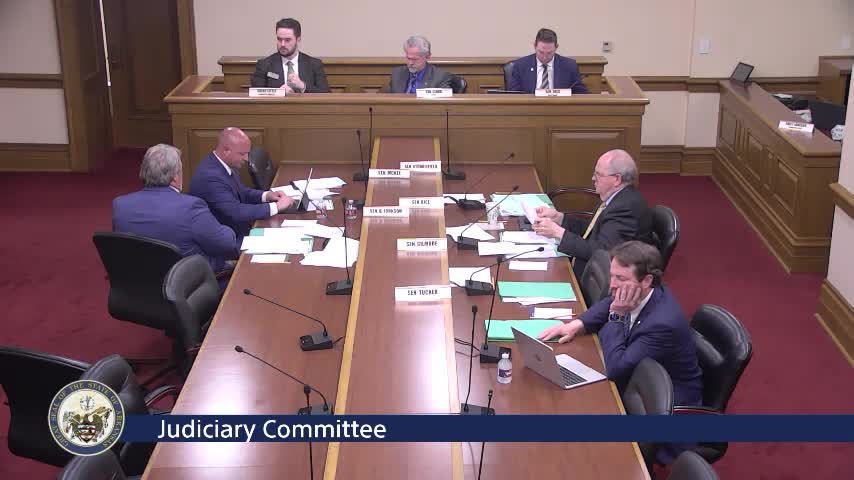
Senate committee approves amendment allowing civil suits over minors' gender-affirming interventions
Summary
The Senate Judiciary Committee passed House Bill 19‑16, an amendment to Act 274 (2023) that allows minors or their parents to sue for damages arising from gender-affirming interventions; testimony from dozens of mental‑health and medical professionals produced sharp disagreement over definitions, scope, and clinical practice.
Representative Mary Bentley, District 54, closed debate in the Senate Judiciary Committee on House Bill 19‑16 and the committee voted to pass the measure. The bill would amend Act 274 (2023) to allow a minor or the minor’s parent to bring a civil claim for injury “including without limitation any physical, psychological, emotional, or physiological injury” caused by a “gender transition procedure, gender affirming intervention, or related treatment,” and extends the statute of limitations to allow suit up to 15 years after the child turns 18.
The bill’s sponsor, Representative Mary Bentley, said the amendment is intended to restore what she called earlier approaches to care and to provide legal remedies for children who, in her view, have been harmed by gender-affirming medical or behavioral interventions. “I want us to return to what works for Arkansas,” Bentley said in closing.
Supporters of the bill and many committee members described the measure as a survivor-protection and malpractice remedy; opponents — including multiple licensed clinicians and medical professionals testifying during the hearing — warned that its language is vague, would expose broad categories of mental‑health practice to litigation, and could further reduce access to treatment in a state with widely reported shortages of behavioral‑health providers.
Why this matters: the bill changes the legal exposure of clinicians and alters the remedies available to minors alleged to have been harmed by gender‑related care, and it would expand the class of defendants beyond physicians to some behavioral‑health providers depending on how courts interpret the statutory language.
Key provisions and disputed points
- Statute of limitations: HB 19‑16 allows a civil claim up to 15 years after a child reaches 18, mirroring the sponsor’s description that it extends the period for bringing suit following a minor’s treatment.
- Definition language: the bill defines “gender affirming intervention” to include “an intervention to support a patient’s identification with a gender opposite of his or her biological ***, including puberty blockers and cross‑*** hormone therapy.” Witnesses repeatedly said the statutory language is broad and leaves unclear what ordinary therapeutic activities (listening, reflective questioning, use of different names or pronouns) would count as a prohibited or actionable “intervention.”
- Standard of liability: committee questioning focused on whether claims under the prior 2023 law and this amendment require proof of professional negligence or impose liability even when care met professional standards. Representative Bentley repeatedly said the amendment is intended to provide a civil remedy for severe, lasting harms; committee members pressed whether the bill creates strict‑liability exposure for clinicians. Bentley answered that harms would be measured by the judge or jury and that she expected proof would be required at trial.
Testimony and concerns from clinicians and medical professionals
Dozens of mental‑health and medical professionals spoke during the hearing. Licensed counselors and psychologists testified they do not prescribe puberty blockers or hormones in Arkansas but said the bill’s current language would nonetheless create considerable uncertainty for therapists about routine therapeutic practices. Josh Garrett, a licensed professional counselor, said the bill’s undefined use of the word “intervention” could make ordinary therapy “intervention” and subject clinicians to suits and ethical dilemmas.
Reverend Gary Cheater, an ordained United Methodist minister and licensed professional counselor who has served on the Arkansas Board of Examiners in Counseling, testified that counselors cannot prescribe medication and that striking lines 27–31 (the definition passage referencing medical interventions) would make the bill more coherent for therapy practice.
Tisha Dean, a clinical psychologist, said the bill would increase liability costs for clinicians and worsen workforce shortages. Lindsey Thomas, a clinical psychologist, and Kirsten Sowell, a licensed clinical social worker, told the committee the bill would deter clinicians from treating minors and urged the committee to oppose or substantially revise the language. Nurse Nikki Boke and other medical witnesses argued that gender‑affirming care is multidisciplinary and that clinical standards emphasize individualized, cautious care; they warned legislative restrictions will not reduce needs but will reduce access.
Questions from committee members
Committee members, including Senator Tucker and others, asked specific questions about whether ordinary therapeutic acts — asking a client’s preferred name or pronoun, reflective listening, documentation of a client’s stated identity — would qualify as an actionable “gender affirming intervention.” Clinicians answered they feared those acts could be construed as interventions under the bill as written.
Other committee discussion addressed the medical literature cited by the sponsor. Representative Bentley asserted statistics and studies supportive of her position; clinicians and other witnesses said the literature is more complex and that the bill’s policy conclusions did not follow from the evidence presented at the hearing.
Final action
After public testimony and the sponsor’s brief closing, the committee took an immediate vote. The chair called for the motion to pass; Senators Johnson and McKee were recorded as the motion’s backers in committee discussion, and the committee announced the motion carried by voice vote. Representative Bentley was told after the vote that her bill had passed the committee.
What the bill does not resolve
The statute does not define limits on which providers are covered or whether out‑of‑state practitioners treating Arkansas minors remotely would be subject to suit; the committee heard that counselors in Arkansas cannot prescribe medications, but the bill text does not explicitly exclude counselors from liability. Witnesses repeatedly asked for clearer, narrower definitions and safe‑harbor language to protect routine therapeutic practices and to clarify the standard of proof and remedies.
Next steps
The committee passed HB 19‑16 and the measure will next proceed according to the Senate calendar for further consideration.
Ending
The hearing lasted through the committee’s scheduled return to session; the chair closed testimony, the sponsor offered brief remarks and asked for “a good vote,” and the committee approved the bill by voice vote. The substantial record of testimony indicates likely follow‑on debate as the bill moves through subsequent stages.