Get Full Government Meeting Transcripts, Videos, & Alerts Forever!
Get email alerts on the Education.governance topic
No spam. Unsubscribe anytime.
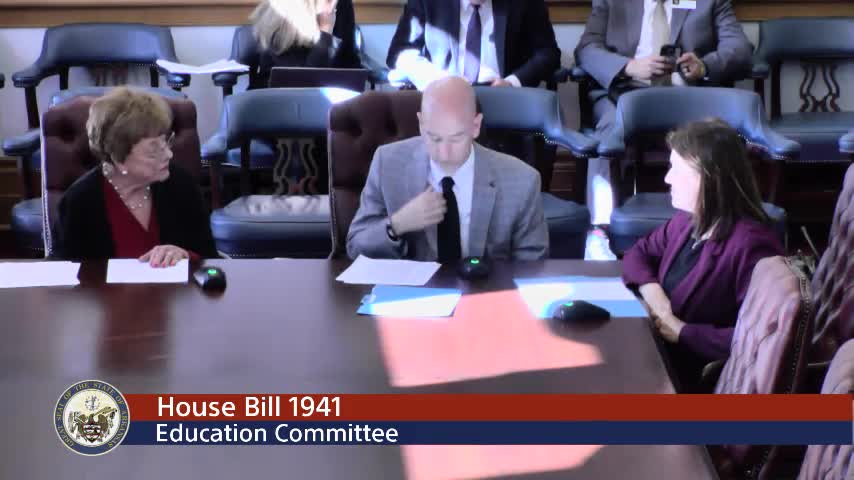
Bill to streamline education boards advances, dissolves inactive panel and sets licensure board terms
Summary
A bill advancing from the Senate Education Committee would establish terms for the Professional Licensure Standards Board, allow electronic complaint filing, dissolve the inactive School Worker Defense Program Board and remove an intermediate appeals board for facilities funding appeals.
Department of Education staff told the Senate Education Committee a bill would change governance for three boards overseen by the department: the Professional Licensure Standards Board (PLSB), the School Worker Defense Program Board, and the Academic Facilities Review Board.
Jacob Oliva of the Department of Education said the PLSB, which handles ethics complaints and violations for licensed teachers, would be given formalized terms for members and the department would permit electronic submission of complaints rather than only hard-copy filings. "This would establish terms for those board members, whereby they have not had terms before. It also ensures that people can submit complaints electronically," Oliva said.
Oliva said the School Worker Defense Program Board has not been operational for many years and that legal questions exist regarding how it was established. The bill would dissolve that board and keep the program's funds available for school employees through department administration.
The bill would also remove the intermediate Academic Facilities Review Board, which heard appeals from the facilities division about partnership funding, and have those appeals go directly to the State Board or commission that has final authority. "Every single appeal we were seeing get elevated up to the commission, and so we just thought it would be more efficient to eliminate that middle intermediate level board," Oliva said.
Committee members asked how many complaints are filed annually and about public access to investigation outcomes. Oliva said "hundreds of complaints" are filed each year, but that not all lead to investigations; an internal committee reviews each complaint to determine whether a formal investigation is warranted. He estimated roughly 80% of complaints are referred for investigation. The committee asked whether settlement agreements or investigation results are public; Oliva said files are confidential unless the matter goes to the State Board of Education, and settlement agreements are kept confidential by law.
Senators requested that the department provide the legal citations and additional data on complaint counts and settlement numbers; an Oliva said the department could provide aggregate counts but that statutory law requires confidentiality of investigative files that do not reach the State Board.
The committee voted to pass the bill by voice vote.