Get Full Government Meeting Transcripts, Videos, & Alerts Forever!
Get email alerts on the Education.school Choice topic
No spam. Unsubscribe anytime.
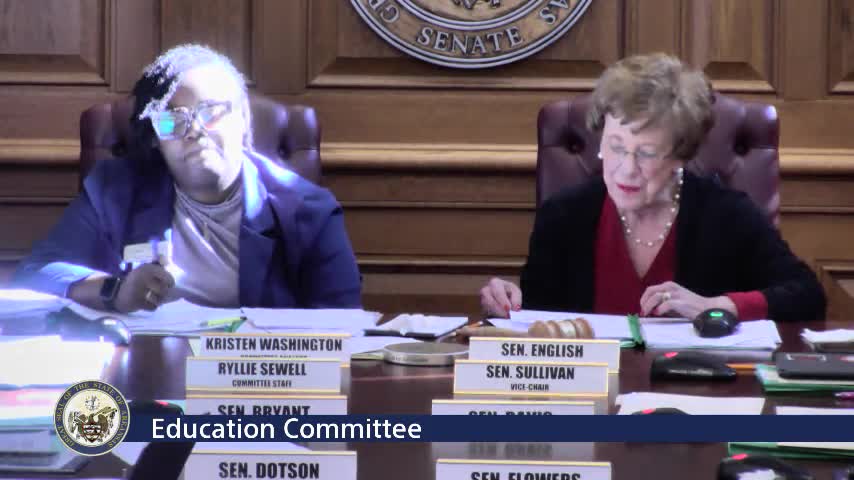
Committee debates changes to Educational Freedom Accounts, including use limits and application window
Summary
Senate debate focused on amendments to Educational Freedom Accounts that change allowable device definitions, cap transportation spending, and shift application deadlines; committee action on the amendment passed but a later roll-call showed insufficient support for final passage in the transcript excerpt.
Senator Bridal Davis (State Senate District 25) presented amendments and led debate on Senate Bill 625, which would change several rules governing Educational Freedom Accounts (EFAs).
Davis described changes that would broaden which public schools may offer EFA-eligible services, clarify that devices used as part of academic modifications (as specified by a clinician) qualify, increase the transportation cap from one-sixth to 25% of the account for certain uses, and extend the application window from March 31 to May 1. She also said the amendment cleans up language around fraud to replace "intends to commit fraud" with stronger wording that an applicant "has committed fraud." "We wanna show that we trust families, but we also value education stewardship," Davis said in closing.
Department of Education staff explained recordkeeping and oversight for EFAs. Courtney Salisbury told the committee that EFAs are administered by an electronic vendor (ClassWallet), individual accounts are established for each approved student, and purchases or tuition payments are routed to vendors or private schools directly. She said the state has upfront records of intended expenditures because families or schools designate vendors or purchases when request funds. Salisbury said the vendor fee is about 1.5% (described in the hearing as approximately 5% of transactions, totaling just under $5,000,000 annually).
Committee members pressed for details on per-student amounts and accountability. A senator said the per-student figure "is somewhere around $7,000 this school year" and noted the EFA amount is approximately 90% of the Foundation funding. Salisbury said participating students are required to take a student assessment (not necessarily the same exact test as public schools) and that the department can deny requests that exceed new caps and seek reimbursement if state rules are violated.
The committee voted to adopt the amendment by voice vote and later recorded a voice vote that produced "Ayes have it." However, a subsequent roll-call sequence in the transcript indicates some uncertainty about final passage: the chair remarked, "K. So we don't have enough votes." The transcript excerpt does not contain a definitive final outcome for the full bill.
Senators asked the department to supply additional information on vendor fees and reporting. Davis said the changes are intended as part of a normal program review to tighten rules after a program's initial rollout.
Because the transcript ends without a clear roll-call final outcome for the full bill, the committee’s action on the amendment is recorded as adopted; the bill’s ultimate committee passage is recorded as not specified based on the provided excerpt.