Get Full Government Meeting Transcripts, Videos, & Alerts Forever!
Get email alerts on the Oil And Gas Royalties topic
No spam. Unsubscribe anytime.
Senate committee advances bill to define ‘net proceeds’ for Arkansas oil and gas royalties after lengthy debate
Summary
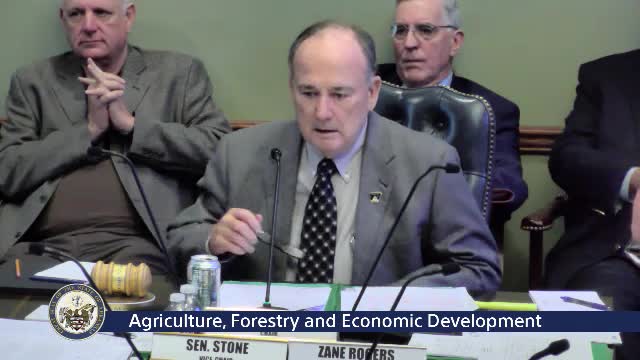
After several hours of testimony from royalty owners, oil and gas attorneys and county officials, the Senate Agriculture, Forestry & Economic Development Committee voted to advance House Bill 16‑56, which would define “net proceeds” under Arkansas law and clarify how the one‑eighth royalty on gas is calculated going forward.
The Senate Agriculture, Forestry & Economic Development Committee voted to advance House Bill 16‑56, which would define “net proceeds” in Arkansas Code § 15‑72‑305 and change how gas royalties are accounted for going forward. The bill drew extensive testimony from royalty owners, oil and gas lawyers and county officials before the committee approved a motion to pass.
Supporters said the bill would remove legal uncertainty created by recent federal litigation and conflicting interpretations of state law. “Net proceeds has no statutory definition,” oil and gas attorney Mark Robinette told the committee, adding that the change is intended to “put a definition on net proceeds” that restores the treatment royalty owners and operators understood before 2019.
The bill’s backers said the change is limited in scope. Robinette told the committee the measure “does not purport to be retroactive. It does not purport to reach back and undo what is already done. It is not here to rewrite private contracts.” He said the bill would treat integrated and private leases differently and would make the operator and royalty accounting clearer going forward.
Opponents, including attorneys for producers, told the committee the proposal risks impairing contracts and could be unconstitutional if applied to preexisting lease obligations. “The law in effect at the time a contract is made forms a part of the contract as if it had been expressed in the contract,” attorney Alan Perkins told the panel, quoting Arkansas case law as part of his argument that the statute as written in 1985 became part of lease obligations.
Royalty owners and local officials described real‑world effects. “The total payout on this was actually the royalty was $386. The net back to that same royalty ... is $178,” said Sen. Jonathan Dismang, reading examples he said show how payments changed after operators altered accounting. Steve Smith, president of the Royalty Owners Association for the Fayetteville Shale, said small royalty owners lack the resources to pursue class actions in state court and described the situation as “a truly a David and Goliath situation.”
The committee heard technical legal arguments about integrated units, deductions “at the well” versus post‑production expenses, and whether federal court rulings interpreting the statute bind state courts. Several witnesses described efforts to keep payments aligned with the wording of privately negotiated leases; others said the absence of a statutory definition left room for costly litigation.
After more than an hour of questions and multiple witnesses on both sides, the committee voted to pass the bill to the full Senate for further consideration. Committee members debated whether the bill would be applied only to payments made after the law takes effect or would affect existing leases; supporters said the intent was to clarify future accounting and “restore” earlier practice, while critics warned of legal challenges.
The committee record shows back‑and‑forth on related matters, including reference to federal cases, Arkansas Court of Appeals decisions and the Arkansas Oil and Gas Commission’s prior rulemaking. Committee members repeatedly asked whether the measure would create retroactive liability; sponsors said it was designed to clarify the statutory term going forward and not to rewrite private leases.
The bill’s passage from committee does not resolve the outstanding legal disputes; several witnesses said litigation is likely to continue in state and federal courts if the law changes. The bill now moves to the full Senate, where senators will have further opportunity to debate the measure and any amendments.