Get Full Government Meeting Transcripts, Videos, & Alerts Forever!
Get email alerts on the Postpartum Medicaid Extension topic
No spam. Unsubscribe anytime.
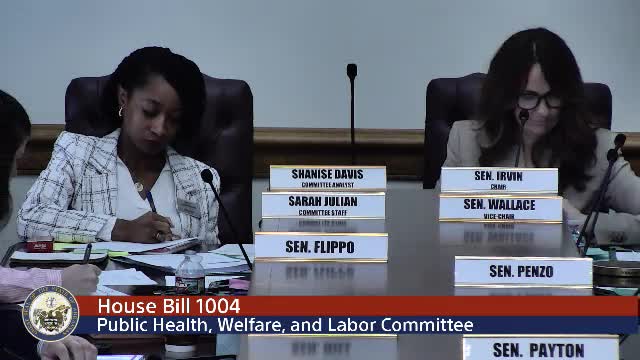
Senate committee rejects targeted bill to extend postpartum Medicaid coverage to 12 months
Summary
A Senate Public Health, Welfare and Labor Committee discussion on House Bill 1004—targeted 12‑month postpartum coverage using CHIP funds—drew extensive public testimony and a fiscal debate; the committee voted the bill down after members voiced fiscal and eligibility concerns.
State Sen. Brandi Davis introduced House Bill 1004, a narrowly tailored measure to extend postpartum Medicaid coverage to 12 months for a subset of women who currently fall between 138% and 209% of the federal poverty level and are not eligible for Arkansas Works, proposing to use CHIP funding as the match.
The bill’s sponsor described the measure as a companion to the ongoing statewide 12‑month postpartum coverage effort, aimed at covering women who “fall through the cracks” after the current 60‑day postpartum Medicaid period.
The measure drew more than a dozen public commenters for and against during the committee’s two‑minute public‑comment slots. Supporters included perinatal mental‑health clinicians, representatives of maternal‑health nonprofits, recovery‑services providers and mothers who described losing coverage shortly after childbirth. Speakers cited clinical evidence that perinatal mood and anxiety disorders can begin or persist through 12 months postpartum and said abrupt coverage loss can interrupt essential mental‑health and substance‑use treatment.
Department of Human Services (DHS) witnesses and fiscal staff opposed the bill in committee testimony, saying Arkansas has a separate statewide Healthy Moms, Healthy Babies effort already under implementation and that HB1004 would add a material fiscal impact. DHS testified the bill’s “total computable” fiscal effect would be approximately $11 million, with an estimated state share under the regular match around $2.7 million and roughly $2.3 million if CHIP funds were used to reduce the state share. DHS staff also said their quarterly reports show a large share of women who lose postpartum coverage are non‑U.S. citizens and that some of those women have incomes above 138% of the federal poverty level.
Committee members asked DHS to explain the scope of current pregnant‑women Medicaid benefits (which DHS said were expanded in 2023 to include full Medicaid benefits) and whether the bill’s extension would be general Medicaid or pregnancy‑related services (DHS answered that the pregnant‑women category now includes the full range of Medicaid benefits). Sponsors and supporters said the bill intentionally avoids duplicating coverage and relies on already‑used CHIP funding under the unborn‑child option (initially adopted in the state plan in February 2004) to extend the postpartum window from 60 days to 12 months for the targeted group.
After public comment and sponsor closing remarks — during which the sponsor said the state could limit eligibility in the state plan amendment to exclude noncitizens if desired, reducing state costs — the committee took a voice vote. The chair called for ayes; when asked for opposing votes the negative side spoke and the chair announced, “The bill fails.” No roll‑call tally was entered into the hearing record.
Votes and outcomes
Motion: “Motion do pass” (sponsor closing) Outcome: failed (committee voice vote; no roll‑call tally recorded)
Fiscal and program details clarified in committee
• DHS fiscal testimony: total computable ≈ $11,000,000; state share ≈ $2,700,000 regular match; ≈ $2,300,000 if CHIP matching structure used. • DHS report cited in testimony: about 905 women in the category losing postpartum coverage; DHS said roughly 38% of women losing coverage in that report were non‑U.S. citizens. • DHS described the pregnant‑women Medicaid category (expanded January 1, 2023) as covering the full range of Medicaid benefits, not limited to pregnancy‑related care.
Why it matters
Supporters framed the bill as filling a coverage gap that can result in untreated postpartum mental‑health issues, worsening maternal outcomes and, in some testimony, loss of life. Opponents and fiscal staff focused on the bill’s incremental cost and the interaction with ongoing statewide maternal coverage expansions already being implemented by the executive branch.
The committee’s rejection leaves the broader statewide 12‑month postpartum expansion under the governor’s package and related administrative actions as the ongoing path the legislature and executive are using to expand maternal coverage; sponsors said they may pursue state plan language to address eligibility questions raised in the hearing.