Get Full Government Meeting Transcripts, Videos, & Alerts Forever!
Get email alerts on the Building Codes topic
No spam. Unsubscribe anytime.
Committee backs House Bill 1991 to exempt some rural developments from sprinkler requirement
Summary
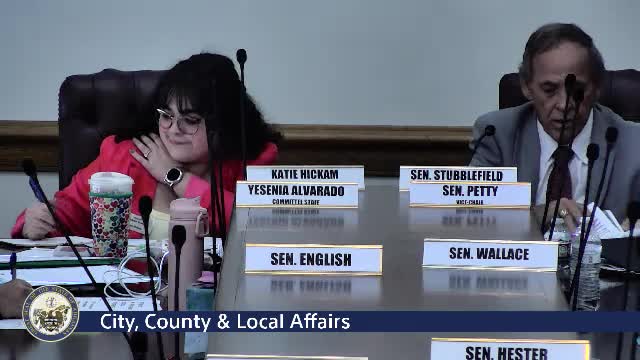
The City, County & Local Affairs Committee — Senate gave House Bill 1991 a do-pass recommendation after Rep. Paul Childress said the bill would exempt certain rural developments from a state fire-code sprinkler requirement when a property has only one access road.
The City, County & Local Affairs Committee — Senate voted to give House Bill 1991 a do-pass recommendation after Representative Paul Childress (R–District 83) described the bill as an exemption to the current state fire code for certain rural developments.
Childress told the committee the current fire code requires sprinkler systems for developments that have only one entrance once a development reaches 30 houses, regardless of acreage. He said sprinkler systems can cost up to about $6 per square foot. Childress said the requirement is generally enforced only if someone notifies the fire marshal; otherwise, the code is not routinely enforced.
Under the bill, rural landowners outside city limits could build more than 30 homes on a single-access property without adding a second entrance or installing sprinklers. The bill explicitly excludes land inside municipal boundaries. Childress said he had witnesses available — a real estate agent and a home builder — and the County Judges Association told the committee it supports the bill.
Committee members had a short exchange and there was no recorded public opposition. Miss Shorter closed the presentation for the sponsor. A committee member moved that the bill receive a do-pass recommendation; another seconded. The chair called a voice vote and announced the bill passed. The transcript does not include a roll-call tally or the full names of the motion’s mover and seconder.
The measure will advance from committee; the transcript does not specify next steps or implementation timelines for the exemption in the state fire code.