Get Full Government Meeting Transcripts, Videos, & Alerts Forever!
Get email alerts on the Budget Compensation topic
No spam. Unsubscribe anytime.
Richardson ISD trustees review three compensation scenarios and favor a more aggressive pay framework
Summary
Board members were presented three salary/benefit scenarios for 2025–26, told of potential costs and health‑benefit impacts, and the discussion ended with trustees coalescing around a more aggressive scenario labeled 'Scenario 3' though no formal vote was taken.
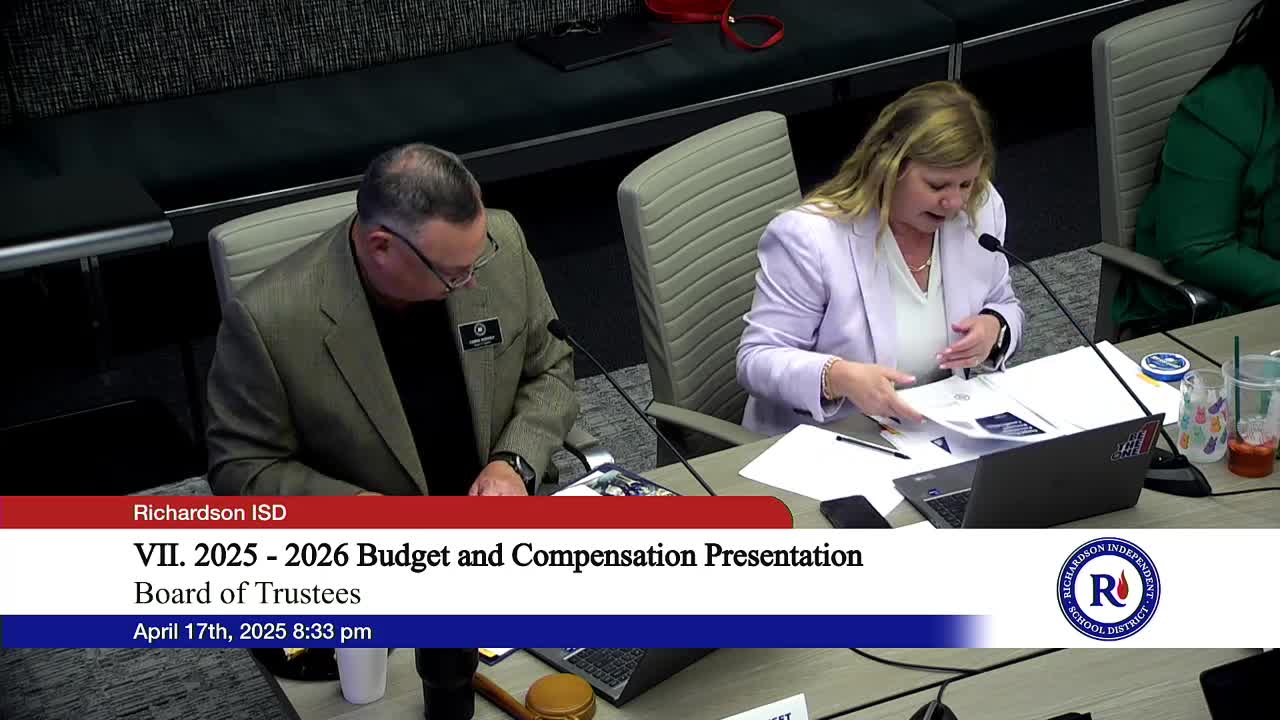
Trustees of the Richardson Independent School District received a detailed budget and compensation briefing during the April work session that outlined three pay scenarios for 2025–26, the staff’s assumptions for health‑insurance contributions and benefits, proposed new positions (including special‑education and pre‑K personnel), and the legislative uncertainty that could alter revenue available for raises.
District staff presented three main scenarios for teacher and staff compensation. Under the first scenario, the district would apply an across‑the‑board 2.5% increase for most employees and set a new starting teacher salary example at about $61,700. The second scenario modeled a 3% increase for teachers and a comparable increase for non‑teacher staff, with a new starting teacher salary near $62,000. The third scenario shifted strategy to raise salary schedule steps such that starting pay could be roughly $63,000 in that model; staff described this third option as a more aggressive market adjustment. Staff cautioned that these are modeling scenarios and said, "we are not making an official recommendation today," noting the proposals are for trustee feedback.
Cost and benefits implications: presenters walked through several cost drivers trustees should consider if they choose higher pay or higher employer contributions to health care. Staff said increasing employer health‑insurance contribution from $313 to $350 per month would cost about $1.8 million annually; a $375 monthly contribution would cost about $2.9 million; and staff also stated that each 1 percentage‑point change in a particular projection was roughly $3.4 million across the district. The presentation included an example showing that, if the district received an additional $24 million in state revenue, an illustrative model could raise certain veteran teacher salaries to the $73,000 level; staff emphasized that such revenue is not guaranteed and depends on the Texas Legislature.
Positions and compliance: the briefing listed specific additions and compliance priorities: new central education professionals for special education, expansion of pre‑K (including a Child Learning Academy), and staffing tied to program expansions. Staff identified $5.6 million in positions tied to bilingual teachers and other expansions and noted some one‑time reductions from vacant positions and efficiency measures already taken.
Legislative and retirement system considerations: staff explained that ongoing uncertainty in the current legislative session affects available revenue and pointed to the Teacher Retirement System (TRS) and pending state rules on contribution limits as additional variables that could affect district costs.
Trustees’ response: trustees and board members generally framed the conversation as a retention and competitiveness issue. Multiple trustees expressed support for a more assertive approach; after deliberation one trustee summarized the board’s sense when they said on the record, "Escenario 3, ese gana. Va ganando el escenario 3." The transcript records no formal motion or roll‑call vote adopting a compensation plan at this meeting.
What’s next: staff will continue to refine numbers, monitor legislative developments and return to the board with updated figures ahead of the district’s formal budget adoption timeline. Trustees asked staff to prioritize retention of experienced teachers while weighing equity and system affordability.