Get Full Government Meeting Transcripts, Videos, & Alerts Forever!
Get email alerts on the State Land Oreo Grande topic
No spam. Unsubscribe anytime.
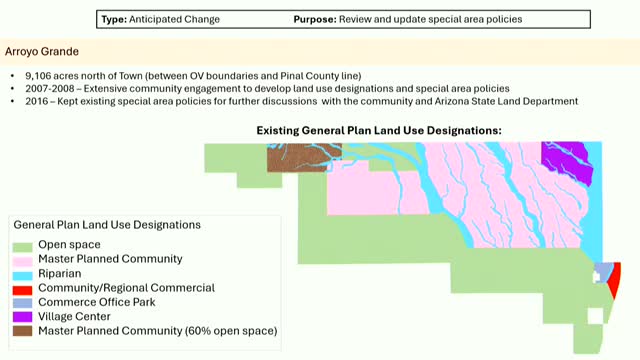
Staff recommends no changes now to 9,000-acre 'Oreo Grande' state land in Oro Valley plan
Summary
Planning staff told the working group the town should not update the general-plan special-area policies or land-use designations for the roughly 9,000-acre state-owned area north of Oro Valley until any annexation or state-led negotiation begins and broader public engagement occurs.
Oro Valley planning staff advised the resident working group not to amend the general-plan land-use designations or special-area policies for the roughly 9,000-acre state-owned tract north of town known in the meeting as "Oreo Grande." Staff said the property has been shown on the town's general plan since at least 1990 and that any change would require coordination with the Arizona State Land Department and broad community engagement.
"We are recommending no changes be made right now to the special area policies or land use designations because it really does need to be a very thorough community engagement process," Melanie, a planning staff member, told the group.
Staff said the state land sits mostly in Pima and Pinal counties and that the town cannot apply zoning until such land is annexed. Participants discussed that state land negotiations typically involve concurrent discussions about annexation, zoning and municipal services such as water. Staff said past interactions with the Arizona State Land Department resulted in the current designations and any future changes would require renewed negotiation.
Working-group members asked whether existing special-area policies contain items that would be inconsistent with today's Oro Valley standards. Staff said nothing in the current policies immediately jumped out as out of alignment but that a future, serious annexation discussion would require re-examination.
No formal decision was recorded at the meeting; staff recommended waiting until the state or an owner-led process brought the parcel forward for annexation or rezoning and noted the matter would require an intensive public process when it occurs.