Get Full Government Meeting Transcripts, Videos, & Alerts Forever!
Get email alerts on the Planning Work Plan topic
No spam. Unsubscribe anytime.
Carbondale planning commission outlines 2025 work plan priorities: ADUs, parking, landscapes and setbacks
Summary
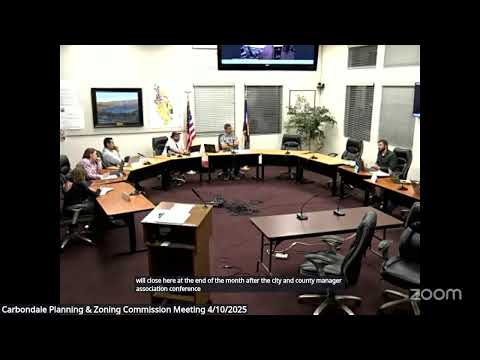
The Planning and Zoning Commission on April 10 reviewed its draft 2025 work plan ahead of a May 20 trustees'work session. Commissioners prioritized revising accessory-dwelling-unit rules and pursuing a targeted parking-code review, and asked staff to prepare materials on ADU options and the landscape-code changes required by upcoming state law.
The Carbondale Planning and Zoning Commission on April 10 reviewed and prioritized its 2025 work plan, which the commission will present to the Board of Trustees at a May 20 spring work session.
The commission identified four primary topics for the year: parking requirements, accessory-dwelling-unit (ADU) regulations, landscape requirements (including state-law-driven changes), and building setbacks along Highway 133.
Commissioners agreed ADU regulations and parking requirements should be the earliest priorities. Staff said ADU work would focus on whether to permit detached ADUs in more zones, whether to relax review processes for low-impact ADUs, and how to limit short-term-rental conversions of ADUs so the units serve long-term housing goals. Jared (planning staff) summarized the current affordable-housing thresholds the town adopted in November: a small development example provided by staff said a four-unit project would require 25% resident-occupancy restriction and no price-capped units, while a 10-unit project would require both 25% price-capped and 25% resident-occupancy-restricted units (staff confirmed applicants should address affordability at annexation or rezoning).
On parking, commissioners proposed a short, targeted request for qualifications (RFQ) for an outside consultant to analyze the town's code, compare Carbondale to similar mountain communities, and recommend whether parking ratios can be reduced or better tailored by zone and by specific streets or event-driven needs. Commissioners stressed the analysis should be a brief technical review rather than a long empirical survey, though several suggested that follow-up observational data collection could be useful at a later stage.
Landscape-code work is partly driven by changes to state law that will restrict local authorities'ability to require certain turf or irrigation practices. Staff said they will inventory where the current UDC provisions will no longer be enforceable and bring options back to the commission for replacement standards (e.g., native plantings, hardscape alternatives).
Commissioners asked staff to prepare briefing materials and to begin drafting an RFQ for a focused parking/code analysis; commissioners also requested a staff memo summarizing where detached ADUs are prohibited by zone, where deed-restrictions or PUD rules would prevent ADUs, and a summary of recent ADU approvals (to the extent records exist). Staff said data limitations may leave some historical ADU approvals incomplete, but they will return with as much objective permitting information as is available.
Next steps
Commissioners agreed to deliver short bullet-point inputs for the planned RFQ and to meet with staff in follow-up sessions before the May 20 trustee work session. Staff flagged that landscape-code changes driven by state law will need attention this year regardless of the commission's other priorities.