Get Full Government Meeting Transcripts, Videos, & Alerts Forever!
Get email alerts on the Zoning Development Permits topic
No spam. Unsubscribe anytime.
Woodland Park planning commission reviews zoning development permit updates, flags notice and inspection language
Summary
At an April 10 work session, the Woodland Park Planning Commission and staff reviewed proposed revisions to zoning development permit (ZDP) rules, discussing public notice, application completeness, bedroom/fixture inspections tied to water taps, and where review authority and appeals language should sit in the new Unified Development Code.
The Woodland Park Planning Commission on April 10 reviewed proposed changes to the city's zoning development permit provisions, with staff saying the draft aligns closely with existing code but needs clarifications on public notice, application completeness, inspection authority and references to the common review procedures.
Planning Director Karen Schmink told the commission that the work session had been noticed in print but that the online agenda posting was incomplete, saying, "It showed up in the March 26 courier. But last week, we did not get the agenda posted online ' ... It's not as clear and robustly noticed as ideal, but the fact that we're at a work session, I'm willing to risk it." The commission continued the review rather than postponing the work session to a later date.
Commissioners and staff focused on three practical topics: (1) where to keep duplicate procedural language, (2) a standard completeness check for applications, and (3) the code language describing inspections used to confirm bedroom and water fixture unit counts that affect water tap and fee calculations.
The draft ZDP language repeats decision-authority wording that already appears in section 6.02 (the city's common review procedures). Several commissioners and staff recommended keeping the consolidated approval/appeals language in the centralized common review procedures rather than copying it verbatim into each permit-specific section to avoid drift and contradictions over time. As one staff member summarized, the approval table in 6.02 and the "approval authorities" table are the canonical source to show which decisions the planning director makes and which appeals go to the Board of Adjustment.
On application completeness, commissioners supported adding an explicit requirement that a "completed application and filing fee" be submitted; staff noted that completeness review is already implemented under the common review procedures but agreed it should be clearly referenced in each application checklist so applicants know what triggers a stoppage in processing.
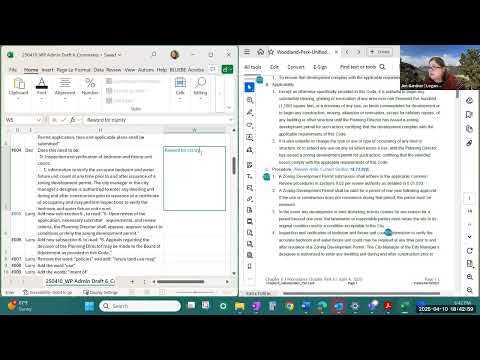
A lengthy discussion centered on inspection authority to verify bedroom counts and water fixture units. Those counts affect water tap fees and other utility charges. After back-and-forth wording edits, commissioners and staff agreed to revised text that makes the city's right to inspect explicit. Planning Director Schmink spoke for the final formulation: "inspection and information to verify the accurate bedroom and water fixture unit count is required and may occur at any time prior to and after the issuance of the zoning development permit." The commission discussed whether the city should be required to inspect every project or whether the code should state that inspections can occur as needed; staff and commissioners agreed the language should preserve inspectors' flexibility while making the requirement clear when it applies.
Other clarifications the commission asked staff to address before legal review included: cross-references to the comprehensive plan consistency language (use a single phrasing across the UDC), removing duplicated "approval/appeal" text that already sits in 6.02, and ensuring references to the city's TAP management program and water-availability ordinance are updated after those pending ordinances complete council review.
What happens next: staff will produce a consolidated clean draft that reduces duplicated procedural text, incorporates the agreed inspection language and completeness references, and then distribute that version for the working group's review before legal review and public hearings. The planning director asked commissioners to submit detailed comments through the Conveio review tool so the consultant can consolidate them efficiently.
Ending: The commission did not take any final vote at the April 10 work session; the revised ZDP language will return in the consolidated draft and later public hearings for formal recommendation and possible ordinance adoption.