Get Full Government Meeting Transcripts, Videos, & Alerts Forever!
Get email alerts on the Neighborhood Safety topic
No spam. Unsubscribe anytime.
Resident asks Lafayette to resolve ’orphan lot’ fence and golf-course safety issue in Indian Peaks
Summary
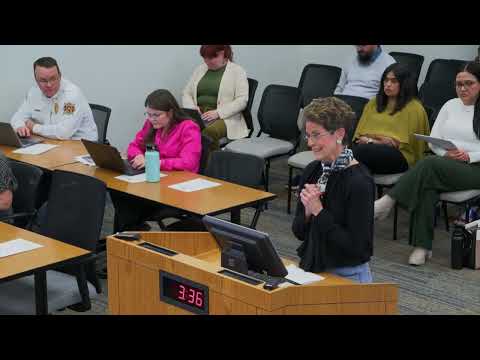
A resident of Indian Peaks asked the Lafayette City Council on April 15 to investigate an ‘orphan lot’ whose failing perimeter fence—required by the subdivision’s PUD—now poses a safety risk between homes and the golf course.
A resident of Indian Peaks asked the Lafayette City Council on April 15 to investigate an unclaimed parcel where a deteriorating split-rail fence that was required by the neighborhood PUD is now failing and poses a safety hazard.
Barbara Padden (spoke as president of the Indian Peaks Master Association) told council that the perimeter fence required by the Indian Peaks Filing 14 planned unit development (PUD) has fallen into disrepair after three decades and that an adjacent parcel was never deeded out of the original developer’s ownership. Padden said McStain (the developer named in her remarks) retained the lot and—after the developer’s bankruptcy—the parcel was not conveyed to the association and now apparently has no clear owner, which she described as an “orphan lot.”
Padden said the golf course management wants a physical barrier between the fairway and the lot to prevent golf balls and public entry during play, while neighbors want the deteriorating fence removed for safety. But Padden said the fence cannot be removed without trespassing, and other legal options her association consulted—such as reopening the bankruptcy or placing a city lien to obtain the parcel—appear expensive or complex.
She told council that planning staff (Melissa Berry) and planner John Hoffman have advised that the fence’s location does not match the approved PUD map and that fully removing the fence would require a PUD amendment. Padden asked council to ask the city attorney and planners to examine options, including whether the city could acquire or condemn the parcel if it is truly abandoned.
Why it matters: The resident framed the matter as a persistent neighborhood safety issue tied to long-ago development approvals, property ownership gaps following bankruptcy, and the limits of homeowner association authority on land they do not own.
City staff references and next steps: Padden reported conversations with planning staff and a follow-up e-mail from staff that confirmed the fence is an element of the approved Indian Peaks Filing 14 PUD but that the installed fence is in a different location than shown on the PUD documents. She asked council to direct the city attorney and planners to investigate possible remedies; council indicated staff follow-up would be provided by e-mail or during council comments.
Quotes: “I am asking you all to step in, look into the situation, please ask the city lawyer and the planners what could possibly be done to remedy the situation,” Padden said. “I don't know anything about condemning properties. But I would think since this property is abandoned, there are no owners and has a falling down dangerous fence, that possibly the city could, you know, call it abandoned and take over the ownership of it.”
Ending: Council closed public input and indicated staff would follow up; Padden requested the city pursue legal and planning options to resolve the safety and ownership questions or report back with next steps.