Get Full Government Meeting Transcripts, Videos, & Alerts Forever!
Get email alerts on the Museum Lease topic
No spam. Unsubscribe anytime.
City approves 20-year no-cost lease and MOU with Lafayette History Museum
Summary
The Lafayette City Council on April 15 approved on first reading a 20-year, no-cost full-service lease and a memorandum of understanding with the Lafayette History Museum for 108 East Simpson Street; both measures passed unanimously and will return for second reading May 6.
Lafayette City Council on Tuesday approved on first reading a 20-year, no-cost full-service lease and a memorandum of understanding (MOU) with the Lafayette History Museum covering the city-owned property at 108 East Simpson Street.
The lease (Ordinance No. 7, Series 2025) establishes a 20-year term with a 10-year extension option. Under the agreement the city will maintain the building and its structural systems; the museum, a 501(c)(3), will remain responsible for exhibits and contents and will maintain liability insurance for its operations. The council also approved an accompanying MOU describing operational coordination, programming expectations and periodic reviews of the partnership.
The MOU is framed as a non‑binding guide to collaboration: it outlines communications between city staff and the museum, expectations for joint programming and historic interpretation, and commitments to support grant applications. City staff said the MOU will be reviewed every two years and the lease will return for second reading on May 6.
Why it matters: The museum has occupied the building since 1976 and reported roughly 3,400 visitors and more than 400 schoolchildren in 2024. Council and staff described the formal agreements as a way to modernize a long-standing, informal operating relationship, clarify maintenance responsibilities for a small, aging building, and preserve a local institution that provides historical context for city projects.
City staff said the building receives approximately $10,000 a year in city-funded maintenance and utilities; major capital work is prioritized in the city’s facilities process. Staff confirmed the city will continue to insure the structure while the museum insures its exhibits and operations.
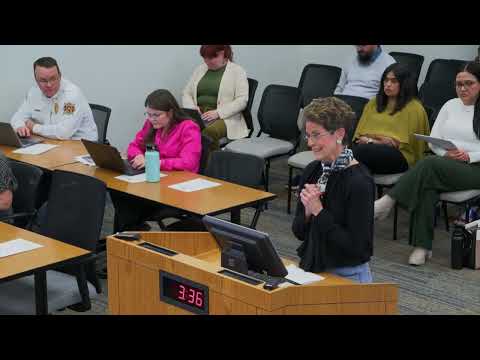
Museum leaders and city officials told the council the formal lease and MOU are intended to enable longer-term planning, including improved storage and climate-controlled space for the museum’s growing collection. Lee Campbell Hill, president of the museum board, told council members the organization hopes to eventually consolidate artifacts under climate-controlled conditions so more materials can be preserved and made available for research.
Council members asked how the city would respond if a major, unforeseen building repair were required. Deputy City Manager (unnamed in the record) and city legal staff said the lease includes termination and relocation provisions should the structure become uninhabitable; capital repairs would be prioritized through the city’s regular budgeting process.
The council voted to approve the lease on first reading and to authorize the mayor to sign the MOU; both votes passed unanimously. The lease will return for second reading at the council’s May 6 meeting.
Quotes: “We rely on the history museum to be our partner in researching and sharing local history,” the Deputy City Manager said during the presentation. Chelsea Pennington Pahn, the museum director, told council members the museum is expanding its exhibits and collections and is working to inventory roughly 5,000 objects. Lee Campbell Hill said the museum hopes the formal agreement will help secure better, climate-controlled storage so artifacts donated now can be properly preserved.
Next steps: The lease will appear on the May 6 agenda for second reading. The MOU will be implemented via annual check-ins between the city and museum and by regular programming coordination.
Ending: Councilors and museum leaders framed the action as a formalization of a long-standing relationship rather than the start of new financial commitments: city funding for the museum remains subject to annual appropriations and the MOU does not itself guarantee future funding.