Get Full Government Meeting Transcripts, Videos, & Alerts Forever!
Get email alerts on the Elections topic
No spam. Unsubscribe anytime.
Richardson mayoral, council candidates debate housing, taxes, DART, drones and transparency at League forum
Summary
Incumbent Mayor Bob Dubey and challenger Amir Omar squared off at a League of Women Voters forum, joined by council candidates Lisa Marie Kupfer and Arifin Samsel, who discussed internships, charter review transparency, housing affordability, DART funding and commercial drones. Uncontested council members introduced themselves at the event.
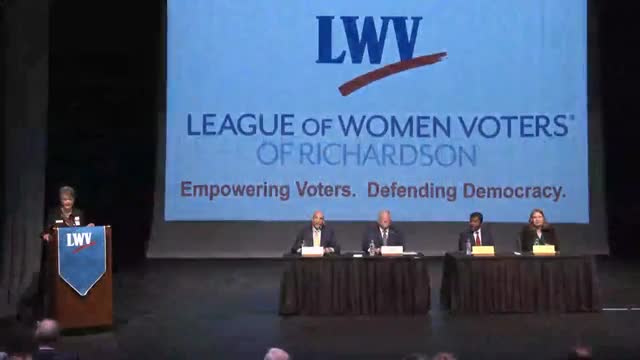
A League of Women Voters of Richardson candidate forum drew mayoral and city council contenders to the stage to outline priorities on housing affordability, public-safety funding, transit and city transparency ahead of the May ballot.
The highest-profile matchup brought incumbent Mayor Bob Dubey and challenger Amir Omar into repeated contrast over the role of the mayor and how the city should respond to economic and planning challenges. Dubey described the office as “a leadership role” and repeatedly invoked his record of lowering taxes and expanding programs for seniors. Omar said the mayor should be “proactive” and pushed for greater transparency, more aggressive economic development outreach and restoring a city-sponsored summer internship program for all Richardson residents.
The forum was moderated by Lynette Greenhaw and hosted by Ellen Steger, president of the League of Women Voters of Richardson. The event included answers from the two mayoral candidates and two candidates for city council Place 6, current Council Member Arifin (Arfin) Samsel and challenger Lisa Marie Kupfer, plus brief remarks from uncontested council members who will also appear on the May ballot.
Why it matters: Richardson officials and candidates said decisions on tax policy, office occupancy and transit funding affect the city’s revenue and its capacity to maintain services. Candidates framed competing approaches to those decisions — one emphasizing stewardship of existing budgets and the other emphasizing research-driven incentives and outreach to attract employers.
Major positions and exchanges
Internship program: Amir Omar said he would “absolutely” reinstate a city-run mayor’s summer internship program, arguing the city should ensure opportunities for students attending Plano ISD, private schools and homeschoolers as well as Richardson ISD students. Dubey said the program was “enhanced” into a multi-semester RISD initiative that increased student participation and noted the school district funds the program; he said the city also added mayoral shadowing opportunities.
Charter review and meeting transparency: Omar called for more openness in the Charter Review Commission process and broader recording of commission and board meetings so residents can review deliberations after the fact. He said he would push for job descriptions and a scoring rubric for appointments to boards and commissions. Dubey said he trusts the commission process and noted that any recommended changes would go to voters; Kupfer and Samsel also urged deference to the commission and voter approval of charter changes.
Housing and affordability: Candidates agreed Richardson has limited developable land. Samsel emphasized fiscal restraint and said the city must prioritize spending; Kupfer highlighted “missing middle” housing types and accessory dwelling units as ideas to explore. Dubey pointed to repurposing Class B office space and encouraging townhomes or other multifamily types near transit to increase housing options while “protect[ing] the integrity of our neighborhoods.” Omar warned against allowing apartment development that departs from adopted plans and said he would rely on housing studies and expert recommendations.
Homestead exemption and taxes: Candidates differed on immediate solutions. Omar said he favors researching homestead-exemption options used regionally before proposing policy and would form research teams to evaluate fiscal impacts. Dubey emphasized that the council has reduced the tax rate in recent years and pointed to expanded senior exemptions (candidates cited different figures: Samsel said the senior exemption rose from $100,000 to $160,000; Dubey said the current senior exemption is $165,000). Omar said he would study best practices before proposing a program that would not endanger the city’s budget.
DART and regional transit: Candidates broadly supported DART but disagreed on what constitutes an adequate defense of current funding. Dubey urged patience until the Silver Line is operational and cited Richardson’s regional transit investments. Omar said support should be paired with concrete plans to activate stations with places to live, work, shop and be entertained; several candidates noted the long time horizon for full transit benefits.
Downtown and economic development: Candidates described competing approaches for Downtown Richardson and City Line. Dubey highlighted recent investments including Interurban Park and events such as the Lunar New Year and Light Up Lockwood; Kupfer and Omar said the city should concentrate on amenities—retail, entertainment and office space—that draw sustained visits rather than allowing unplanned apartment development to replace potential destinations. Omar said City Line decisions that allowed apartment conversions reduced options for entertainment and retail.
Commercial drones: The candidates expressed caution. Omar said he opposed commercial drone operations over residential areas, citing safety and limited regional precedents. Dubey said the city has no control over airspace and would require demonstrations and noise evaluations before decisions. Kupfer said she would weigh public-safety implications, noting municipal drone use for first-responder operations.
Boards, commissions and appointments: Several candidates advocated clearer, more predictable processes for appointing members to boards and commissions. Omar proposed published job descriptions and a rubric for selections; Dubey said the city follows charter guidelines and seeks geographic balance across places; Kupfer urged more appointments of women to quasi-judicial boards.
Public-comment, turnout and logistics: League president Ellen Steger reminded the audience that all candidate responses were unedited and that voters could find additional answers online at vote411.org. She noted 75,000 registered Richardson voters and cited 7,000 voters in the 2023 mayoral election as a turnout example.
What candidates emphasized about leadership
Dubey repeatedly framed his tenure as steady stewardship: “As a leader, I think it’s really important…that you don’t step out of your lane,” he said, describing the mayor as “the face of the city.” Omar emphasized active, project-oriented leadership and described prior experience securing corporate sponsorships to fund city programs; he said the mayor should “be proactive” and take concrete steps to deliver programs and economic development results.
No formal actions were taken at the forum; the event was a platform for candidates to present positions and for uncontested councilmembers to introduce themselves to voters. Candidates were asked to limit answers to 90 seconds and to abide by forum ground rules prohibiting personal attacks and interruptions.
Speakers and appearances
The moderator was Lynette Greenhaw. Mayor Bob Dubey and Amir Omar debated the mayoral role; council candidates on stage included incumbent Arifin Samsel and Lisa Marie Kupfer. Uncontested council members who introduced themselves included Curtis Dorian (Place 1), Jennifer Justice (Place 2), Dan Barrios (Place 3) and Ken Hutchenrider (Place 5). Allen C. North, who appears on the ballot in a May mayoral position, did not attend and the League announced his absence.
Looking ahead
Candidates will appear on the May ballot; the League urged voters to consult printed and online voters guides for extended candidate answers. Forum remarks did not produce council or charter decisions; several candidates said they would seek more research or public engagement before proposing binding policy changes.