Get Full Government Meeting Transcripts, Videos, & Alerts Forever!
Get email alerts on the Police Use Of Force topic
No spam. Unsubscribe anytime.
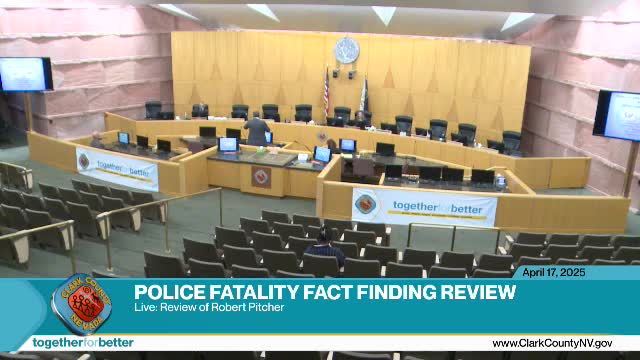
Clark County holds public fact-finding review after officers fatally shoot Robert Pitcher
Summary
Mandy McKellar, the presiding officer, opened the Clark County police fatality public fact‑finding review by saying, “This is not a trial,” and explaining the hearing was required after the Clark County District Attorney’s Office made a preliminary determination that no criminal prosecution of officers involved in the death of Robert Pitcher is appropriate.
Mandy McKellar, the presiding officer, opened the Clark County police fatality public fact‑finding review by saying, “This is not a trial,” and explaining the hearing was required after the Clark County District Attorney’s Office made a preliminary determination that no criminal prosecution of officers involved in the death of Robert Pitcher is appropriate.
The review, presented by Chief Deputy District Attorney William Flynn and led in evidence by Detective Gilberto Valenzuela of the Force Investigation Team (FIT), laid out investigators’ timeline, body‑worn camera (BWC) video, crime‑scene photos and the autopsy finding that the cause of death was “multiple gunshot wounds” and the manner of death was ruled homicide by the Clark County coroner.
Why it matters: Clark County Ordinance Chapter 2.12 requires a public review when the district attorney preliminarily declines prosecution in a police‑involved death. The hearing offered the public the factual record compiled by FIT and gave the ombudsman appointed to represent the public and the family an opportunity to question investigators.
Detective Gilberto Valenzuela, the FIT case agent, summarized the scene and the evidence. The shooting occurred at a driveway/alley behind townhomes near Seaton Place and Edgemoor Way, south of Chaparral High School in Las Vegas, Clark County. Fitz investigators said officers responded to a call from family members reporting that Pitcher was in distress and armed with a knife; the call to dispatch was recorded at about 2:55 a.m.
Valenzuela said Officer Kyle Corso (hired Feb. 2021, Southeast Area Command) fired eight lethal rounds from a Glock 17 and also fired a low‑lethality Remington 870 shotgun loaded with beanbag rounds (10 rounds). Officer Philip Din (hired Apr. 2021, Southeast Area Command) fired six lethal rounds from a Glock 17. Officer Oscar Nuno Reynoso (hired Feb. 2021, Southeast Area Command) fired three lethal rounds. FIT’s counts came from documented weapon “countdowns,” BWC review and scene evidence.
Valenzuela described deployment and sequence: the first arriving officer located Pitcher around 3:40 a.m.; officers formed “north” and “east” incident action teams to contain the area; low‑lethality beanbag rounds and taser cartridges were used starting around 3:46 a.m.; shots were reported at about 3:47 a.m.; officers placed Pitcher in custody at about 3:49 a.m.; medical personnel continued life‑saving measures and Pitcher was pronounced deceased at about 4:19 a.m. The coroner’s autopsy was completed Nov. 26, 2023, and identified multiple gunshot wounds as the cause of death.
FIT presented BWC clips and stills from multiple officers. Valenzuela acknowledged that Officer Corso’s BWC view was largely obscured by a jacket, but that other officers’ cameras captured the sequence. The review included crime‑scene photographs showing spent beanbag rounds, spent shotgun shells, taser cartridges and the kitchen knife investigators say Pitcher carried; forensic testing identified blood on the knife as Pitcher’s.
Family members who spoke to investigators (identified in FIT materials as FM and DM) told detectives they had tried to get Pitcher help for depression after his son’s death and that on the morning of the incident they found a kitchen knife missing and called police when they feared he might hurt himself. FM told detectives Pitcher had grown more depressed after his son’s funeral; DM described Pitcher as “suicidal and acting strange and erratic.” These accounts were presented as witness statements by Valenzuela.
Valenzuela explained that the three officers who fired lethal rounds did not give formal recorded statements to FIT; instead each participated in a voluntary walk‑through conducted in the presence of counsel and a Police Protective Association representative. Valenzuela said those walk‑through summaries, provided through attorneys, state the officers gave repeated verbal commands, used low‑lethality options (beanbag shotgun and electronic control devices), and that each officer who fired lethal rounds believed he or his partners were in danger when he discharged his firearm.
The ombudsman, Karen Connolly, questioned investigators about training and de‑escalation. Valenzuela said Metro requires crisis intervention training (CIT) in the academy and provides additional, mandatory online training afterward, but he could not provide specific dates of training for individual officers. He testified that dispatch can and did send CIT‑trained officers to the scene and that several of the responding officers had CIT training, though he said he did not know the exact training history for every officer present.
Connolly and counsel raised tactical questions: whether officers could have continued to back up to increase distance, whether family members behind officers constrained their movement, and whether repeated loud commands and nonlethal strikes might have aggravated Pitcher. Valenzuela acknowledged officers reported family members were behind the east action team and that Sergeant Schmidt told investigators that family members limited how far his team could move back; FIT noted officers perceived distances differently during the event (one officer estimated being roughly 21 feet away when he fired; others later placed the decedent nearer to 12–13 feet at the time of discharge based on BWC and scene evidence).
The hearing included discussion of typical FIT procedures. Valenzuela said crime‑scene analysts photographed officers and weapons before any weapon countdown and that all walk‑throughs and voluntary statements with involved officers were not audio or video recorded. He described the countdown process used to determine how many rounds each officer fired.
The review also covered medical and forensic steps: the coroner’s autopsy, toxicology results (which Valenzuela said showed only a small amount of THC), and laboratory testing of the knife. Valenzuela reiterated the district attorney’s preliminary determination not to criminally charge the officers; the public review’s stated purpose was to present the investigative record supporting that decision.
McKellar closed by noting the hearing record and materials were public and that a video and transcript of the proceeding are available on the Clark County website.
For readers: the public fact‑finding review presents the investigative record and witness accounts but is not a criminal trial and does not itself determine criminal culpability. The Clark County District Attorney’s Office issued the preliminary decision that no criminal prosecution was appropriate; the FIT record and the coroner’s report were the evidentiary basis presented at this hearing.