Get Full Government Meeting Transcripts, Videos, & Alerts Forever!
Get email alerts on the Cannabis Regulation topic
No spam. Unsubscribe anytime.
Senate approves bill to regulate hemp-derived cannabinoid products after extended debate
Summary
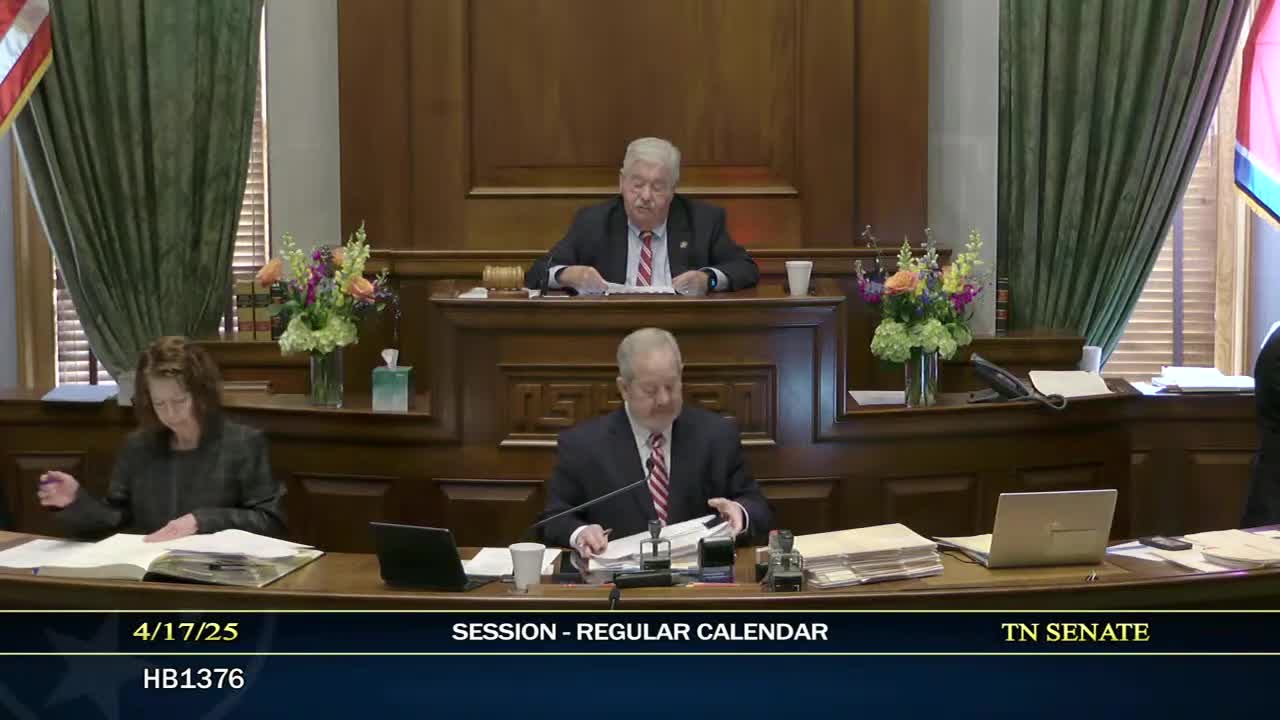
After nearly four hours of debate, the Tennessee Senate passed House Bill 1376 (conforming to Senate Bill 1413), a measure to regulate hemp-derived cannabinoid products, set new taxes, and move oversight largely to the Alcoholic Beverage Commission.
The Tennessee Senate passed House Bill 1376, which the sponsor described as a package to regulate hemp-derived cannabinoid products and address an unregulated market that speakers said has emerged in recent years.
Sponsor Sen. Brent Briggs said the bill creates a modified three-tier system for suppliers, wholesalers and retailers, places most enforcement under the state Alcoholic Beverage Commission (ABC) and defines total THC limits that determine when hemp becomes marijuana. "We will have, I'll call it, a modified three-tier system, much like we do for alcohol, where we have suppliers, wholesalers and the retailer where the finished product will eventually be sold to the public," Briggs said on the floor.
Supporters said the bill aims to give regulators tools to ensure product safety, limit youth access and provide clear taxation. Briggs described tax elements in the bill: a per-milligram tax on cannabinoid products; a $50-per-ounce tax on flower with 80% to the general fund, 10% to ABC and 10% to the Department of Revenue; a $300 annual brand fee; and a $4.40 per-gallon tax on certain liquid cannabinoid products.
Opponents raised concerns about process, federal alignment and impacts on Tennessee farmers and businesses. "This bill doesn't clean it up. It makes a bigger mess," Sen. Jeff Yarbro said, arguing the state should align its definition with federal law and that market realities have already filled the unregulated vacuum. Sen. Reginald Roberts urged the bill's THC definition be tethered to federal code so Tennessee law and criminal code align.
Some senators voiced public-safety concerns and cited medical cases and research they said demonstrate harms from high-potency products. "I am very concerned about cannabis-induced psychosis," Sen. Jason Campbell said, recounting a constituent's family experience and urging stronger safeguards.
The bill also incorporates a legal interpretation the sponsor said the Senate sought from U.S. authorities: total THC (the decarboxylated delta-9 THC plus THCA when heated) at or below 0.3% is treated as hemp; above that threshold the product is marijuana under the bill's working definition. Briggs said the measure follows guidance the legislature requested from federal authorities and that enforcement and testing will be performed by ABC and the Department of Agriculture as specified.
Senators debated whether the state should set its own limit or adopt federal standards, and whether the regulatory shift from the Department of Agriculture to ABC is appropriate. Several senators asked for delay to allow court cases and pending litigation and to avoid sudden changes for farmers and existing businesses that relied on prior rules.
The Senate declared the bill to have received the required constitutional majority and passed the measure. The sponsor renewed his motion for passage and the chair declared the bill passed by constitutional majority.
What the bill does and next steps
- Regulatory oversight: moves most compliance and enforcement for retail cannabinoid products to the Tennessee Alcoholic Beverage Commission; field testing remains with the Department of Agriculture as specified. - Product definition: the bill adopts a total-THC threshold described on the floor that treats the decarboxylated delta-9 plus THCA (after heating) as the relevant measure for distinguishing hemp from marijuana, with 0.3% cited during debate as the operative guideline. - Taxes and fees: multiple taxes and fees were described on the floor, including a per-milligram tax, a $50/oz tax on flower (80% to general fund, 10% to ABC, 10% to Department of Revenue), a $300 annual brand fee and a $4.40/gallon tax on certain liquids. - Enforcement and legal risks: sponsors and some opponents noted pending litigation and federal-federal circuit court rulings that could affect definitions and implementation; senators urged attention to court outcomes and federal actions.
Votes and outcome
Sen. Brent Briggs renewed his motion for passage; the presiding officer declared the bill passed by constitutional majority.
Speakers (as recorded in the transcript)
- Brent Briggs — State Senator (sponsor) - Jason Campbell — State Senator - Massey (Jeremy Massey) — State Senator - Reginald Roberts — State Senator - Jeff Yarbro — State Senator - Jeff Yarborough — State Senator - Rusty Yeager — State Senator - David Wally — State Senator - Other senators who spoke during debate are listed in the provenance section below.
Authorities cited in debate
- Controlled Substances Act / federal guidance referenced by sponsor in correspondence with U.S. authorities (referenced on the floor by Sen. Briggs) - United States Domestic Hemp Production Act (referenced by sponsor) - Tennessee statutes and administrative rules affecting hemp testing and regulation were referenced in general terms during debate (specific code sections not amended on the floor during debate).
Clarifying details recorded on the floor
- Tax structure described by the sponsor: per-milligram tax on cannabinoid products; $50 per ounce tax on flower with distribution (80% general fund / 10% ABC / 10% Department of Revenue); $300 annual brand fee; $4.40 per-gallon tax on certain liquid cannabinoid products. - Enforcement: most oversight to be done by the Alcoholic Beverage Commission; field testing continues to involve the Department of Agriculture. - Thresholds: sponsor cited a 0.3% total THC threshold (delta-9 plus THCA when decarboxylated) as the operative line used to distinguish hemp from marijuana for the bill's purposes.
Community relevance
- Geographies: statewide impact. - Impact groups: farmers/growers, retail store owners, wholesalers/distributors, consumers (including youths), public-safety stakeholders, health-care providers. - Funding: new tax revenue streams directed largely to the state general fund and enforcement agencies (as described by the sponsor on the floor).
Meeting context
- Engagement level: extended debate with numerous senators speaking over roughly 3–4 hours of floor time on this single measure; several senators moved for passage after extended discussion. - Implementation risk: medium — sponsors and several senators noted pending federal guidance and litigation that could change definitions or enforcement; courts and federal policy could affect implementation.
Searchable tags
cannabis, hemp, THCA, taxation, Alcoholic Beverage Commission, public safety, agriculture, hemp growers, Senate
Provenance (selected transcript evidence)
- topicintro: block_id "b_3720.045" local_start 0 local_end 300 evidence_excerpt "Thank you very much, mister speaker. And I'm going for a 30 page bill and a 14 page fiscal note... we have a situation here in Tennessee where we essentially are dealing with unregulated recreational marijuana..." reason_code "topicintro" - topfinish: block_id "b_6824.1396" local_start 0 local_end 200 evidence_excerpt "House Bill 1376. Having received the Constitution majority, I declare it passed." reason_code "topicfinish"
Salience
- overall: 0.82 - overall_justification: The bill changes statewide regulation and taxation of hemp-derived cannabinoid products, shifts enforcement responsibilities and addresses a large, fast-growing retail market; debate included public-health and legal concerns, and the measure passed on the floor. - impact_scope: "state" (regional/national links possible) justification: Statewide regulatory and tax changes affecting growers, retailers and consumers across Tennessee. - attention_level: "high" justification: Extended floor debate and detailed technical provisions, plus potential litigation and federal policy interaction. - novelty: 0.68 justification: The measure consolidates new regulatory structures and taxes; it responds to market changes rather than continuing an established regime. - timeliness_urgency: 0.74 justification: Sponsors argued prompt action was needed to address products already available in stores and public-safety concerns. - legal_significance: 0.6 justification: Changes regulatory authority and definitions; potential conflict or interaction with federal interpretations and pending litigation. - budgetary_significance: 0.45 justification: New taxes and fees are expected to generate state revenue; exact fiscal projections discussed in fiscal note described on floor. - public_safety_risk: 0.62 justification: Senators cited increased emergency visits, traffic and mental-health incidents in states with recreational markets. - affected_population_estimate: 100000 (approximate) affected_population_estimate_justification: Large retail market and statewide consumer base; estimate approximate based on retail availability and prevalence in other states. - policy_stage: "passed" justification: Measure passed the Senate on final action and will move forward per legislative process. - follow_up_priority: 8 justification: Implementation will require agency rulemaking, enforcement changes and communication with growers and retailers.
Engagement_forecast
- newsworthiness: {"national":0.10,"regional":0.60,"local":0.85,"justification":"High local/regional interest because changes affect Tennessee growers, retailers and public health; moderate regional interest as other states watch regulatory models."} - notify_recommendation: {"audience":"state","reason":"Statewide regulatory and tax changes with public-safety implications; notify state agencies, agricultural stakeholders, ABC and major local news desks.","audience_regions":["US-TN"],"justification":"Significant policy change affecting many stakeholders across Tennessee."} - predicted_click_through:0.45 - predicted_read_time_minutes:4
graph_signals
- jurisdictions:["US-TN"] - ontology_topics:["cannabis regulation","public safety","tax policy"] - entities:[{"id":"sen-briggs","name":"Brent Briggs","type":"person"},{"id":"tn-abc","name":"Tennessee Alcoholic Beverage Commission","type":"agency"},{"id":"tn-dept-ag","name":"Tennessee Department of Agriculture","type":"agency"}]