Get Full Government Meeting Transcripts, Videos, & Alerts Forever!
Get email alerts on the Affordable Housing topic
No spam. Unsubscribe anytime.
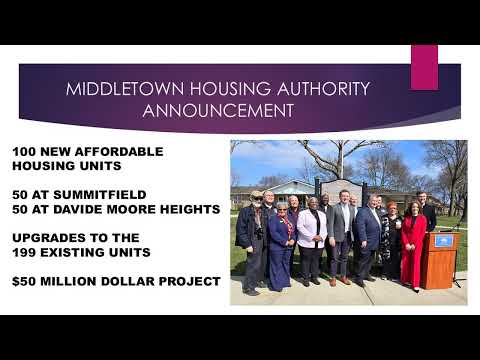
Middletown officials outline $50 million plan to add 100 affordable housing units with Middletown Housing Authority
Summary
City officials described a $50 million project to add 100 affordable units and renovate 99 existing units under a Middletown Housing Authority-led plan; city participation would be a payment-in-lieu-of-taxes and a 1.1-acre property donation, not direct cash.
Mayor (name not specified) told the Common Council on April 15 that a proposed $50 million project with the Middletown Housing Authority and developer Edgemere Development would create 100 new affordable housing units and fully renovate 99 existing units across Summit Field and David Moore Heights.
The mayor said the city's participation would be limited to a payment in lieu of taxes (PILOT) that “will mirror what the Housing Authority pays now” and the donation of about 1.1 acres of city-owned land contiguous to Housing Authority property on Sweezy Avenue. The mayor said there would be no direct city cash commitment to the project.
The plan, the mayor said, would be financed principally with tax-exempt bonds and New York State low-income housing tax credit financing; the mayor identified the New York State Housing Finance Agency as the likely lender of low-interest loans that make the project feasible. He said the package also supports the city’s “pro housing community” designation, which helps score state grant applications.
Why this matters: the mayor described the project as a mix of preservation and new construction — 99 units would be renovated, and 100 new regulated units would be added — and said tenants and Housing Authority leaders who attended a recent announcement expressed support. He portrayed the development as a way to expand regulated, affordable inventory rather than rely on rent controls alone.
Details discussed at the meeting included: - Project cost: the mayor said the total project cost is $50,000,000. - Units: 100 new units proposed; 99 existing units in Middletown Housing Authority inventory would be renovated. - Land donation: roughly 1.1 acres of city-owned property on Sweezy Avenue would be donated; the mayor said the city acquired that parcel about 20 years ago for roughly $5,000. - Community garden: the mayor said the Housing Authority would place a community garden on the donated parcel with a $50,000 grant the mayor said came from Senator James Skoufis’s office. - Financing: tax-exempt bonds, New York State low-income housing tax credits, and loans through the New York State Housing Finance Agency were described as primary sources. - City role: city participation was described as a PILOT and land donation; the mayor said, “This is not a direct city project” and that “there’s no city money involved in this whatsoever other than a benefit of being, having a payment in lieu of taxes.”
Council members asked for clarification about the PILOT. Alderman Johnson asked whether the properties would pay full taxes; the mayor replied they would not, saying they pay much less than a typical apartment development, which is one reason PILOT terms are used to make projects viable.
At least one critic was referenced during the discussion: the mayor read and rejected social-media criticism attributed to “Mr. Sierra,” calling the remark “a stupid comment.” The mayor defended the Housing Authority and tenants who attended the announcement and said he expected a resolution for the council on the PILOT and property transfer “in the next month or two.”
What was not resolved: the council did not take a formal vote on the housing project at this meeting. The mayor said a resolution formalizing the PILOT request and property transfer will be prepared for a future meeting. Specifics of the PILOT request (rate, duration, covenants) were not provided at the meeting; the mayor said the Housing Authority had been asked to forward the PILOT request to the city.
Context and next steps: the mayor said the financing structure and state credits are essential to the transaction and that the city’s “pro housing community” designation improves the municipality’s competitiveness for state grants such as the Downtown Revitalization Initiative. He urged that, if the council does not approve a PILOT, “I doubt very much that this project will go forward.”