Get Full Government Meeting Transcripts, Videos, & Alerts Forever!
Get email alerts on the Finance Reorganization topic
No spam. Unsubscribe anytime.
Joint committees review proposed centralized finance reorganization; ordinance and charter changes tabled
Summary
Holyoke99s joint ordinance and charter rules committees spent April 16 reviewing a proposed centralized finance reorganization that would create a CAFO, combine some finance roles and reassign functions; committees tabled the proposed ordinance and requested more financial and personnel detail.
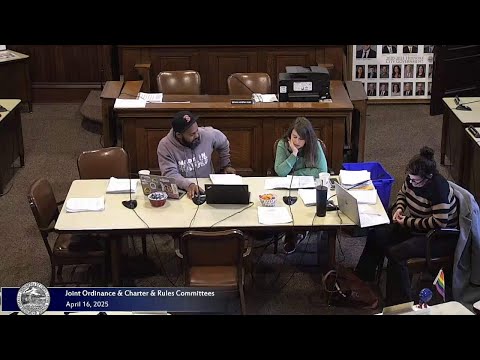
Holyoke99s joint ordinance and charter rules committees spent most of the April 16 meeting discussing a proposed reorganization of city finance functions that would create a centralized finance operation (referred to in materials and discussion as a CAFO), combine some positions including the treasurer and tax collector, and create new department-level roles such as a comptroller and a director of internal audit. The committees did not adopt the ordinance language; several items were tabled for further review.
The presentation was led by Rory Casey, the city99s current elected treasurer, with consultant TJ Plant and city staff providing detail on draft ordinances, job descriptions and a budget comparison. Committee members were presented with a summary showing the proposed fiscal 2026 budget essentially flat compared with FY25 budgeted costs, and projected savings in FY27 on the order of roughly $100,000. Presenters said those figures reflect moving some work in-house that the city currently pays contractors to provide and eliminating two full-time budgeted lines under the proposed structure.
Committee members pressed staff on specifics. Councilor Linda Bacon asked for actual-cost comparisons (what the city has spent this year) rather than budget-to-budget comparisons, noting positions that were budgeted but unfilled cannot be counted as real-dollar savings. Rory Casey and TJ Plant acknowledged the distinction and said the FY26 numbers are budget comparisons while FY27 assumes a full year of restructured staffing; they said the earlier $150,000 placeholder salary for a CAFO was revised to a mid-range figure of about $136,000 after job-grade and market analysis.
Presenters identified specific expense lines that would be reduced if more work is done in-house, including computer consulting services (projected to fall roughly $40,000), professional accounting/auditing (projected down about $45,000) and software license/usage fees (a relatively small decrease shown). Rory Casey and TJ Plant said some contracted services exist because current staffing and systems do not allow the work to be done internally and that the proposed structure would reassign or redeploy responsibilities so the city could absorb those tasks.
Committee members also questioned proposed personnel rules and appointment processes. Draft ordinance language would make the CAFO an appointed department head (the mayor would appoint the CAFO with council approval), while the council would continue to appoint the director of internal audit, the treasurer-collector and the chief assessor. Discussion included whether the CAFO99s certification role in reviewing appropriations and transfers (the CAFO would have seven days to provide a certification) could create de facto veto authority if the office failed to respond; TJ Plant and Rory Casey said in their experience a long silence has not occurred and that the ordinance language can be tailored to avoid unintended consequences.
Several councilors raised other points: - Residency requirement: committee members warned a residency requirement for the CAFO could limit the applicant pool; TJ Plant and others advised that many communities are moving away from residency requirements to attract qualified candidates. - Bonding: speakers noted the treasurer/collector must be bondable; Rory Casey explained bonding involves background and credit checks and is legally required for certain positions. - Cybersecurity: Rory Casey emphasized current cybersecurity vulnerabilities and argued that a centralized function with in-house IT oversight would be more secure than current contractor-dependent arrangements.
The committees did not vote to adopt ordinances. Procedural motions were made and carried to take up packages of ordinance items for joint discussion. Ultimately the ordinance committee tabled items 1, 4 and 5 to the next meeting (roll call recorded as passing 4-0), and the charter rules committee tabled items 2 and 3 (roll call recorded as passing; roll call names recorded in the minutes). Presenters and councilors agreed to provide additional documentation requested by councilors, including: actual-dollar spending comparisons for the current year versus budget; finalized job descriptions that match any ordinance text; and clarifying charter language needed to change an elected treasurer to an appointed treasurer and to combine treasurer/collector roles if the council so chooses.
No final policy was enacted; the committees scheduled follow-up work and asked staff and the consultant to supply the further detail requested.