Get Full Government Meeting Transcripts, Videos, & Alerts Forever!
Get email alerts on the Guaranteed Basic Income ARPA topic
No spam. Unsubscribe anytime.
Somerville ARPA-funded guaranteed basic income pilot served 200 households; city says pilot cannot continue in current form
Summary
City ARPA staff reported the guaranteed basic income pilot distributed $750 monthly debit-card payments to 200 households through June 2025, totaling $1.8 million; staff said constraints on general fund use, staffing and legal/budget issues mean the program cannot simply continue unchanged and will return with options.
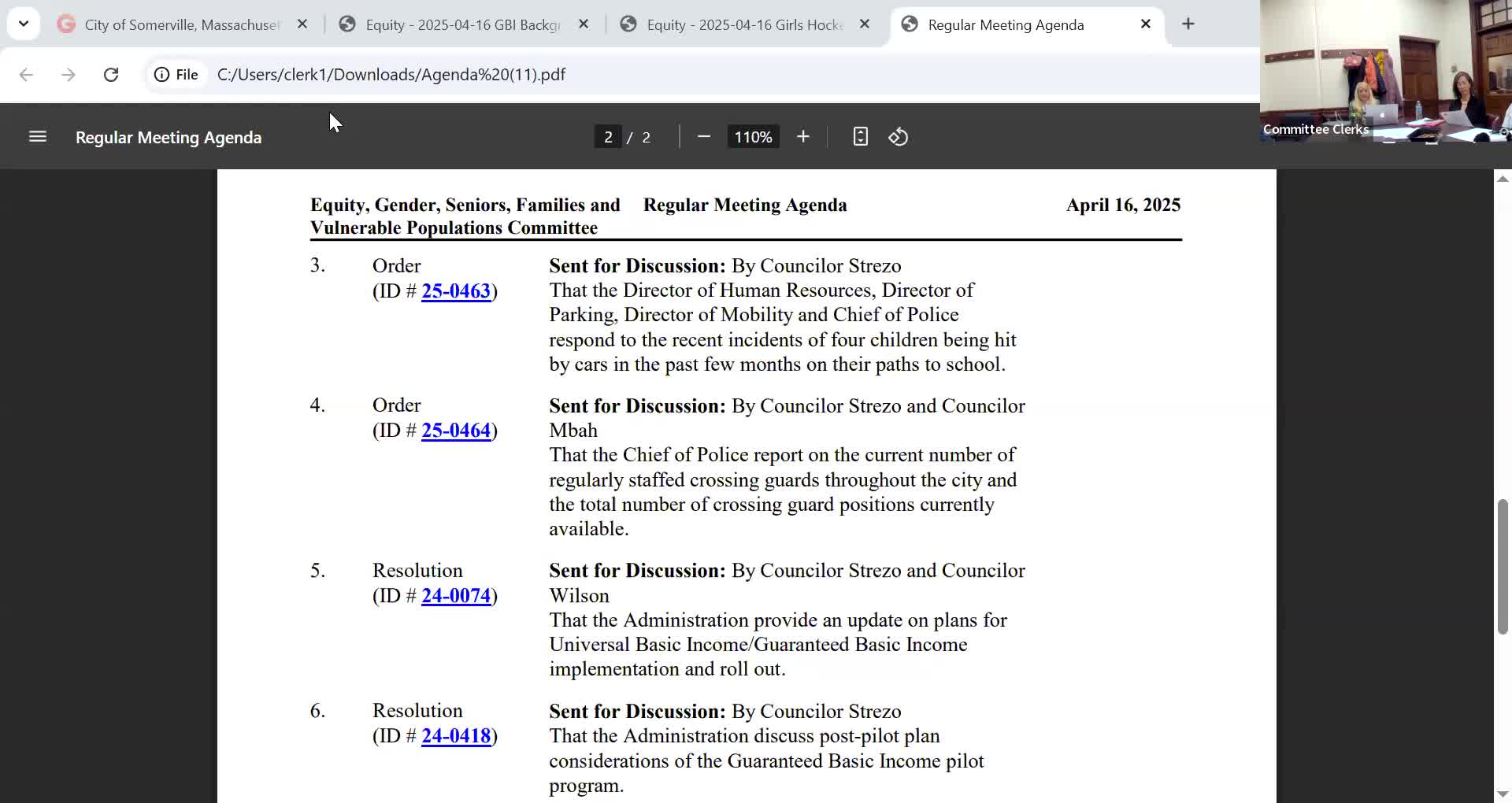
Somerville officials told the Committee on Equity, Gender, Seniors, Family and Vulnerable Populations on April 16 that a city pilot to provide guaranteed basic income (GBI) using American Rescue Plan Act (ARPA) funds has delivered monthly cash payments to 200 households but cannot continue in the same unrestricted form without resolving legal, budgetary and staffing constraints.
Erica, who identified herself as the ARPA director for the city, said the pilot ran from July 1, 2024, through June 30, 2025, and enrolled 200 households. “We are serving 200 households, and they are each receiving $750 a month during this 12 month pilot,” Erica told the committee, adding that the program loads payments onto reloadable debit cards and that the total distribution equals $1,800,000 over the year. The ARPA director said participants were recruited through existing city partner offices to prioritize households facing housing instability.
Jenny Tse, an ARPA program manager, described evaluation work and early findings. Staff have completed a baseline survey and are close to finishing midpoint interviews. Jenny said that at the end of each month more than three‑quarters of participants have less than $50 remaining on the card, which staff interpret as participants using most of the funds for near-term needs. “What we're hearing from our surveys and interviews is that some of the biggest expenditures people are spending on are rent, but also paying off loans and debts, and basic needs like food, transportation and childcare,” the ARPA director said.
Officials discussed the pilot’s strengths — direct cash transfers on debit cards to minimize stigma and the advantages of enrolling participants through existing Office of Housing and Stability (OHS) and partner casework — and the barriers to continuing the program on an ongoing basis. Staff told the committee that ARPA’s grant language allowed direct cash assistance, but the city’s general fund has stricter rules that limit direct cash benefits to individuals without significant legal review. Staff also said administering an ongoing program would require dedicated staffing capacity that ARPA temporarily funded for the pilot.
Next steps: Committee members agreed to continue the item in committee for a fuller report. Staff said they will complete the evaluation, provide demographic and outcome breakdowns at a future meeting, and work with legal, finance and departments to present options for post‑pilot steps. The committee did not vote to continue payments or appropriate general fund money; staff said the pilot will transition participants out of monthly payments as scheduled while the city considers alternatives.