Get Full Government Meeting Transcripts, Videos, & Alerts Forever!
Get email alerts on the Public Health Budget topic
No spam. Unsubscribe anytime.
Southeast Idaho Public Health presents FY2026 budget; Bannock County request edges down to $1,116,271
Summary
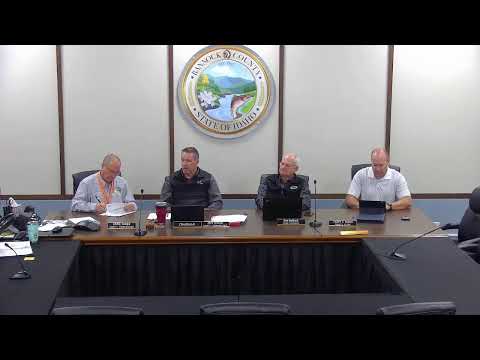
Southeast Idaho Public Health presented its Board of Health–recommended fiscal year 2026 budget to the Bannock County Board of Commissioners at their April 17 meeting, saying the district will ask counties for a net contribution that is largely unchanged for Bannock County after the district covers half of a proposed 3% increase from its restricted reserve.
Southeast Idaho Public Health presented its Board of Health–recommended fiscal year 2026 budget to the Bannock County Board of Commissioners at their April 17 meeting, saying the district will ask counties for a net contribution that is largely unchanged for Bannock County after the district covers half of a proposed 3% increase from its restricted reserve.
The presentation, delivered by a Southeast Idaho Public Health representative identified in the meeting as Maggie, covered the district’s revenue and expenditure forecasts for the fiscal year that begins July 1, the county funding formula set in Idaho law, and public‑health preparedness activities in response to national disease clusters.
Maggie said the district’s Board of Health voted April 10 to recommend the FY2026 proposal and that the district will hold a public budget hearing May 22 (hosted by Bannock County, with a virtual option). She said the district proposes a 3% increase overall in county funding but that the board recommended covering 50% of that increase from a restricted county drawdown fund; after that split and timing adjustments the proposed contribution for Bannock County would be $1,116,271, slightly lower than the current year contribution of $1,117,275.
Why it matters: county contributions fund roughly a quarter of the district’s budget; changes in grants, state timing and market valuations can cause meaningful swings for smaller counties. The board’s recommendation to use restricted reserves to cover half of the requested increase was framed as a way to smooth year‑to‑year impacts on counties.
Budget details: the district projects a 5.1% decrease in expenditures ("just under $500,000," per the presentation) and a 4.4% decrease in revenue (about $413,836). The presentation said full‑time equivalents are expected to fall by 5.52 FTE (about a 6.5% reduction) largely because several COVID‑related grant positions are ending. The presenter also noted an agency health‑insurance increase of $14.30 per employee factored into personnel costs. The largest funding streams named were subgrants and contracts (45.2% of revenues), fees for service (27.1%), county contributions (26.5%) and opioid‑settlement drawdown funds (about 1.1%).
County formula and Bannock numbers: the presenter said Idaho code (cited on the packet as "39 chapter 4") allocates county contributions 70% by population and 30% by assessed market valuation. For the district population figures delivered in March, Bannock County was shown at just over 91,000 residents (48.5% of district population), which produced a population component request of $828,798. Its market‑valuation share was shown as 41.5%, producing a market‑valuation component of $303,009.69; after removing a one‑time county drawdown adjustment the packet shows the net county request at roughly $1.116 million and a negative 2% change in share for Bannock County compared with the current year.
Reserves and drawdown: the presenter said the district maintains an unobligated reserve equal to roughly 4.4 months of operating expenses and also holds designated restricted funds (building, legal, public‑health emergency, opioid drawdown, etc.). She said the restricted fund balance is about $260,000 and that the board recommended using $35,552 from those designated funds to fund half of the 3% county increase this year. The presenter said that while the board generally takes a conservative approach to using designated funds, the board judged this drawdown appropriate to reduce one‑time impacts on counties.
Program and revenue context: the presenter said subgrants are projected to fall about 10.9% (just over $500,000) and that fees are projected to rise about 3% ($71,835). She also explained that opioid‑settlement revenues were largely front‑loaded—about four years’ worth placed in a restricted drawdown—and the district draws from that restricted account to fund opioid‑related programming.
Preparedness concerns: district staff also briefed commissioners on infectious‑disease monitoring. Maggie said the district has been conducting preparedness exercises, notifying child‑care providers and local clinicians about correct testing for suspected measles to avoid delayed diagnosis, and coordinating with the Idaho Department of Health and Welfare and other districts. She quoted Idaho’s state epidemiologist, Dr. Christine Hahn, as emphasizing that an outbreak in other states makes local cases “not a matter of if but when.” The presenter said the district has had no recent confirmed local measles cases but is watching regional clusters and testing patterns closely.
The presenter also reported the district is evaluating one person locally for probable active tuberculosis; she said the case is under investigation and expected to be clarified in the next day or so, and outlined the usual contact‑tracing and evaluation steps if an active TB case is confirmed.
Policy and funding risk: the presenter told commissioners the district has lost Title‑10 funding for a portion of reproductive‑health services because of a state‑federal conflict (as described to the board), and that the Idaho Department of Health and Welfare is exploring short‑term coverage while the district monitors federal‑level flexibility that could restore funding in several months.
Next steps: the district’s public budget hearing is scheduled for May 22; district staff said they will send meeting materials and that Bannock County may designate a proxy to vote if county commissioners cannot attend in person. The presentation concluded without a formal action by the Bannock County Board; it was informational and intended to solicit questions prior to the May 22 hearing.
Commissioners asked staff about the long‑term prudence of drawing from designated reserves; the presenter said the board’s policy is to hold at least three to four months’ operating expenses unobligated and that the recommended drawdown would leave the district with a reserve consistent with the board’s policies.
The district representative encouraged commissioners to contact her if they had follow‑up questions and confirmed she would provide materials and the virtual meeting link for the May 22 hearing.