Get Full Government Meeting Transcripts, Videos, & Alerts Forever!
Get email alerts on the Land Use topic
No spam. Unsubscribe anytime.
Perry County planners debate requiring recorded PennDOT HOPs for subdivision approvals
Summary
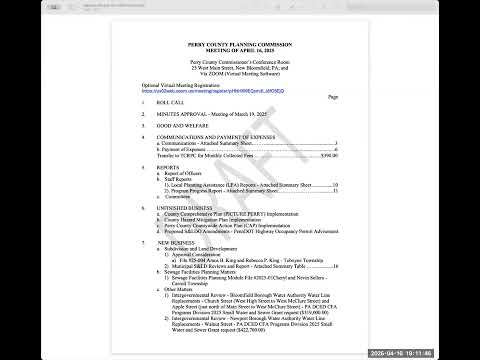
Commissioners debated whether to require recording PennDOT Highway Occupancy Permits (HOPs) in the county courthouse as part of subdivision and land development approvals, and agreed to seek PennDOT input before finalizing ordinance language.
At the April meeting of the Perry County Planning Commission, members debated whether subdivision and land-development approvals should require applicants to record a PennDOT Highway Occupancy Permit (HOP) in the county courthouse and whether townships should be notified when an HOP is issued.
The issue arose while the commission considered a proposed addition to the county Subdivision and Land Development Ordinance (SALDO) plan note. The proposed sentence would state that an applicant’s approval is subject to any conditions PennDOT places on the plan and that the applicant is responsible for recording the HOP in the county recorder’s office. Commission members discussed practical consequences for development, saleability of lots and whether blank HOP-number fields should appear on recorded plans.
Commissioners and staff highlighted trade-offs. One staff member noted the county currently collects a $50 fee to obtain HOP documentation as part of final plan approval and that the fee is refunded if an updated plan with the HOP number is provided. Several commissioners said requiring recording could impose an additional step on applicants and potentially be seen as “anti-development.” Others said recording gives townships and emergency services better information and protects the public record.
Members also raised a recurring operational problem: PennDOT sometimes will not issue an HOP to a buyer who is not yet the recorded owner, which can create a circular problem when an HOP is required before a plan can be recorded. Commissioners said that practice can restrict conveyance of lots created by subdivisions and complicate conditional approvals.
The commission discussed a two-tiered approach: retain conditional approvals for single-lot cases where an owner can obtain an HOP, but remove or alter the requirement for multi-lot subdivisions where recording cannot proceed until the HOP exists. Several members suggested the county should track which municipalities still rely on the county for land-development review; as municipalities adopt their own ordinances, the county’s responsibilities would decline.
Rather than adopt final language at the meeting, the commission reached consensus to table the item and directed staff to draft “tail-end” note language that eliminates blank fields that will likely remain empty, to circulate that draft internally, and to seek a formal technical review with PennDOT district staff about the agency’s current HOP issuance practice.
Next steps: staff will prepare revised draft wording, request a meeting with PennDOT to confirm HOP issuance policy and whether recording requirements are workable in Perry County’s context, and return the item to the commission for further action.