Get Full Government Meeting Transcripts, Videos, & Alerts Forever!
Get email alerts on the Human Resources topic
No spam. Unsubscribe anytime.
Hartford human resources highlights recruitment push, training pipelines and benefits costs in FY26 briefing
Summary
Human Resources Director Marlene Fleeting outlined FY26 priorities including recruitment marketing, updated job descriptions, trainee and upskilling pipelines, continued negotiations with unions over work schedules and benefits, and a relatively modest health‑plan increase compared with statewide averages.
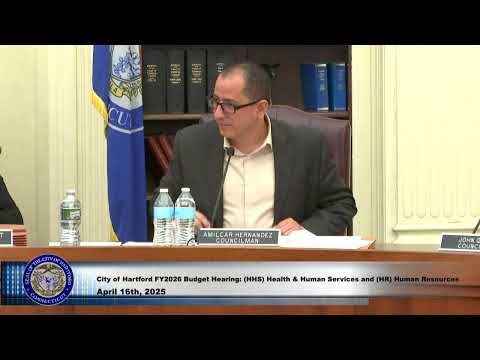
Human Resources Director Marlene Fleeting presented the department’s FY26 recommendations to the Operations, Management, Budget and Government Accountability Committee, emphasizing recruitment, training and benefits management.
The presentation summarized FY25 accomplishments — marketing and outreach campaigns, a citywide career fair, updated job descriptions for many classifications, training and promotional testing — and described FY26 priorities that include negotiating collective bargaining agreements, automating HR systems, expanding employee orientation and continuing recruitment efforts focused on Hartford residents.
Why it matters: HR told the committee the city faces the same labor market challenges as other employers (competition on pay, hybrid work options and retention). Council members pressed HR on measurable progress in reducing vacancies, residency hiring rates and the feasibility of hybrid or alternate work schedules.
Recruitment, residency preference and job descriptions
Fleeting and Assistant Director Pamela Ratti said the department runs targeted outreach including bus and radio ads, job‑fair attendance and mailings aimed at Hartford residents. Ratti described a civil‑service process that requires departments to interview Hartford residents listed on an eligible register before hiring outside the city.
Fleeting said the department has updated or created roughly 100 classifications in the last two to three years and is actively working on another 10 classifications. Teams meet with departments to identify minimum qualifications and to consider experience as an equivalent to formal education where appropriate, a change HR said it has negotiated with unions in some cases.
Training, trainees and upward mobility
HR described several training and trainee programs that create entry points and internal promotion pipelines. Examples cited in the presentation and exchanges with councilors included maintainer/CDL training coordinated with Public Works and environmental sanitarian trainee positions administered by Health and Human Services. Chief Sanitarian testimony during the HHS presentation noted environmental trainee appointments and certification tracks.
Benefits, health insurance and plan options
Benefits Director Rich Bukorski reported an overall actuarial increase of 3.9% for the city plan for FY26 — substantially lower than many municipal increases cited elsewhere. He explained that the state plan (which covers Medicare‑eligible retirees) has larger increases this year and that moving active employees to the state plan in FY26 would have increased the city’s budget by an estimated $3.2 million in the director’s assessment. The presentation said the city has about 520 contracts on the under‑65 retiree plan and about 630 on the over‑65 state‑administered plan.
Council members asked about long‑term strategies to reduce health costs and whether shifting to the state plan would yield savings; HR staff replied that state plans have different underwriting and legal constraints and that the move would require collective bargaining and further legal review.
Hybrid schedules, retention and succession planning
Councilors asked whether a hybrid or compressed workweek would improve recruitment. Fleeting said some department heads offer one‑day‑a‑week remote work in particular roles, but broader hybrid policies would require negotiations with unions because such changes are a mandatory subject of bargaining. Committee members pressed for clearer succession‑planning targets and for a timeline to modernize job descriptions and qualifications; Fleeting and Ratti said HR would supply follow‑up information and work with council on realistic goals.
Staffing, vacancies and diversity metrics
Fleeting reported the department’s internal statistics: about 23.5% of HR staff are residents of Hartford; HR’s presentation included EEO breakdowns and new‑hire data. Committee members requested additional demographic breakdowns of managerial positions and an age profile of the workforce to anticipate retirements and insurance cost pressures. Fleeting said staff would provide those datasets.
Clarifying details
- HR full‑time positions and vacancies: Committee members were told roughly 1,398 city employees appear in the HR data table (grant‑funded positions included); HR agreed to add pension‑commission employees to future summaries if desired. - Recruitment activity: The department ran multiple recruitments in FY25, including police and firefighter exams; one police recruitment generated roughly 409 applications with 92 candidates forwarded to the department. - Job‑class modernization: HR reported about 100 job classifications updated or created in recent years and additional work underway; staff said the job‑classification modernization is a multiyear effort involving unions and administration.
What HR will provide to council
Councilors asked HR to provide: (1) a demographic breakdown of managerial positions by race/ethnicity; (2) an age profile of the workforce to support succession planning; and (3) a list of grant‑funded positions and associated grant sources. Fleeting said HR will supply follow‑up reports on those items.
Ending
Fleeting closed by thanking staff and council for support and said HR will continue to prioritize recruitment of Hartford residents, policy modernization and training to improve retention and upward mobility.