Get Full Government Meeting Transcripts, Videos, & Alerts Forever!
Get email alerts on the Public Health topic
No spam. Unsubscribe anytime.
Hartford health department presents budget, highlights Hart team crisis response and rodent-control gains
Summary
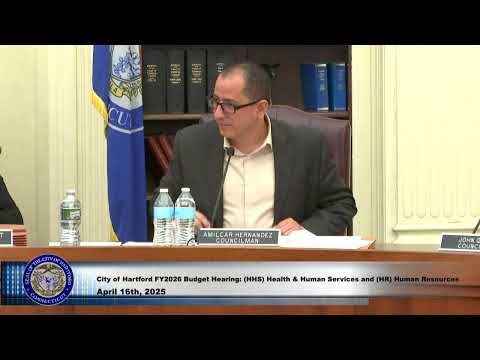
Hartford Health and Human Services Director Ebony Jackson Shahid told the committee that the FY26 request keeps core public‑health services, improves billing with an electronic medical record and expands outreach with a newly licensed mobile clinic.
Hartford Health and Human Services Director Ebony Jackson Shahid told the Operations, Management, Budget and Government Accountability Committee that the department’s FY26 request focuses on protecting core public‑health services, improving revenue through an electronic medical record and expanding outreach through a newly licensed mobile clinic.
The presentation outlined staffing and program changes and detail on community programs: the Hart Team alternative crisis response, the city’s three‑inspector rodent control unit, a documentary on vaccine hesitancy funded by an immunization grant, and several senior and maternal‑child health initiatives.
Why it matters: The department described both new operational tools and continuing fiscal uncertainty tied to state and federal grants. Committee members pressed staff on whether grant funds are being spent on schedule and how programs supported by one‑time or ARPA replacement funds will be sustained.
Jackson Shahid summarized work the department said is intended to strengthen prevention and frontline services while improving billing and revenues. “We implemented an electronic medical record, CureMD, for improving billing,” she said, and added the department created a licensed mobile clinic “to be used as an education tool for the community.”
Hart Team crisis response
Patricia McIntosh, deputy director of social services, gave a detailed update on the Hart Team, which the department described as a three‑year‑old alternative crisis response model. McIntosh said the Hart Team has handled roughly 4,400 responses and that about 80–81% of those calls were handled without police, fire or EMS co‑responders. The team also deploys for targeted outreach; McIntosh said Hart Team outreach reduced warming‑center calls in a high‑call area by about 75% after targeted visits.
Committee members asked how the Hart Team is funded. Mohammed Corte, the department’s MSO, said initial funding came from COVID‑era savings and a mayoral allocation of $5 million to launch an alternative crisis response program; current operations are funded through contracts with community providers and ARPA replacement funds are available for an upcoming year. McIntosh said the city contracts and pays CRT (a contracted provider) for clinician/peer teams; Mobile Crisis is state funded and not paid by the city. She said the Hart Team is dispatchable and available for dispatch roughly 9 a.m.–9 p.m. daily and that CRT presents quarterly and annual reports to the department.
Rodent control, environmental trainees and inspections
Jackson Shahid and Chief Sanitarian Elizabeth Cavanaugh described a three‑inspector rodent control team the department calls a statewide model. Cavanaugh said the department has “3 rodent control inspectors” and that they use a range of tactics, including on‑site mitigation and specialized gassing equipment. Jackson Shahid said the department is acquiring an additional machine to bolster operations and that other municipalities have sought the city’s advice.
Cavanaugh said the department maintains an environmental sanitarian trainee pipeline to staff inspections and food safety work. She told the committee that three environmental health sanitarian trainees are currently on staff and the department was interviewing for an additional trainee; trainees are working toward state food‑safety certification under a 24‑month training plan.
Grants, carryovers and billing
Jackson Shahid said the department’s requested budget increase is modest and “driven by union and non‑union salary adjustments and a shift of some grant‑funded positions to general fund.” She reported a budget increase figure (presented in the hearing materials) and noted challenges and uncertainty around state grant administration: the department had received stop‑work orders from the state on specified immunization and laboratory ELC (Epidemiology and Laboratory Capacity) grants but had not had contracts terminated.
On questions about low expenditure rates for shelter and warming center line items, Mohammed Corte said the low spending for the first half of the fiscal year was a timing issue — invoices had not yet been submitted to and processed by the city’s pay system.
Jackson Shahid and staff said they are using grant funds in part to subcontract services to local organizations and that some large grants — including a roughly $1 million WIC grant and an approximately $2 million lead hazard reduction grant — cover both department staffing and subcontracted services. Committee members requested a list of subcontractors funded by HHS grants; Jackson Shahid said the department would provide that list.
Senior services, nutrition and senior center concerns
Councilors raised concerns about decreased ARPA funding for senior meals and asked what the department will do to replace lost food funding. Jackson Shahid said one senior nutrition grant was reduced by about $30,000; the administration provided some supplemental funding during the year and the department is exploring pantry programming and other means to mitigate food insecurity at senior centers.
Council members also described students’ reports of mice in school buildings; Jackson Shahid said rodent control focuses on exterior/perimeter mitigation while interior infestations in multi‑unit residences and school interiors may fall under housing code or facility maintenance, but the department offered to coordinate with schools and other city agencies if requested.
Public health accreditation, documentary and public outreach
The department said it is restructuring public‑health accreditation focus areas to align with new federal priorities (presentation referred to the accreditation process as “FAB accreditation” and to Public Health Accreditation Board requirements). Jackson Shahid described a documentary produced with immunization‑grant funds, Complicated Confidence, which she said is published on the department’s YouTube page and has subtitles available in Spanish. She said the film was submitted to the American Public Health Association for possible presentation and publication.
Clarifying details and staffing
- Rodent control inspectors: 3; department described the unit as fully staffed. - Hart Team responses: about 4,400 responses since inception; roughly 80–81% of calls handled without police or other co‑responders; a reported 75% reduction in targeted warming‑center calls in one outreach effort. - Environmental sanitarian trainees: 3 trainees on staff; department interviewing for an additional trainee. - Grants: the committee was told the department manages a portfolio of grants (a councilor cited approximately $17 million in grants across the department in questioning). Major grants mentioned included ELC immunization and lab capacity grants (state stop‑work orders were described), the WIC program (noted at roughly $1 million), a lead hazard reduction grant (about $2 million), Ryan White/HOPE‑conference funding, and federal immunization grants used for education work such as the documentary. - EMR/EHR system: CureMD implemented for clinical billing and revenue capture.
What the department was asked to provide
Council members asked the department to supply: (1) a list of subcontractors and partner organizations paid through HHS grants; (2) explanations of timing and invoice processing for low early fiscal‑year expenditures (Corte cited invoices not yet submitted/processed); and (3) documentation and reports associated with grants described on the back pages of the budget book.
Ending
Jackson Shahid closed her department’s presentation by restating the department’s emphasis on protecting essential public‑health services and advancing community health through clinic services, outreach and environmental control programs. Committee members thanked the director and staff and moved to a brief recess before the human resources presentation.
Speakers quoted or referenced in this article are drawn from the meeting record and include: Ebony Jackson Shahid, Director, Health and Human Services; Patricia McIntosh, Deputy Director of Social Services; Elizabeth Cavanaugh, Chief Sanitarian; Mohammed Corte, MSO, HHS; and Council members Amir Carr Hernandez (committee chair), Alex Thomas, John Gale (Gayle as recorded), Merli Rossetti and others.