Get Full Government Meeting Transcripts, Videos, & Alerts Forever!
Get email alerts on the Education School Bond topic
No spam. Unsubscribe anytime.
Middleton School District urges $19.9 million elementary bond to address overcrowding
Summary
A district official told the Middleton City Council the district is over capacity at two elementary schools and outlined a multi-year effort to reduce the tax impact of a proposed bond that would build a new elementary school.
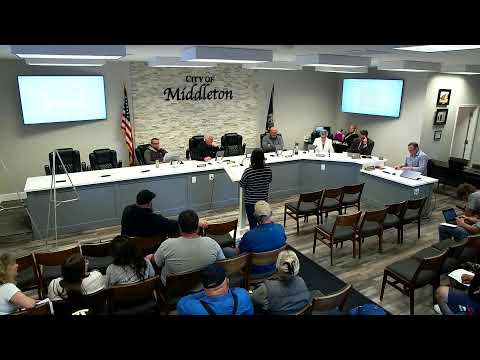
Mark Gee, a Middleton School District official, told the Middleton City Council on April 16 that two of the district's three elementary schools are operating well over capacity and urged support for a bond measure to build a new elementary school.
Gee said “we are over capacity in 2 of our 3 elementary schools. Currently, we are at 145% of capacity at Heights Elementary.” He said Mill Creek Elementary is at about 115% of capacity and Purple Sage Elementary is under capacity in part because it houses special‑needs programs that require more space per student.
The district is currently using 22 portable classrooms at Heights and Mill Creek, Gee said, and those portables do not add cafeteria, gymnasium or restroom capacity. He reviewed prior bond attempts: the district first identified the need in February 2015 and pursued bonds in 2018 and again in February 2022; the 2022 measure reached 53% support but fell short of the two‑thirds threshold required for passage.
Gee described steps the district has taken to reduce cost and tax impact. The district removed a career and technical education building from the bond request and funded smaller CTE work through grants and donations. It changed the school design and location to reduce earthwork and utility costs and secured donated land from a developer for a proposed site on the eastern border of the district. Those changes reduced the estimated cost from about $59 million to roughly $28 million for a 72,000‑square‑foot school with capacity for 600–700 students, Gee said.
The district also plans to use state modernization funds. Gee said the board intends to apply approximately $8 million in state modernization funding toward the project, which the district projects would lower the tax impact from $161 to about $34 per $100,000 of taxable value for the proposed $19.9 million bond ask.
Gee told the council the district cannot collect developer impact fees under Idaho law, and said a state law passed in February 2023 requires districts with building capacity to accept out‑of‑district students, a factor that has previously increased enrollment. He said efforts to reduce open‑enrollment students lowered out‑of‑district enrollment from about 380 to about 190 before the state law required acceptance when capacity exists.
If the bond fails again, Gee said the district has considered alternatives including re‑districting elementary boundaries, adding portables at Purple Sage, refurbishing an older unused school building (estimated in 2022 at $5–8 million to refurbish), or adopting split schedules or year‑round calendars — all described as undesirable contingency options. He noted these alternatives carry operational and transportation tradeoffs and additional costs for food service, janitorial and administration.
Gee said the district expects the current high school bond to expire in 2029 and that state bond offset funding currently applied to the high school would then be available to reduce elementary tax impact over the four years after the new bond, a timing he described as reducing long‑term taxpayer burden.
Council members asked about projected household child counts for planned housing, restroom access in portables, supervision arrangements when students walk between portables and main buildings, and how funding arrives for out‑of‑district students. Gee explained the district receives state per‑pupil funding for enrolled students but does not receive local levy or bond dollars from families who live outside the district boundaries. He described supervision practices for portable restroom trips and said decisions about boundary exceptions are constrained by state law.
Gee closed by offering to answer follow‑up questions from council members or constituents.