Get Full Government Meeting Transcripts, Videos, & Alerts Forever!
Get email alerts on the Zoning Museum topic
No spam. Unsubscribe anytime.
Abington considers zoning change to allow private museum on 10‑acre R‑1 parcels
Summary
At an April 10 working session the Abington Township Board of Commissioners discussed a draft ordinance to permit a G‑3 museum use in the R‑1 low‑density residential district with restrictions including a 10‑acre minimum, limited hours and parking controls. No vote was taken; the ordinance may be advertised for public hearing at the May meeting.
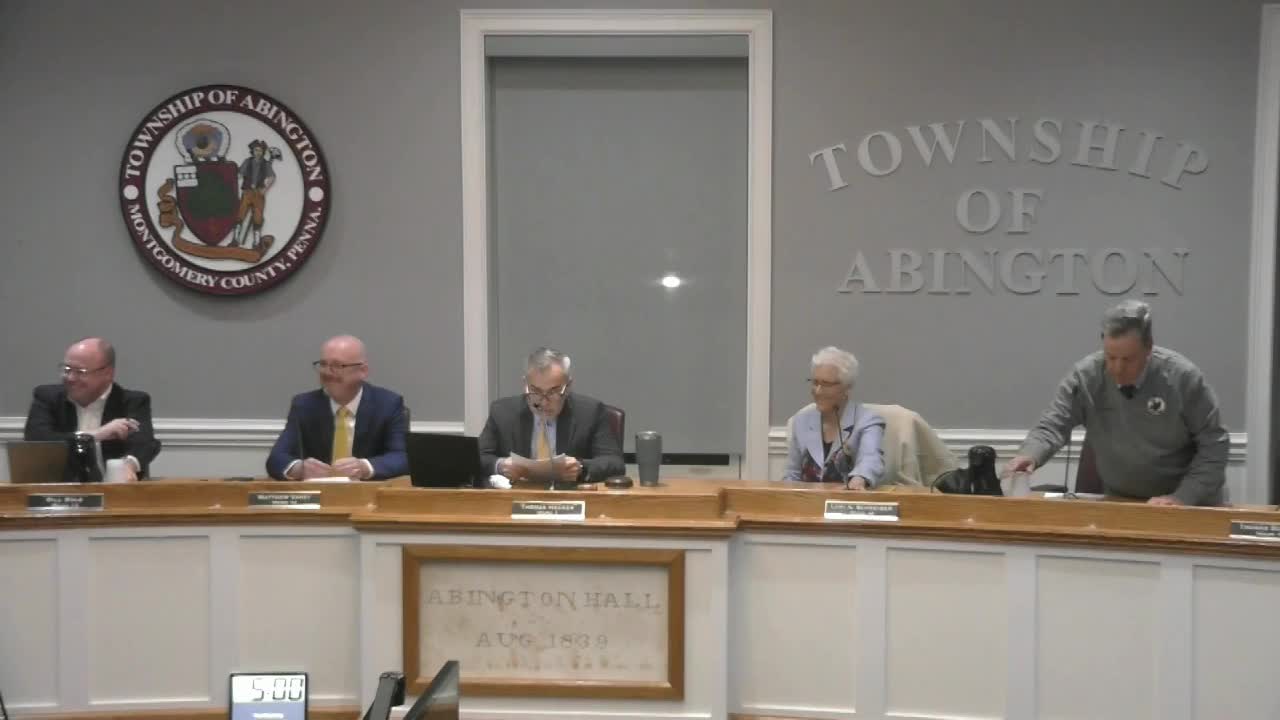
Abington Township commissioners discussed a proposed amendment that would allow a museum use in the R‑1 low‑density residential zoning district during their April 10 working session.
The draft ordinance would add the G‑3 art gallery/museum use to the R‑1 use matrix and create new regulations including a minimum lot size of 10 acres, public hours limited to 10 a.m. to 10 p.m., and a 1 parking space per 350 square feet exhibit-area standard that the Board may reduce if the applicant demonstrates reduced need and environmental benefit.
Township solicitor Julie Von Sprekelsen, of Eastburn and Gray, explained the draft and the limits placed on the museum use. She said the existing code separates an art gallery (which can include retail sales) from a museum and that the museum definition “does not have a retail component.” She described the proposed R‑1 limitations, adding that the ordinance text currently treats the museum as a conditional use but that she favors permitting the museum “by right” where the use already appears by right in a number of other districts.
Michael Markman, speaking for property owner Bruce Toll, said Toll has built a private art collection over several decades and would like to house it in Abington rather than donate it to the Philadelphia Museum of Art. “He wants to create a museum here in Abington to display his art, that would be run by a foundation that he created,” Markman said. He identified the parcel in discussion as a large, park‑like tract on Meeting House Road and said no land‑development plans have been filed yet; the current request is only for the zoning change.
Commissioners questioned process and neighborhood notice. Commissioner De Placido and others asked whether nearby residents had been informed; township staff said no specific resident notices were required at this conceptual zoning stage but that property posting and statutory advertising would occur if the Board authorizes advertisement. Township staff and the solicitor also said any later land‑development application would include standard notice procedures and public hearings.
Board members expressed mixed views about whether the use should remain conditional or be permitted by right. Several commissioners, including Commissioner Bowman and Commissioner Spiegelman, said they were supportive of the concept but split on whether to require a conditional‑use review. Commissioner Bowman said he “support[ed] the concept of adding it by conditional use,” while Commissioner Lainie Martin said she “support[ed] it by right.” President Hecker characterized the proposal as “a unique opportunity to retain a cultural asset within the community.”
The Board did not take a vote at the working session. Staff said the next procedural step would be to place a draft ordinance on the Board’s May agenda for possible authorization to advertise; if advertised, the ordinance would be referred to the County planning commission for review and then set for public hearing. Commissioners were given the option tonight to direct staff to remove or retain the conditional‑use pathway before advertising.
Public commenters linked to the agenda raised broader concerns about code enforcement, neighborhood blight and traffic, and urged careful public notification and scrutiny. A caller objected to placing a museum in a residential area and urged the Board to prioritize code enforcement before new zoning allowances; Bill Reardon and other residents urged the Board to craft measures that would prevent the change from creating a precedent that could alter R‑1 residential character.
Next steps: No ordinance was adopted. If the Board places the item on the May agenda, members will be asked to authorize advertisement of the draft text; after advertisement the County planning commission review and a public hearing would follow.