Get Full Government Meeting Transcripts, Videos, & Alerts Forever!
Get email alerts on the Housing Funds topic
No spam. Unsubscribe anytime.
Council committee reviews fund-administration options for $75 million Improve Our Tulsa housing program
Summary
City housing staff presented options for administering the voter-approved $75 million Improve Our Tulsa housing fund, discussed possible bonding of up to $35 million, and outlined a plan to issue a request for proposals for a third-party fund administrator after a recent request-for-information returned roughly 60 responses.
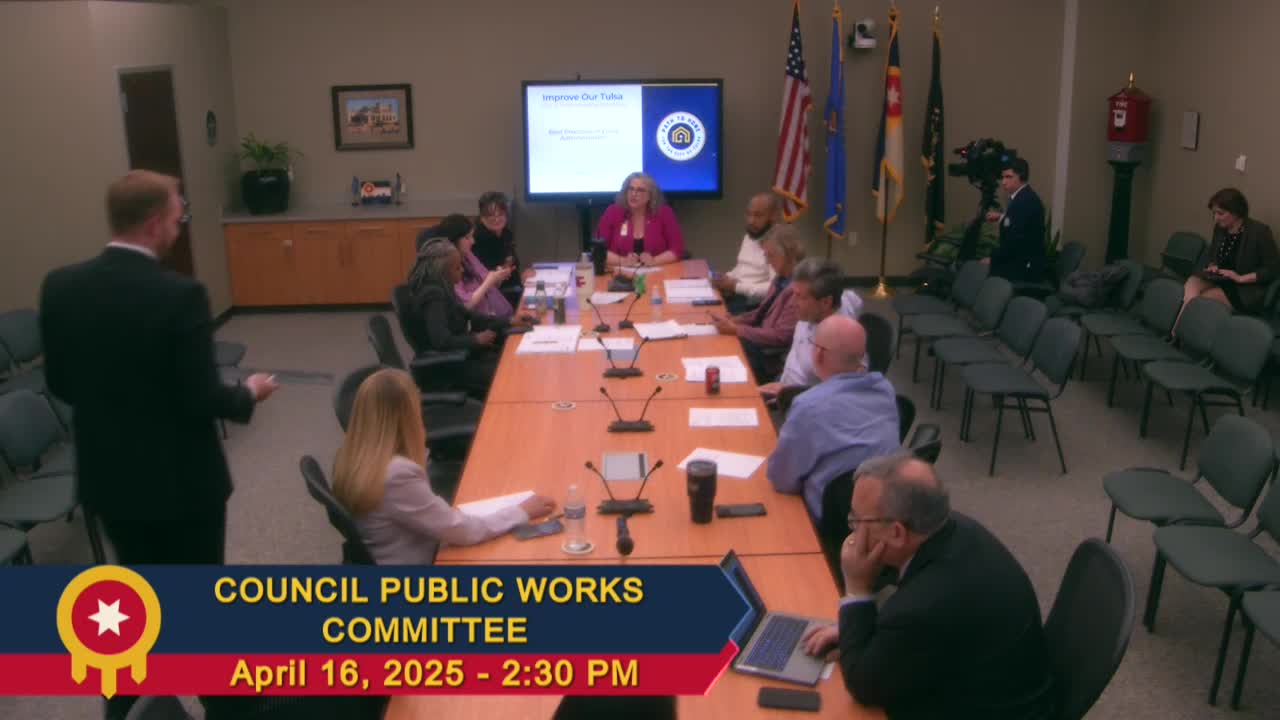
Travis Holst, Tulsa’s housing director, told the Public Works Committee on April 30 that city staff are preparing a request for proposals to identify how the voter-approved $75 million Improve Our Tulsa (IoT) housing funds should be administered.
“We’re talking about the city of Tulsa, $75,000,000,” Holst said as he framed the presentation. He said staff received roughly 60 responses to a request for information from developers and expects many more project proposals when programs are launched.
The committee heard staff describe four program categories the city is considering: a grant fund, an investment/loan fund, an acquisition fund and infrastructure support, plus preservation/rehabilitation programs for existing housing. Holst said some peer cities use third-party administrators for developer-focused loan and investment programs while keeping infrastructure, water and sewer work under city departments.
Jean Goldmesh, senior advisor to Mary Nichols, joined Holst and described infrastructure as typically remaining within public works. “Infrastructure, you know, we have public works and infrastructure departments and sewer and water teams who are doing that work,” Goldmesh said.
Committee members pressed staff on timing and scale. Holst said a competitive RFP process to select an external fund administrator typically takes about 120 days from drafting to contract, but that shorter timelines are possible where proposals and community demand already exist. “As quickly as people can move, we can move,” Holst said when asked if the process could accelerate.
Several councilors urged faster action and clarity on bonding. The resolution the council approved in November contemplates bonding up to $35 million of the IoT funds; staff said they will return with recommendations after completing a review of the RFI responses. Holst said the RFI results will help determine whether the city should bond the full authorized amount or a smaller amount based on projected pipeline demand.
Councilors also asked about fundraising and private leverage. Holst and Goldmesh said third-party administrators typically handle private fundraising and philanthropic outreach, and that outside managers can often raise additional capital more effectively than the city. Holst said examples from peer cities include partnerships with local Community Development Financial Institutions (CDFIs) and nonprofit intermediaries that blend public and private dollars.
Committee members repeatedly raised aging public infrastructure as a constraint on development. Holst said public works and water-and-sewer staff were working in parallel to map capacity and that infrastructure questions will be part of project evaluation when the city designs incentive policies.
Staff asked council members to submit high-level objectives they want in any RFP (for example: fundraising capacity, transparency and city accountability) before the next meeting. Holst said staff plan to return to the committee with RFP objectives and a recommended timeline, and then to bring bond recommendations and program design in the coming months.
Why it matters: The administration model — city-run programs versus third-party managers — affects how quickly projects can be funded, the amount of private leverage that can be raised, and how the city exercises oversight of public dollars. The committee’s direction will shape the mechanics of allocating up to $75 million in public funds tied to a broader $370 million fundraising goal described in the housing strategy.
Staff said next steps will include a summary of the 60 RFI responses, drafting a potential RFP, and a return to the committee for guidance on bonding and program priorities.