Get Full Government Meeting Transcripts, Videos, & Alerts Forever!
Get email alerts on the Land Use Development topic
No spam. Unsubscribe anytime.
Hemet council refuses to certify EIR for Simpson warehouse project after hours-long public hearing
Summary
After a packed public hearing with more than 60 public commenters, Hemet City Council voted 5-0 to decline certification of the environmental impact report for the Newland Simpson warehouse project and directed staff to return with a denial resolution and next steps.
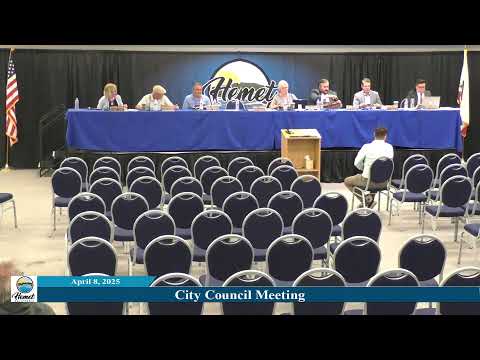
Hemet City Council on April 8 declined to certify the environmental impact report (EIR) for the proposed Newland Simpson logistics project, a development that would have built two high-cube warehouse buildings totaling roughly 1.19 million square feet on about 74.88 acres near the intersection of Domenigoni Parkway, Simpson Road and Warren Road.
The vote followed a multi-hour public hearing that drew more than 60 speakers, a developer presentation, and detailed staff reports. Councilmember Kroupa moved to not certify the EIR; Councilmember Lodge seconded. The motion passed 5-0. The council instructed staff to prepare a resolution formalizing the denial and to return the matter on a future agenda.
The proposal, advanced by Newland Capital Group with Rialto Distribution identified as the prospective tenant, would have included two warehouse buildings (approximately 883,080 square feet and 309,338 square feet), an ancillary trailer parking area, on- and off-site street and utility improvements, 47 electric vehicle chargers on site, and funding offers such as $75,000 toward a signal synchronization study and $50,000 toward a Dominigoni Parkway median study. Developer and consultant presentations included a fiscal-impact analysis by DPFG estimating about 1,309 permanent on-site jobs and construction-period employment and an overall public-benefit package that Newland said exceeds $3 million in commitments since the earlier Planning Commission hearing.
Opposition from residents and community groups was broad and sustained. Speakers cited concerns about truck traffic on Warren and Simpson roads, air quality and greenhouse-gas emissions, noise, impacts on local roads and bridges (including the aging Warren Road bridge), encroachment on agricultural land, impacts on nearby neighborhoods and parks, and a lack of robust community outreach. Many senior residents emphasized health risks and reduced quality of life. The Planning Commission previously recommended denial (a 0–5 vote) after concluding the economic benefits did not outweigh significant and unavoidable impacts.
Representatives of Rialto Distribution and several union trade groups spoke in favor of the project, stressing job creation, workforce training programs, local hiring and benefits, and commitments to site sustainability measures such as rooftop solar and electric trucks. Developers also presented revised design changes intended to improve aesthetics, additional landscaping, and infrastructure commitments to widen or repave adjacent road segments and to construct or fund segments of the Salt Creek Trail.
City staff and environmental consultants summarized the EIR analysis and noted several significant and unavoidable impacts that the report disclosed, including greenhouse-gas emissions, noise on Warren Road (where existing noise levels lower applicable thresholds), loss of agricultural land, and vehicle-miles traveled (VMT) impacts tied to the location. Staff said some project adjustments—such as removing the larger building—would be required to eliminate certain identified impacts.
Councilmembers said they were sympathetic to job-creation arguments but raised persistent concerns about scale, gateway aesthetics, cumulative traffic and air impacts, and whether the city’s West-side planning guidance and general plan had adequately anticipated this scale of industrial development. Multiple councilmembers said they were not prepared to certify the EIR as presented and asked the developer and staff to consider revisions or remand the project for further review if the applicant wished.
The council approved a motion not to certify the EIR (5-0). The city attorney noted that if the council cannot certify an EIR it cannot approve the project; the council asked staff to return with a resolution documenting the decision and outlining next procedural steps.