Get Full Government Meeting Transcripts, Videos, & Alerts Forever!
Get email alerts on the Workforce Development topic
No spam. Unsubscribe anytime.
North Coast Opportunities’ BUILD program reports high placement rate, wins ARPA extension for Lake County cohorts
Summary
North Coast Opportunities updated the Lake County Board of Supervisors on its BUILD (Building Up Individuals and Local Development) workforce program, reporting multi‑year placement figures, a forthcoming application window and a $265,000 extension to an ARPA grant that raises program funds to $1,065,000.
At a Lake County Board of Supervisors meeting, North Coast Opportunities (NCO) staff presented updated outcomes for the BUILD (Building Up Individuals and Local Development) program and said an ARPA grant extension has increased available funds for program work in Lake County.
Justin Gaddy, director of community wellness at North Coast Opportunities, told supervisors the program combines paid, apprenticeship‑style training with community construction work to create pathways to long‑term employment in the trades. “Our mission is to support individuals and families in achieving self reliance while building stronger, more resilient communities across the region,” Gaddy said.
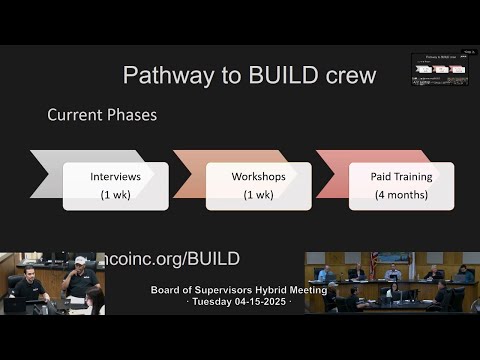
NCO described the BUILD construction fundamentals track as a four‑month, paid earn‑and‑learn program that typically receives about 60–65 applications per cohort and narrows applicants to six participants for paid training. Trainees are generally adults 18 and older who face barriers to employment such as lack of experience, housing instability, transportation challenges or justice involvement. The in‑program training is roughly 300–400 hours and includes hands‑on site work, tool training, safety certifications (CPR/First Aid, OSHA 10) and classroom time through partners such as Mendocino College’s Lake Center.
Mike Willis, project coordinator and crew coach for BUILD, described individual repair projects the crew has completed for residents, and a homeowner video thanked the team for installing a new front door and other repairs. Willis said the program has completed projects that include accessibility and habitability repairs and that crews have performed 43 projects countywide: 6 transitional housing, 31 rental units and 8 owner‑occupied homes.
Presenters summarized multi‑year participant outcomes: about 48 participants over roughly five years; approximately 36 participants completed on‑the‑job training (the program says OJT runs at least 300 hours while it aims for 400); and presenters reported 32 graduates employed plus two early placements, for a stated total of 34 employed builders. Presenters framed that result as an 89 percent placement rate for graduates they track, higher than the roughly 50 percent benchmark cited for similar state workforce programs.
Funding and next steps: Gaddy said the program’s Lake County ARPA allocation was originally $800,000 and that a $265,000 extension approved late last year raised the total available to $1,065,000. He said some line items reflect combined spending with a smaller “Breaking Barriers” grant used to cover costs that ARPA could not. Gaddy provided a partial spending summary (personnel, operating, program supplies) and said approximately $50,000 in program supplies covered materials such as doors and lumber used on projects. The presentation noted that ARPA funds were subject to state/federal deadlines for expenditure and that the extension created the spring cohort funding.
Program growth: presenters said applications for the next (fall) cohort open June 15 and close Aug. 15, and that the fall crew will include six paid positions. Justin Gaddy also said NCO plans additional specialty tracks by year‑end for HVAC and solar work to give graduates additional pathways and to allow some participants to remain in training for up to a year to accumulate hours toward contractor licensing.
Supervisors commented in support. Supervisor Pyska described the program as “what generational change looks like” and urged colleagues to attend graduations. Supervisor Spatier suggested exploring ways to embed BUILD crew opportunities into future county housing contracts or development agreements to reduce barriers to crew participation on larger projects.
No formal board action or vote was recorded on the agenda item during the presentation; supervisors asked for future updates when new specialty tracks and funding details are available.
The presentation included specific employer and training partners named by presenters, and several individual success stories were given as examples of how participants moved into steady work and housing following graduation.