Get Full Government Meeting Transcripts, Videos, & Alerts Forever!
Get email alerts on the Monetary Policy topic
No spam. Unsubscribe anytime.
Cleveland Fedpresident outlines cautious outlook, urges regional engagement amid tariff uncertainty
Summary
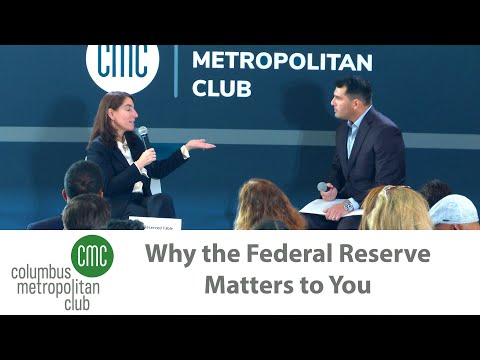
At a Columbus Metropolitan Club forum, Beth M. Hammock, president and CEO of the Federal Reserve Bank of Cleveland, described a mixed U.S. economic picture, warned that recent tariff actions raise risks of simultaneous slower growth and higher inflation, and urged Central Ohio stakeholders to share local economic information with the Fed.
Beth M. Hammock, president and CEO of the Federal Reserve Bank of Cleveland, said the U.S. economy faces a mixed outlook and that the Fed is monitoring heightened uncertainty from recent tariff actions during a Columbus Metropolitan Club forum at the Ellis in Columbus.
Hammock said the Cleveland Fed's work combines national monetary policy input with local outreach. "We start by looking no further than our own backyard," she said, noting the Cleveland Fed represents all of Ohio, western Pennsylvania, eastern Kentucky and the Northern Panhandle of West Virginia.
The Fed president summarized the central bank's roles and recent indicators: supervision of more than "260 financial institutions" in the district, operation of payment services, consumer-protection and community-development work, and participation in the Federal Open Market Committee (FOMC) that sets monetary policy. She said the FOMC has a dual mandate to achieve maximum employment and stable prices and generally meets about eight times a year.
Hammock cited recent data showing a healthy labor market but continued elevated inflation. "The unemployment rate was 4.2% in March," she said, and "headline PCE inflation was 2.5% through February," with core PCE somewhat higher. She told the audience that much of the hard data is backward-looking and emphasized the Fed's reliance on district contacts and research to interpret where the economy is headed.
A central theme of the discussion was uncertainty from trade policy. Hammock described recent tariff changes as "a substantive trait change in trade policy" whose full economic effects will take time to appear. She warned this raises the risk of a "stagflationary impulse" ' a scenario of slower growth and higher inflation ' and said that would complicate policy because the Fed must weigh risks to both employment and inflation.
"When clarity is hard to come by, waiting for additional data will help inform the path ahead," Hammock said, adding that the current modestly restrictive policy stance is appropriate to keep downward pressure on inflation. She said the Fed is watching financial conditions closely and adjusting its assessment as incoming data and district anecdotes arrive.
Audience questions covered the tariffs' district-level effects, market moves that saw Treasury yields and equities fall at the same time, and how the Fed's community-development work addresses housing and workforce issues. Hammock said the dominant theme she hears from businesses is uncertainty about how tariffs and policy changes will affect investment and supply chains. She said some businesses might raise prices in response to competitors affected by tariffs, a dynamic the Fed will monitor.
On community development, Hammock pointed to three focus areas for the Cleveland Fed: housing affordability, small businesses and workforce development. She described district programs and partnerships she has seen, including Lorain County Community College's employer-focused training programs, the Cleveland Food Bank's community resource center that co-locates services, and similar wraparound service efforts in Cincinnati.
Hammock also asked residents and organizations to engage with the Cleveland Fed as Beige Book contacts or advisory-council members. She said the Fed views regional outreach as essential for bringing local perspectives into national policy discussions: "Please get involved with the work that we're doing at the Cleveland Fed to thoroughly represent all parts of the district."
In closing, Hammock said she would like the Cleveland Fed to be a trusted resource so community leaders "pick up the phone and say, gosh, I wonder what the Cleveland Fed would say about this" when major issues arise. She noted the Cleveland Fed will host its policy summit in late June and described plans to continue amplifying local programs and research.
This event was primarily a public forum and discussion; no formal actions or votes were taken.