Get Full Government Meeting Transcripts, Videos, & Alerts Forever!
Get email alerts on the Pension Funding topic
No spam. Unsubscribe anytime.
City pension officials warn market swings could boost Milwaukee contribution needs; sales tax allocation complicates outlook
Summary
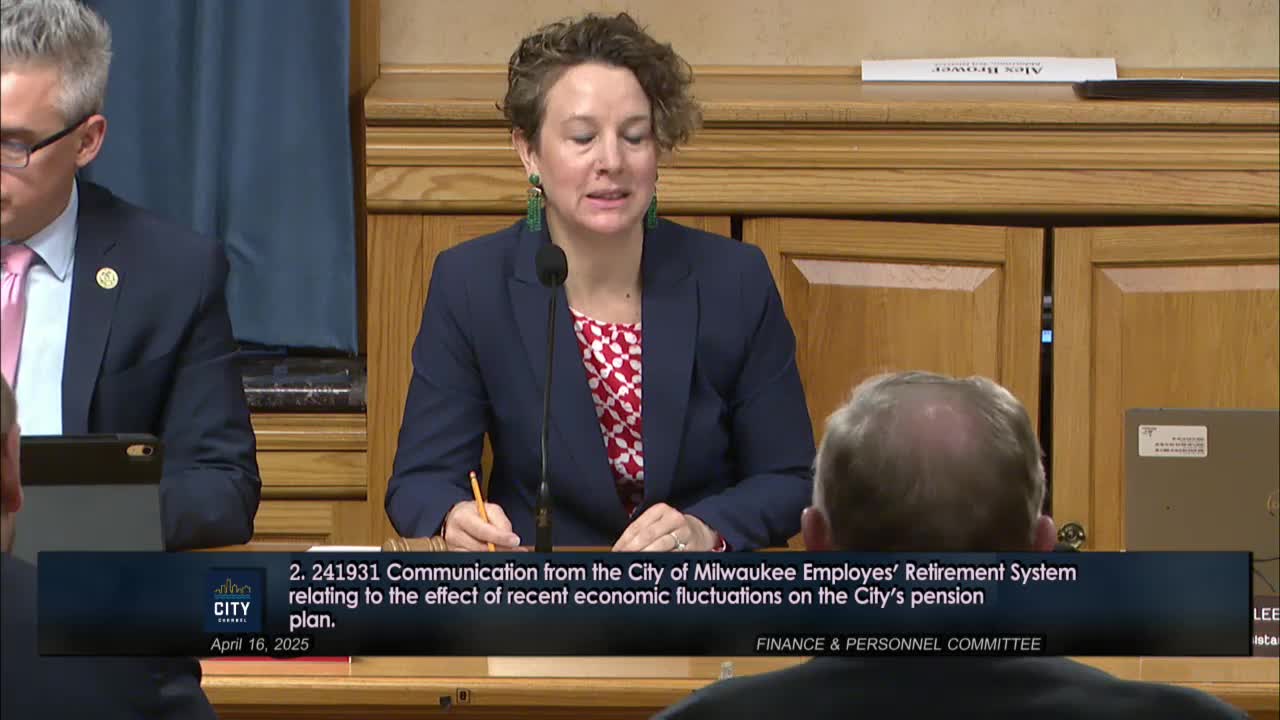
The City of Milwaukee Employees’ Retirement System presented to the Finance and Personnel Committee about recent market volatility, saying the $5.92 billion fund was about -0.6% year-to-date at a recent estimate and that failing to meet the 6.8% actuarial target creates multi-year budget pressures. Officials and the actuary said Act 12 and other
Officials for the City of Milwaukee Employees’ Retirement System told the Finance and Personnel Committee that market swings and recent changes in state law could increase the city’s required pension contributions in coming years.
Jerry Allen, executive director of the Employees’ Retirement System (ERS), told the committee the fund was resilient historically but had moved from an estimated +1.9% as of March 24 to an estimated -1.5% on April 9 amid market volatility; ERS Chief Investment Officer David Silber reported a year-to-date return of about -0.6% in a recent estimate and a fund value near $5.92 billion. Silber said the fund’s relatively modest exposure to public domestic equities helped reduce downside volatility compared with some peers.
Why it matters: Under Act 12, the pension-related portion of the recently enacted sales tax is earmarked for pension costs, but the ERS actuary warned that actuarial smoothing and the assumed 6.8% investment return mean large market declines can translate into materially higher city contribution requirements over several years.
Actuarial scenario: Larry Langer, the fund’s independent actuary with Kevin and McDonald, said the plan’s funding rules smooth investment returns over five years. “For example, if we miss our bogey by 1%…on a $6,000,000,000 fund, that’s $60,000,000. It doesn’t get recognized immediately because we…smooth our asset values over 5 years. So only 1 fifth of that gets recognized in any 1 year, but still, that’s a big number. It’s $12,000,000. That's a huge impact on the city budget,” Langer said.
Langer also said Act 12 removed the city’s prior “stable contribution policy,” lowered the discount rate used in valuations and set longer amortization windows in some cases; those changes raise the risk that employer contribution amounts will be higher and less predictable. He presented a projection in which employer contributions could rise to roughly $206 million by 2028 under some smoothing assumptions — roughly $30 million higher than earlier projections used in legislative analyses when Act 12 was considered.
Scope and allocations: ERS staff explained that 90% of the 2% sales tax, up to the statutory cap, is designated for pension-related costs (unfunded liabilities and normal cost increases) and up to 10% may be used for police and fire public safety spending. Officials cautioned that the statutory allocations and reporting obligations under Act 12 add complexity to budgeting decisions.
Ending: Committee members asked the budget director for a memo describing the fiscal effects and to work with ERS, the comptroller and the city attorney on forecasting and reporting. The committee placed the communication on file for follow-up.