Get Full Government Meeting Transcripts, Videos, & Alerts Forever!
Get email alerts on the Affordable Housing topic
No spam. Unsubscribe anytime.
Habitat for Humanity asks Wicomico County for temporary property tax credit and down-payment funding
Summary
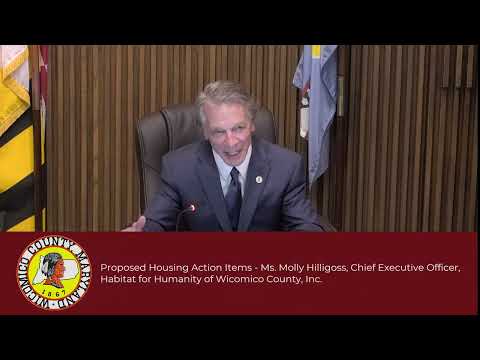
Molly Hillegas, chief executive officer of Habitat for Humanity of Wicomico County, told the Wicomico County Council at an April 15 work session that Habitat needs a short-term property tax credit and down-payment assistance (proposed $40,000 per household) — potentially funded with cannabis tax revenue — to close affordability gaps created as home prices doubled in the last decade.
Molly Hillegas, chief executive officer of Habitat for Humanity of Wicomico County, told the Wicomico County Council at a work session April 15 that rising home prices and stagnant wages have created a widening affordability gap and asked the county to consider two short-term measures: a property tax credit for Habitat while it rehabs properties and a $40,000 down-payment assistance fund drawn from cannabis tax revenue.
Hillegas said housing prices in the county have more than doubled over 10 years, noting a home sold for $97,000 a decade ago and similar homes now list for roughly $272,000. She said Habitat is required to sell at fair market value and that the gap between loan limits for lower-income buyers and listing prices is the primary barrier to homeownership for the families Habitat serves.
In an example she presented, a family of four at 60 percent of area median income (AMI) with annual income of $56,208 could receive a maximum mortgage of about $159,000 while the median listing price for a livable home is roughly $299,000 — an affordability gap of about $139,949 and a total need of about $157,889 once down payment and closing costs are included. Hillegas proposed a down-payment-assistance program that could provide $40,000 per household and suggested cannabis tax revenue as a funding source. She also said a short-term property tax credit while properties are rehabilitated — for no more than five years, she suggested — would reduce Habitat’s carrying costs and allow the nonprofit to acquire and rehab more homes. Hillegas estimated the direct impact to the county budget would be “a little over $3,000 for FY26.”
Council members asked for clarifications about the tax credit’s scope and duration. Hillegas said the credit would apply only during redevelopment and might be shorter than five years depending on project timelines (rehabs, she said, can take one to three years; new construction can take longer). She described a typical financing mix for Habitat: down-payment assistance, a “silent third mortgage” from Habitat on the resale, and other program funds; she said the proposed $40,000 down-payment assistance would reduce the silent mortgage amounts for many households but would not eliminate the need for some Habitat financing.
Council responses were mixed. One council member said he was “worried about the precedent it sets when we start giving tax breaks to nonprofits,” citing prior requests the council denied; another said the request seemed financially small relative to the county budget and noted that Habitat’s rehabilitations also produce neighborhood economic benefits — increasing property values and generating contractor jobs. A council member asked whether the county executive supported the cannabis-tax funding idea; Hillegas said the county executive had been supportive in prior conversations and that Habitat would apply for cannabis-revenue grants as available.
Hillegas said Habitat’s current capacity averages roughly three houses a year and that the tax relief and down-payment assistance could allow the nonprofit to double that work. She asked the council to consider either a cap on the program (for example, a fixed number of properties over a fixed term) or a capped dollar amount to limit fiscal exposure.
Council members did not take formal action at the work session. The council indicated it would review the request further — possibly in a second work session or as a resolution referred to a future meeting — and that staff would follow up with Habitat on details the council requested, including exact property counts, estimated fiscal impact, and program caps.
Why it matters: The request attempts to address an affordability gap the nonprofit described in detail, and it ties a local revenue stream (cannabis tax receipts) to housing assistance. Council members signaled interest but also concern about precedent, program scope and fiscal limits.
What’s next: The council will revisit the proposal at a later meeting or work session; staff indicated they would notify Habitat of the council’s inclination and of any next steps.