Get Full Government Meeting Transcripts, Videos, & Alerts Forever!
Get email alerts on the Department Overview topic
No spam. Unsubscribe anytime.
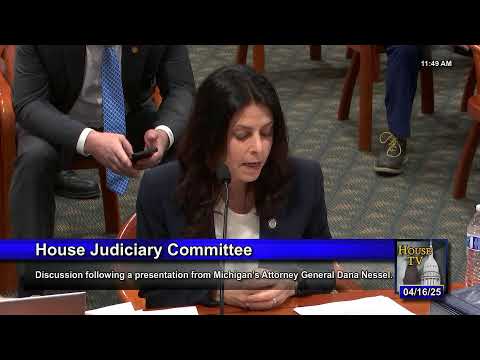
Attorney General Dana Nessel briefs House Judiciary Committee on department priorities, litigation and victim services
Summary
Attorney General Dana Nessel told the Michigan House Judiciary Committee that the Department of Attorney General represents the state and its people, outlined the office’s major programs and litigation results, and identified legislative priorities for the session.
Attorney General Dana Nessel told the Michigan House Judiciary Committee that the Department of Attorney General represents the state and its people, outlined the office’s major programs and litigation results, and identified legislative priorities for the session.
Nessel said the department handles a large caseload, produces significant recoveries for the state, and provides services including consumer protection, criminal prosecutions, elder-abuse investigations and specialized units such as a retail-theft task force and a new parole-appeals unit. She also described ongoing work on opioid settlements, human trafficking, guardianship reform and consumer‑protection litigation.
Nessel opened by describing the office’s role: “I am the lawyer for the state of Michigan, for the governor, but also for the people,” and stated the office’s annual caseload and financial impact. She said the department handles roughly 48,000 cases a year (not including investigations, expungement requests or trainings), operates on a small portion of the state general fund, and that “for every dollar the state pays for our department, we bring $4 back to the state and to the state residents.”
Nessel gave specific recent results: she said the office recovered over $505 million in awards payable to the state and residents in 2024 and that the department’s average annual recoveries exceed $435 million. On opioid litigation she said the state has passed 11 settlements to date, with total awards in the low billions and $282 million already paid into the Michigan Opioid Healing and Recovery Fund; local governments have received more than $176 million from those settlements.
She described the department’s consumer-protection work and enforcement divisions, saying the office fields roughly 20,000–24,000 consumer complaints per year and recovered more than $16 million in direct consumer and state recoveries last year. Nessel urged stronger consumer-protection statutes, characterizing Michigan as an outlier among states with more limited civil remedies.
Nessel summarized several criminal‑justice and victim‑services units: the Criminal Justice Bureau and a specialized “Saki” unit for sexual‑assault kit testing and prosecutions; Operation Survivor Justice for extradition and prosecution of defendants who fled the state; an Address Confidentiality program (about 315 current participants) for victims of violence; a Sentinel Project that conducts unannounced inspections of long‑term‑care facilities; an organized retail‑crime unit that she said has charged more than 85 defendants and recovered millions in merchandise and cash; and a parole‑appeals unit created to assist victims and prosecutors in challenging early parole decisions.
On the Sentinel Project, she described surprise visits to nursing homes to check for care problems and said the program has led to criminal referrals and other enforcement actions. On parole appeals, she said the office is alerted mainly by victims who receive parole notices and that the department must often assemble decades‑old case files quickly to seek circuit‑court review of a parole decision.
Nessel listed legislative priorities she planned to bring to the committee, including human‑trafficking legislation, guardianship and conservatorship reform, and changes to consumer‑protection law. She also discussed an office initiative to track Social Security problems and began collecting reports after recent federal field‑office reductions.
Committee members asked questions after the presentation on topics including parole‑appeal staffing and timelines, guardianship enforcement, the Sentinel Project, job‑court outcomes, and the status of a Michigan Supreme Court case (Eli Lilly) that bears on consumer‑protection authority. Nessel said the Eli Lilly matter required supplemental briefing and reargument and that the department supports legislative fixes in addition to litigation.
The committee did not take formal action on the presentation; members followed with questions and a request for follow-up materials.