Get Full Government Meeting Transcripts, Videos, & Alerts Forever!
Get email alerts on the Probate Timing Statute topic
No spam. Unsubscribe anytime.
Utah Supreme Court considers whether three-year probate deadline can be revived under savings statute
Summary
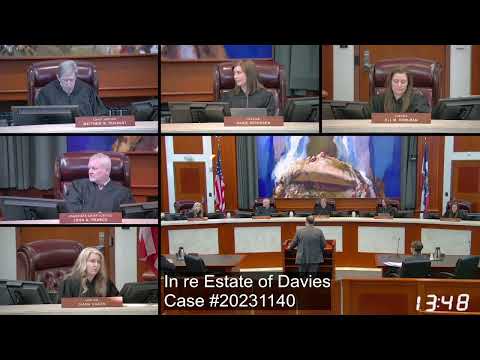
SALT LAKE CITY — The Utah Supreme Court heard argument on whether Utah’s three-year probate timing provision bars later attempts to admit a will, or whether the state’s savings statute can permit refiling after an initial probate petition was dismissed for failure to prosecute.
SALT LAKE CITY — The Utah Supreme Court heard argument on whether Utah’s three-year probate timing provision bars later attempts to admit a will, or whether the state’s savings statute can permit refiling after an initial probate petition was dismissed for failure to prosecute.
Nathan Garcia, arguing for Tiffany Harmon and her siblings, told the court the probate-code timing rule should operate as a strict cutoff tied to the decedent’s date of death. Garcia said the Court of Appeals treated the provision as a statute of repose and that allowing the savings statute to revive a dismissed probate petition would “delay the ability for the swift administration of the estate and for the distribution of the estate towards the heirs.” He described the facts here as a petition that was first dismissed for failure to prosecute and then refiled 364 days later under the savings statute.
Garcia asked the high court to confirm that the probate provision measured from the date of death sets an absolute limit on admitting a will: “We believe it is a statute of repose because it starts from the date of the death of [the] decedent as opposed to an accrual of the cause of action.” He warned that permitting revival could require reopening estates many years after death; counsel noted the decedent in this case has been dead for almost nine years.
Counsel for the opposing parties, identified in the transcript as Ms. Adams, urged the court to treat the timing rule as a statute of limitations subject to equitable tolling. Adams, citing this court’s earlier decision in Brimo v. Martineau (discussed in briefing), said the court has applied equitable tolling to the probate timing rule in the past and that the statute’s text and the court’s precedents support applying the savings statute. “Justice Pullman is right, this is a different beast,” Adams told the bench, arguing the statute is triggered by death and that prior Utah decisions have allowed tolling and grace periods in probate contexts.
The parties debated the meaning of the statutory term “probated” and whether merely commencing a probate action within three years satisfies subsection 1 of the timing provision or whether more — such as notice and appointment of a personal representative — must occur within that window for the will to be considered probated under subsection 3. Garcia relied on older precedents that interpret “probated” to require some administrative actions, while Adams cited cases and statutory interpretation principles supporting application of the savings statute and judicially recognized tolling doctrines, including this court’s prior discussion of the probate code’s scope.
Justices questioned both sides about practical consequences. One justice observed that allowing revival could produce late claims and evidentiary difficulties; another asked whether the court’s prior decisions already resolved the question by treating the timing statute as a limitations provision. Counsel for both sides pointed to differing out-of-state and appellate-court treatments of similar timing rules; Adams argued Utah precedent (including decisions this court cited in briefing) supports application of the savings statute and equitable tolling in probate matters.
The court took the arguments under advisement and adjourned. No opinion was announced at the hearing.
Votes at a glance: no legislative motions or votes were taken; this was an appellate oral argument proceeding.