Get Full Government Meeting Transcripts, Videos, & Alerts Forever!
Get email alerts on the Water Rights topic
No spam. Unsubscribe anytime.
Utah Supreme Court weighs whether water-application appeal survives applicant’s death
Summary
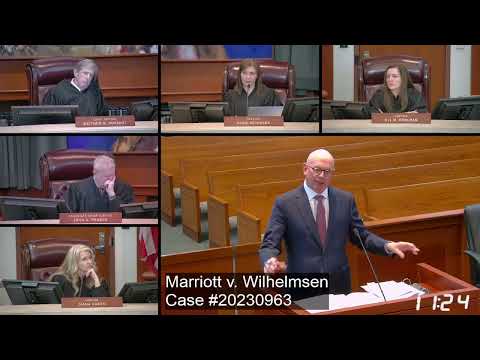
The Utah Supreme Court heard argument in Marriott v. Helmsen on whether an appeal of a state engineer’s denial of a water-appropriation application survives the applicant’s death and can be continued by the applicant’s personal representative.
The Utah Supreme Court heard argument in Marriott v. Helmsen on whether an appeal of a state engineer’s denial of a water-appropriation application survives the applicant’s death and can be continued by the applicant’s personal representative.
The issue was joined by counsel for the appellant, Robert Mansfield; counsel for Weber Basin Water Conservancy District, Melissa Reynolds; and Andrew Dimock for the State. The court’s questions focused on three legal lines: whether an application to appropriate water is a property interest that can survive death under common law, whether Utah’s water code precludes applying common-law survivability rules, and what practical effects survival would have on the statutory administrative review process.
Appellant counsel Robert Mansfield, representing the estate’s proposed personal representative, said the application should survive. “We believe that that claim would survive, the death of mister Marriott under the common law,” Mansfield told the court, arguing that the application gives “rights … to possess, use, enjoy, and dispose of a thing” under property definitions the parties cited in briefing.
Melissa Reynolds, counsel for Weber Basin Water Conservancy District, acknowledged that filing an application creates a priority date but emphasized how tentative that interest is. “Once you file an application, you have a chance to obtain a water right, but that’s all you have,” Reynolds said, pressing that an unapproved or rejected application is not the same as an approved, vested water right.
Andrew Dimock, representing the State, argued the water code displaces common-law survivability, saying, “The Water Code water rights are entirely a creature of statute.” Dimock pointed to Title 73 provisions, including the provision that a person may acquire the right to use public waters only as provided in the code, and argued the statute does not provide for a personal representative to acquire a water right when the original applicant dies.
Justices tested both sides on finer points. Justice Hagan asked whether the court should treat the matter as “a cause of action” or as a statutory request for judicial review of an agency decision. Mansfield responded that the statutory right to de novo review effectively creates a cause of action that can be evaluated for survivability. The State questioned whether allowing survivability would conflict with the water code and the code’s comprehensive allocation scheme.
Counsel and justices also discussed statutory mechanics: Utah Code Ann. §73-3-18(5) (assignment of applications before a certificate issues), §73-3-1 (who may acquire water rights under Title 73), and the probate code definition of property cited at oral argument (75-1-201). Counsel described the factual scope of the application: the briefs and argument referenced an application filed decades earlier that sought a very large appropriation—argued in court as roughly 4,000,000,000 gallons per year, irrigation of about 2,000 acres and watering several thousand head of cattle—illustrating why priority dates and proof of beneficial use matter to land value.
The State and Weber Basin emphasized practical consequences if survival were recognized: the judicial review proceeding substitutes the court into the state engineer’s role and examines conjunctive statutory factors (including water availability, interference, feasibility and financial ability). Dimock argued those inquiries are personal to the applicant’s financial and operational capacity and that an applicant’s death can change the factual record the agency and judge must evaluate.
Appellant counsel countered that courts have treated inchoate property-related rights as survivable in other contexts and asked the court to apply a property-focused survivability test rather than a tort-only rule. Counsel cited Gressman and other precedents discussed in briefs and at argument; the State and Weber Basin urged the court instead to respect the statutory scheme and to avoid expanding survivability beyond established common-law categories or the legislature’s terms.
The justices did not announce a decision from the bench. Chief Justice: “We will take it under advisement,” the court said at the close of argument. The court’s eventual opinion will determine whether a decedent’s personal representative may be substituted in an appeal of a state engineer’s denial of a water-appropriation application or whether the statutory framework requires any successor to start a new application process.
Background: The dispute arises from an appeal of a state engineer’s rejection of a water-appropriation application filed by the decedent, Randy Marriott. The estate seeks substitution of Cammy Marriott as personal representative to continue the appeal under Utah R. Civ. P. 25(a)(1). The key legal question is whether the right to pursue judicial review of the agency decision constitutes a survivable interest under state common law or whether Title 73 preempts such a survivability rule.