Get Full Government Meeting Transcripts, Videos, & Alerts Forever!
Get email alerts on the Fentanyl Emergency Ordinance topic
No spam. Unsubscribe anytime.
San Francisco supervisors grant mayor expanded emergency powers to tackle fentanyl, homelessness
Summary
The San Francisco Board of Supervisors on Jan. 28 passed an ordinance amending the administrative code to give Mayor Lurie expedited contracting and other temporary authorities aimed at accelerating homelessness, mental-health and overdose response. The measure passed 10–1 after committee amendments that set limits and reporting deadlines.
On Jan. 28, 2025, the San Francisco Board of Supervisors approved an ordinance amending the administrative code to give the mayor temporary authorities intended to speed procurement, hiring and service delivery aimed at homelessness, drug use and mental-health crises. The board voted 10–1 to pass the measure as amended; Supervisor Shimon Walton cast the lone no vote.
The ordinance, introduced from the budget committee, allows the executive branch to use expedited contracting and to accept certain non-governmental donations tied to the city's "core initiatives," subject to new limits. Supervisor Chan, the budget committee chair, told colleagues the amendments include a $10,000,000 cap on non-government donations tied to the core initiatives, clarifications about how the measure is published by the Clerk of the Board, and a narrowed scope and deadline for the temporary waiver of the city's behested payments policies. "We are limiting at $10,000,000," Chan said while outlining the changes.
Supervisor Jackie Fielder, a co-sponsor, said she would vote in support but stressed the size of the change. "With my vote, I want to be clear that this ordinance is an unprecedented transfer of power and a significant transfer of responsibility to Mayor Lurie to transform street conditions over the next year," Fielder said. She urged the mayor to accompany the ordinance with a concrete operational plan for treatment and shelter capacity and cited examples abroad she said offered useful models for combining enforcement, treatment and outreach.
Supervisor Shimon Walton opposed approving the authority without a plan in hand. Walton called the measure "premature" and warned it could create fiscal exposure. "So we are talking about the possibility of a blank check and at least a hundred million dollars and the mayor can change already approved budgets without any process," Walton said.
Board members said amendments were drafted with an eye toward preserving legislative oversight while speeding the executive's ability to stand up treatment beds, shelter and street outreach. The amended ordinance sets a firm deadline for the temporary authorities and requires the executive to return to the board with operational details before certain authorities lapse; as presented during the meeting, the package includes a deadline tied to Jan. 8, 2026 for aspects of implementation and review.
The board took the amendments up at the start of the debate; Supervisor Chan moved the circulated amendments and Supervisor Jackie Fielder seconded them. The amendments were adopted without objection. The ordinance then passed on a roll-call vote of 10 ayes, 1 no.
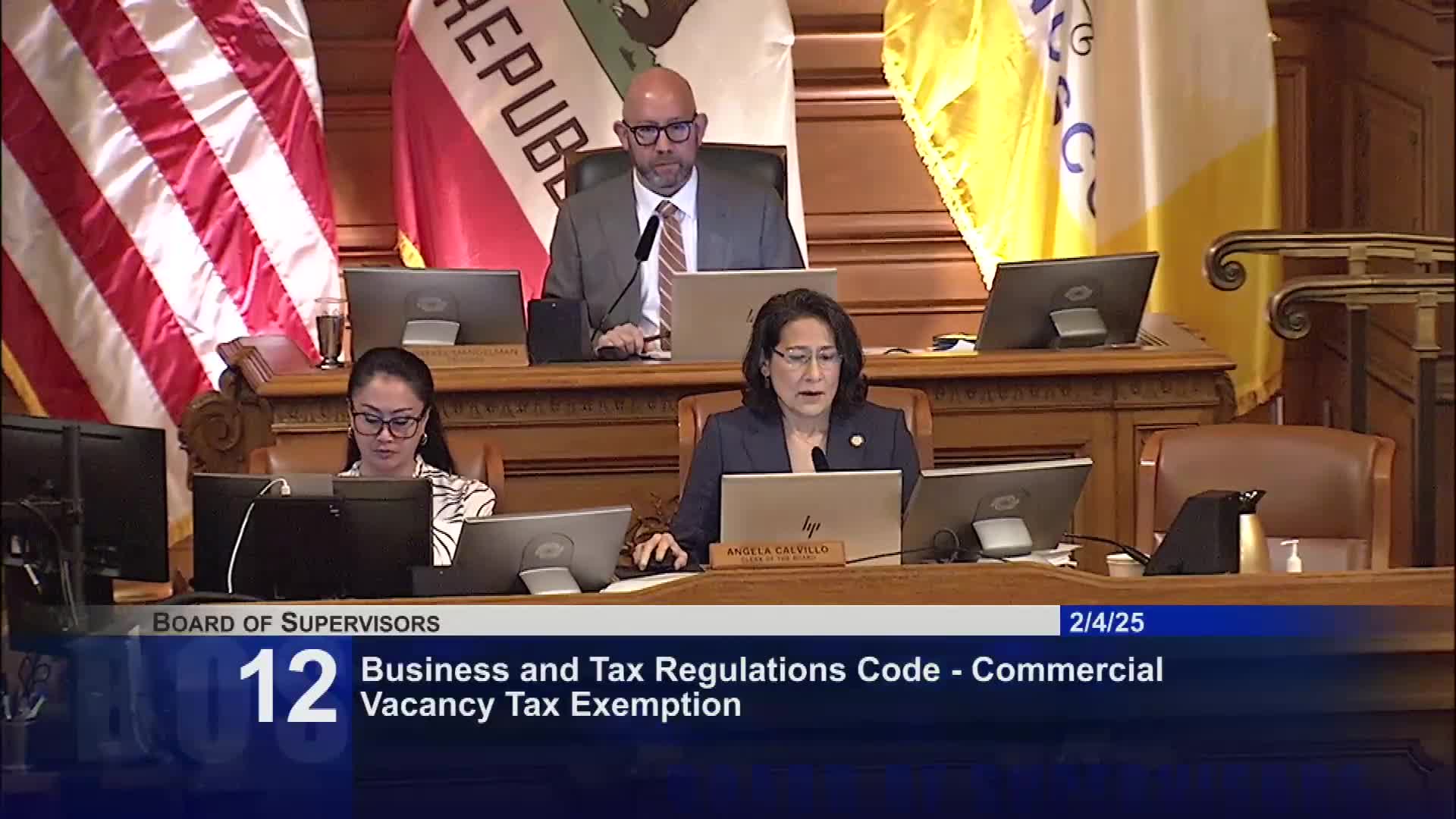
Votes at a glance: the board also approved a range of unrelated resolutions and ordinances during the meeting, including first-reading passage of two Port of San Francisco refunding certificates of participation (items 10 and 11), an exemption to the commercial vacancy tax for certain construction zones (item 12, first reading), a third amendment to a grant agreement with Episcopal Community Services increasing funding for rapid rehousing by $11,500,000 to a total of $21,500,000 and extending the term to June 30, 2027 (item 14), and four multi-year contracts for the Department of Children, Youth and Their Families totaling roughly $48.6 million across items 15–18. Numerous leases, retroactive grant acceptances and administrative resolutions (items 19–33) were also adopted; where dollar amounts were stated in the record, they are reflected in the meeting transcript and included below in the actions list.
Why it matters: the ordinance hands the mayor's office temporary tools intended to accelerate responses to drug overdoses, homelessness and mental-health crises, while the board's amendments aim to preserve some legislative oversight and set limits on private funding and the waiver authority. Supporters said the change will let city agencies "cut through red tape" and deploy life-saving services faster; critics said the board is granting broad authority without a detailed plan or a bounded fiscal estimate.
What happens next: the mayor's office is expected to develop and publish operational plans for how it will use the new authorities; the board's amendments attach a deadline and reporting expectations so the legislators will reevaluate the approach as implementation details become available.