Get Full Government Meeting Transcripts, Videos, & Alerts Forever!
Get email alerts on the City Government topic
No spam. Unsubscribe anytime.
San Francisco supervisors adopt package of housing, infrastructure and finance measures on Nov. 5
Summary
On Nov. 5, 2024, the San Francisco Board of Supervisors approved a series of ordinances, resolutions and loan agreements — largely by unanimous consent — covering affordable housing loans, redevelopment plan amendments, interim funding increases for utilities and multiple grant and contract authorizations.
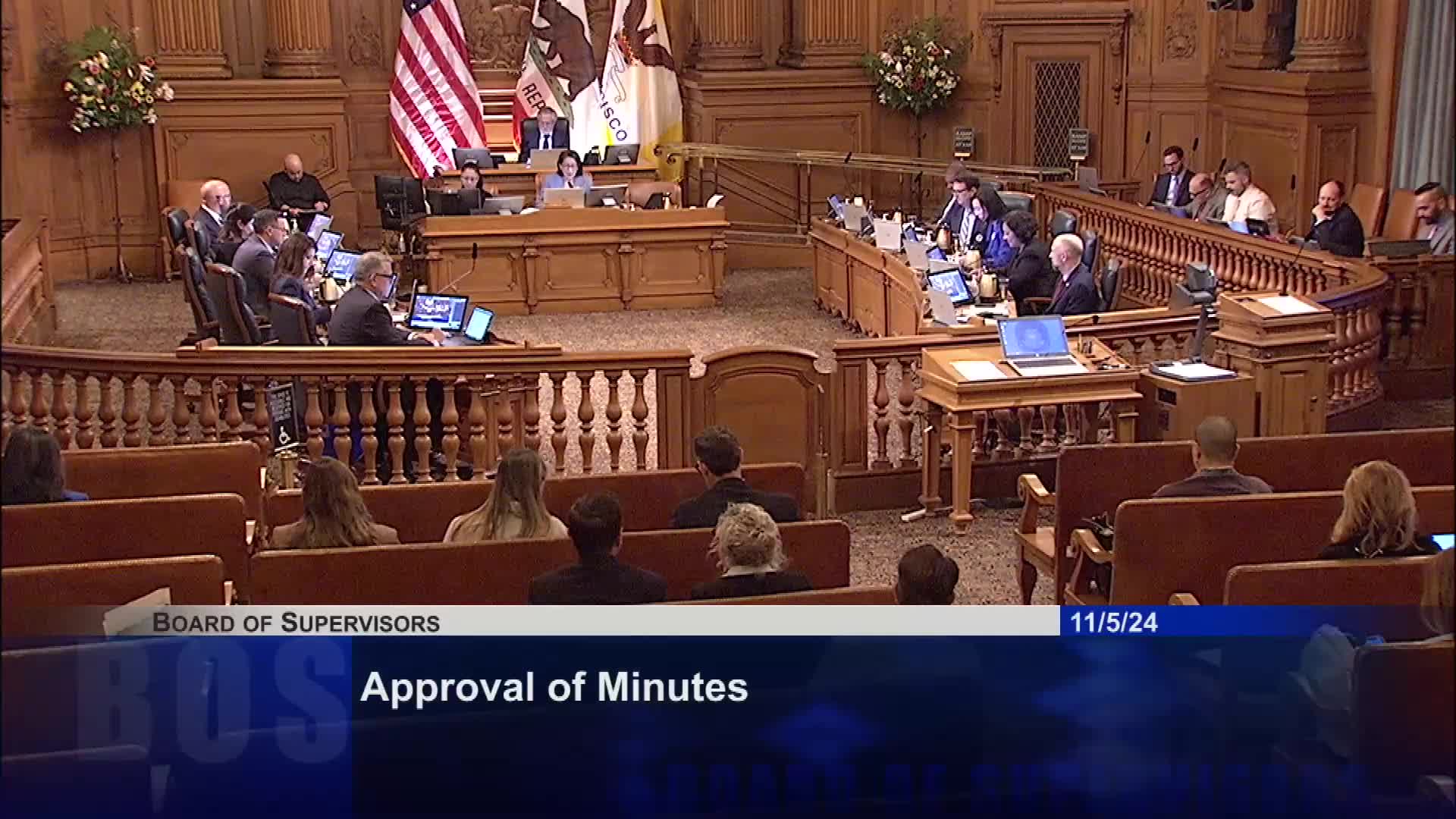
SAN FRANCISCO — On Nov. 5, 2024, the San Francisco Board of Supervisors adopted a package of ordinances, resolutions and financing actions affecting housing, public utilities and development projects, with most items approved by unanimous consent.
The measures, taken during the board’s meeting at City Hall, included amendments to redevelopment plans for Hunters Point and Bayview Hunters Point, changes to the planning code affecting below-market-rate (BMR) resale rules, increases to interim funding programs for the city’s wastewater, water and power enterprises, and several housing loan and grant agreements administered by the Mayor’s Office of Housing and Community Development (MOHCD).
Why it matters: The actions authorize or expand financing that city agencies say will support capital projects, affordable housing production and infrastructure work across multiple neighborhoods, while also extending development agreements and program-level funding caps that could affect future project schedules and budgets.
Key actions and amounts
- The board adopted two ordinances (items 14 and 15) amending redevelopment plans for the Hunters Point Shipyard and Bayview Hunters Point project areas to authorize the transfer of up to approximately 2,000,000 square feet of research-and-development and office space and to extend redevelopment plan time limits.
- An ordinance (item 16) amending the planning code was passed to allow certain BMR owned units to be resold at prices affordable to households at an increased area median income (AMI) level, to require BMR owned units originally purchased with parking or other amenities to be resold with the same amenities, and to require periodic reporting to the inclusionary housing technical advisory committee, the planning commission and the Board of Supervisors on AMI-level increases approved under the ordinance.
- Two items related to the 3333 and 3700 California Street project (items 17 and 18) were adopted: a resolution of intention to establish San Francisco Enhanced Infrastructure Financing District No. 3 to finance public capital facilities related to the project, and an ordinance approving an amendment to the development agreement with Laurel Heights Partners LLC to extend the term of the agreement to Sept. 11, 2043, modify affordable housing requirements and allow temporary fee reductions under Planning Code section 403, among other provisions.
- The board approved an ordinance (item 19) increasing the aggregate principal amount of the Wastewater Enterprise Interim Funding Program (WEIFP) from $750,000,000 to $1,250,000,000; a secondary increase for the Water Enterprise from $500,000,000 to $750,000,000; and an increase to the Power Enterprise interim funding program from $250,000,000 to approximately $450,000,000. The ordinance language states these increases are to finance capital projects on a short-term, interim basis for the respective enterprises.
- The San Francisco Public Utilities Commission was authorized to execute a professional services contract not to exceed $10,700,000 with a term from February 2025 through April 2029 (item 20).
- The board approved a purchase-and-sale agreement and easement deeds with a local school district described in the transcript as "Sonold Glen Unified School District" for a 4,008-square-foot easement for an underground water pipeline and an approximately 35,000-square-foot temporary construction easement on a parcel identified as 11601 Main Street, for a total amount of $50,000 (item 21). The transcript contains the district and location names as read into the record.
- MOHCD items (items 22–25) included two Affordable Housing and Sustainable Communities (AHSC) program agreements with the California Department of Housing and Community Development (HCD): one authorizing a total award amount of $29,700,000 with MOHCD accepting and expending $11,200,000 through Nov. 30, 2044 (item 22), and another authorizing approximately $41,000,000 for public transportation improvements near 160 Freelon Street and authorizing MOHCD to accept and expend approximately $12,000,000 through Nov. 30, 2044 (item 23). Item 24 authorized three loan agreements to finance Golden Gate Avenue Phase 1 projects: up to $12,500,000 for a 55-unit low-income rental development (Golden Gate Avenue Phase 1, LIHTC); up to $10,200,000 for a 20-unit moderate-income project with a preference for San Francisco Unified School District (SFUSD) and City College of San Francisco (SFCCD) employees; and up to $1,250,000 to finance a parking garage, for a cumulative loan amount not to exceed $23,000,000. Item 25 authorized a multifamily housing revenue note in an aggregate principal amount not to exceed approximately $32,100,000 to provide financing for the Golden Gate Avenue Phase 1 LIHTC project.
- Additional administrative and program approvals included a trunked radio system usage agreement between the Department of Technology and the University of California, San Francisco with a minimum revenue commitment of $2,400,000 (item 26); a retroactive acceptance of a $440,000 Centers for Disease Control and Prevention grant through the California Department of Public Health for a state physical activity and nutrition program through Sept. 30, 2028 (item 27); amendments to the city’s employee catastrophic illness program administrative code administration and the juvenile probation department surveillance-technology policy (items 28 and 29); and reappointments to the In-Home Supportive Services Public Authority (item 30).
Procedure and votes
The clerk read the consent and adoption calendars and, where noted in the record, the board took items "same house, same call," meaning they were adopted without separate roll-call votes or extended debate. The meeting began with roll call; the board approved the Oct. 1 minutes with a roll-call count recorded as 11 ayes. For the other items the transcript records the clerk or president saying the ordinances or resolutions were "passed" or "adopted" on the same call; individual roll-call tallies for each consent item were not read into the record.
Public comment
During general public comment, several residents spoke on varied topics. Chris Fort Cline warned of alleged data misuse in the Homeless Management Information System, saying, "San Francisco, if you don't report it, it doesn't get investigated." Jim McAfee criticized city institutions in broader terms, saying "San Francisco is neither embarrassed or ashamed of fraud." Leah McGeever spoke about her family’s military service and said she felt threatened by harassment and campaign activity. Other commenters addressed student debt, elections and related concerns. Those remarks were part of the public comment period and did not result in board action recorded in the transcript.
What the record does not show
Most items were adopted on the consent calendar with the shorthand, "same house, same call," and the transcript does not include separate roll-call tallies or extended debate for each item. Several proper names and place names are recorded in the transcript with spellings that may be nonstandard (for example, the school district name and parcel location read into the record); the article reports names and amounts as they appear in the official meeting record.
The board adjourned after the adoption calendar and encouraged attendees to vote if they had not done so.