Get Full Government Meeting Transcripts, Videos, & Alerts Forever!
Get email alerts on the Municipal Administration topic
No spam. Unsubscribe anytime.
Board adopts multiple consent items: grants, leases, contracts and appointments
Summary
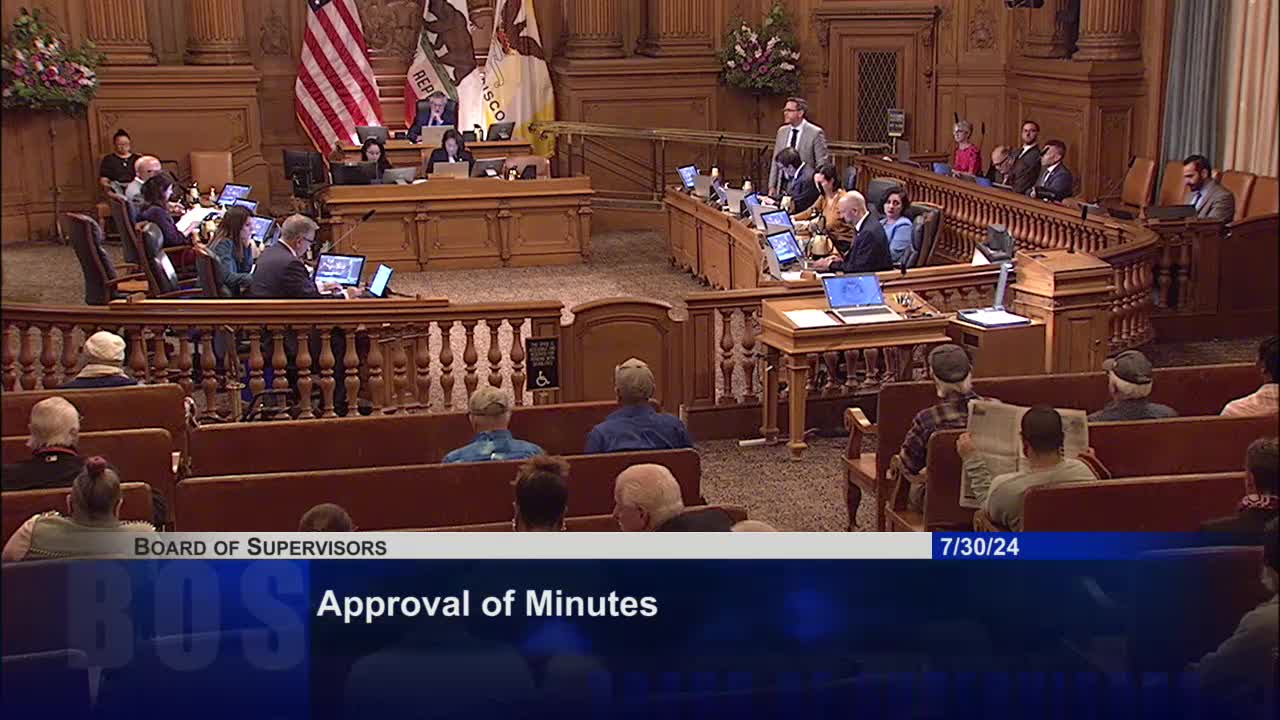
On July 30 the San Francisco Board of Supervisors approved a series of consent and noncontroversial items including grants, leases, contract amendments, and appointments. Most measures were adopted 'same house, same call.'
The San Francisco Board of Supervisors adopted a package of consent and routine items on July 30 covering a range of city business: grant acceptances, contract amendments, real property actions, bond and financing updates, and mayoral and board appointments.
Key items adopted without substantive debate included:
- Item 9: An ordinance amending the Business and Tax Regulations Code to lower gross receipts tax rates for businesses in NAICS code 7221, conditioned on passage of a ballot measure in November. - Item 10: An ordinance approving Health Service System plans and employer contribution rates for calendar year 2025 (charter requires nine votes; taken same house, same call). - Item 11: An ordinance reallocating approximately $13.7 million in unappropriated earned interest in the Our City, Our Home fund to allow use for specified homelessness services and temporarily suspending a funding limit for short‑term rental subsidies. - Items 15 & 16: Retroactive authorization to accept and expend grants for the Department of Emergency Management — roughly $125,000 from the CareStar Foundation for community paramedicine/alternate destination programs and approximately $350,000 from the California Office of Emergency Services for emergency management performance (terms and amounts as stated on the agenda). - Items 17 & 18: Grant agreements through the Department of Children, Youth, and Their Families for Boys & Girls Clubs of San Francisco and Centers for Equity and Success (aggregate multi‑year funding through 2029; totals listed on the agenda). - Item 19: Retroactive grant to Eviction Defense Collaborative, Inc., to provide housing subsidies for seniors and adults with disabilities (term through 06/30/2028; approximate $11,000,000). - Item 20: Acceptance of in‑kind supplies valued at $57,000 to Department of Public Health from the San Francisco Public Health Foundation to support primary care operations. - Item 21: Second amendment to a Port Commission lease with Golden Gate National Parks Conservancy for Pier 31/33 — a long‑term public-serving café/retail project with negotiated rent credits and revenue‑sharing provisions. - Item 22: Contract increases for natural resources technical services with AECOM, ATS and Avila and Associates, each increased by $7,000,000 to new individual ceilings of $21,000,000 (aggregate $63,000,000) through January 1, 2029. - Item 24: Third amendment to agreement between Positive Resource Center and Department of Public Health increasing the total to $15,300,000 and extending term through Feb. 29, 2028. - Item 25: Authorization related to amendments to multifamily housing revenue bonds supporting acquisition/rehabilitation of scattered-site affordable housing. - Item 26: Retroactive authorization to accept FEMA hazard mitigation grant funds (approx. $190,000) for guidance on earthquake risk reduction financing related to the Concrete Building Safety Program. - Item 27: Assignment of the Market Street flower market permit from one operator to another. - Item 28: Authorization to execute loan documents for permanent financing of 2901 16th Street under the small sites program (loan not to exceed $30,000,000) and CEQA confirmation. - Items 30–33: Multiple board confirmations and mayoral appointment approvals for the reentry council, planning commission, and building inspection commission.
Several of these items were approved unanimously and identified as routine; the charter‑required items were approved as noted on the record. The board took these items largely "same house, same call," meaning they were adopted without separate roll‑call debate.
Why it matters: These routine approvals move forward grant funding, long‑term leases, affordable housing financing, and contract work that support city services and capital projects.
What’s next: Items now proceed to administrative implementation by the responsible departments as described in the agenda language; several multi‑year grants and contracts will be monitored through usual departments and analyst reporting.