Get Full Government Meeting Transcripts, Videos, & Alerts Forever!
Get email alerts on the Public Health And Safety Drug Policy topic
No spam. Unsubscribe anytime.
Supervisor Dorsey seeks departmental input on "drug-free sidewalks" plan and court-mandated treatment options
Summary
Supervisor Dorsey submitted a letter of inquiry asking city departments about steps needed to scale citations, arrests and treatment options for public drug use, including how the city could use treatment-mandated felony categories if a pending statewide ballot measure passes.
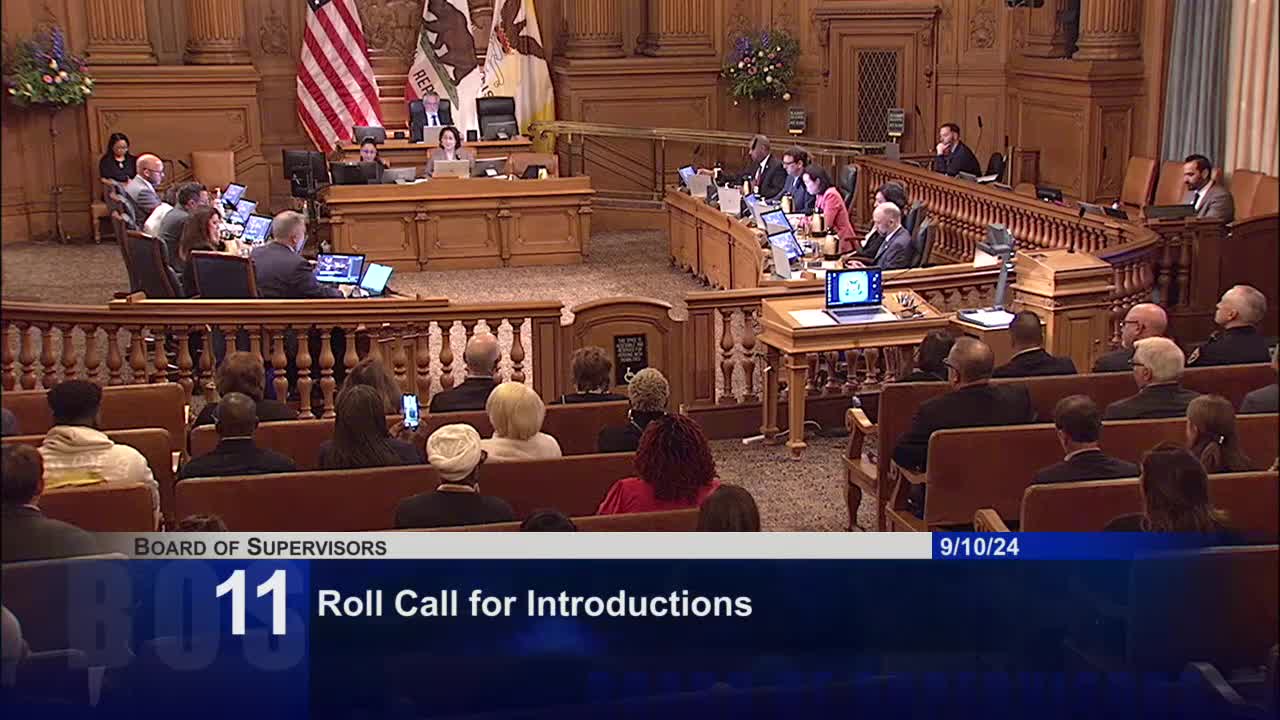
Supervisor Shamann Dorsey told the Board of Supervisors on Sept. 10 that he has submitted a letter of inquiry to city departments seeking information and collaboration on a policy he described as "drug-free sidewalks."
The inquiry asks the police department, fire department, sheriff's office, district attorney and Department of Public Health to assess capacity and funding needs to scale citation arrests and custodial arrests for public drug use or possession, to provide prompt access to addiction medications including buprenorphine, and to expand locked capacity and prosecutions where necessary to maximize treatment-mandated options.
"A court mandated drug treatment in my view should be central to that effort," Dorsey said. He referenced the National Institute on Drug Abuse and its 2018 Principles of Drug Addiction Treatment as evidence cited in the inquiry that nonvoluntary treatment can be effective.
Dorsey also framed the inquiry in the context of a possible change in state law: statewide voters will soon weigh a measure (referred to in the meeting as Proposition 36) that he said could create a new category of "treatment-mandated felonies" and further empower local drug courts. He said the letter asks departments for a needs assessment on scaling treatment access, expanding custodial and prosecutorial capacity, and expanding outpatient and other services, whether or not the state measure passes.
Dorsey described three guiding principles for the effort: that criminal-justice interventions be used as life-saving measures and include access to appropriate addiction medications; that successful completion of mandatory treatment include expungement of charges for use or possession; and that the dignity of people with substance use disorders be honored while public drug use is denormalized.
The item was introduced as a letter of inquiry; it does not enact a policy but signals the supervisor’s intent to pursue legislative or administrative steps pending departmental feedback.